Blog Archives
Armenia, Nagorno Karabakh Flags Raised at Florida International University
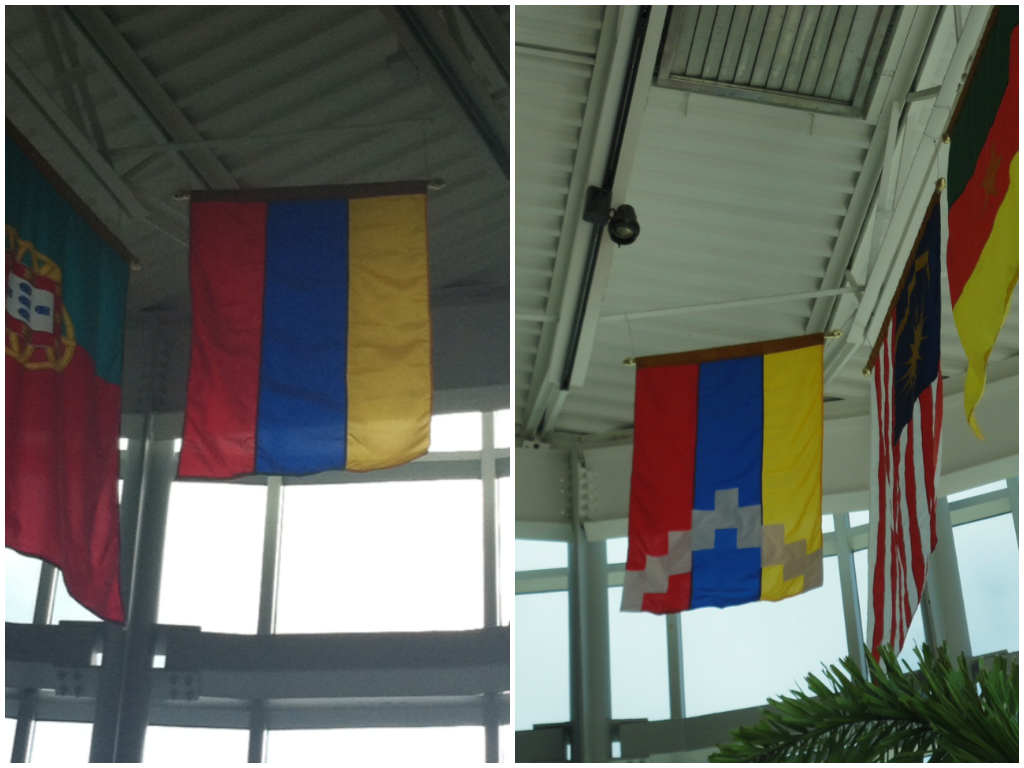
The Flags of Armenia (left) and Nagorno Karabakh (right)
April 8, 2014
By Taniel Koushakjian
Last month, the flags of two tiny South Caucasus countries got their day in the sunlight at one of Florida’s largest universities. We’re talking, of course, about the republics of Armenia and Nagorno-Karabakh, two Christian, land-locked countries that are roughly the size of Maryland and Rhode Island, respectively. On March 11, the two flags were raised in the Atrium of Florida International University (FIU), where the colors of several other countries hang. Tucked away in a far away region known as the South Caucasus, Armenia and Nagorno Karabakh declared their independence after the fall of the Soviet Union.

Lusine Shahbazyan and Gevorg Shahbazyan
FIU Junior Gevorg Shahbazyan led the effort to have the flags raised. “Every time I walked into the Graham Center, I would look up, but never see the [Armenian] flag,” Shahbazyan told FLArmenians.com. “So I decided to do something about it.” After a month of back and forth with school officials he was able to meet with the person responsible and arranged to have the flags procured and hung. “I always wanted to see the Armenian flag with the other flags,” he said.
Originally from Yerevan, Armenia, Gevorg Shahbazyan and his family first moved to Los Angeles, California, before settling in Miami in 2010. An aspiring diplomat, Shahbazyan is currently studying international relations and hopes to attend graduate school.
Although the flags of Armenia and Nagorno Karabakh have been raised, they are smaller in size than the other flags. Shahbazyan said that full sized flags have to be custom made, so they have been ordered and should be up soon. Thanks to the help of Carlos F. Carrasco, the senior director of business and finance, and Ruth Hamilton, executive director of student affairs, Shahbazyan’s efforts were successful.

Gevorg Shahbazyan and Carlos F. Carrasco
Shahbazyan has even been encouraged by faculty and staff to start an Armenian club at FIU. There are only a few students at FIU, but Shahbazyan said he hopes to “introduce our culture to FIU Panthers.” If established, it would be the only active Armenian student club in South Florida.
From Crimea To Kessab: Did the West Approve the Attack on Kessab?
April 3, 2014
By Hagop Koushakjian
The March 21 attack on the historic Armenian coastal town of Kessab was a shock to the Armenian nation worldwide.
Kessab seemed a peaceful, sleepy town far removed from the Syrian civil war that has been raging for the past three years. Then, early on Friday morning, the majority Christian Armenian populated town awoke to the sounds of rockets and gunfire, forcing 670 Armenian families to flee in haste to nearby Latakia, leaving behind the sick and the elderly. From what we know now, the town was attacked by Al-Qaeda related Al-Nusrah Front Islamist terrorists that crossed the Turkish border with the support and approval of the Turkish authorities. Turkey’s role was clearly evidenced by the fact that the Turkish military shot down a Syrian fighter jet that was providing air support to the regime’s forces. The downing emboldened the jihadists to carry out their raid on Kessab Armenians.
So why was Kessab a target and why now?
Armenian President Serzh Sargsyan’s decision on September 3, 2013 to join Russia’s Customs Union instead of the EU Eastern Partnership, after two years of negotiations, was not welcome news to the West. Then the referendum in Crimea to have that region join with Russia was assessed positively by Yerevan, hailing the self-determination right of the regions Russian majority. Then on March 27, the UN General Assembly voted 100 to 11 on a non-binding resolution declaring the Crimean referendum invalid. Armenia, considering the Karabakh factor, was among the 11 nations. In addition, the Republic of Armenia has developed close economic ties with Iran offsetting the 20-year blockades of Turkey and Azerbaijan.
All this was viewed negatively by the West, it appears, prompting US Ambassador to Armenia John Heffern to call Armenia’s UN vote “regrettable.” James Warlick, the US representative at the OSCE Minsk Group, also voiced his displeasure for Armenia’s pro-Russian stand vis-à-vis Ukraine. Taken together, this latest move on Crimea seems to have irritated the US. It is as though Armenia has crossed a red line.
On March 29 the US State Department called last week’s unprovoked attack on innocent Armenian civilians “deeply troubling.” Deputy spokesperson Marie Harf said, “we have seen some statements by groups fighting in Kessab saying they will not target civilians and will respect minorities and holy places. We expect those commitments to be upheld.” Interestingly, spokesperson Harf was careful not to use the word “terrorists” when referring to the foreign fighters that attacked Kessab. She referred to them as “groups,” downplaying the terrorist element of the attackers.
The Syrian civil war is ground zero for the latest East vs. West international proxy war and it is well known that NATO member Turkey is providing Al-Qaeda terrorists and other foreign fighters with arms, medical supplies and safe border access to Syria. Which begs the question, is the West calling the shots in Kessab while offering assurances that these jihadist butchers will respect minorities and their holy places of worship?
Kessab is located in the far northwestern part of Syria with no military strategic significance.
Which brings us back to the question, why Kessab, why now? It can easily be argued that Kessab was the price the Armenian nation had to pay for their close ties with Russia and Iran.
U.S. State Department “Deeply Troubled” by Attacks Against Armenians in Kessab, Syria

March 29, 2014
By Taniel Koushakjian
Yesterday, Marie Harf, Deputy Spokesperson at the U.S. Department of State, made the following statement during the daily press briefing:
We are deeply troubled by recent fighting and violence that is endangering the Armenian community in Kessab, Syria, and has forced many to flee. There are far too many innocent civilians suffering as a result of the war. All civilians, as well as their places of worship, must be protected. As we have said throughout this conflict, we deplore continued threats against Christians and other minorities in Syria. And as you may have seen from the readout of President Obama’s conversation with Pope Francis yesterday, they discussed among other things the plight of minorities, especially Christians, inside Syria today.
We have seen some statements by groups fighting in Kessab saying they will not target civilians and will respect minorities and holy places. We expect those commitments to be upheld. The United States will continue its steadfast support to those affected by violence in Syria and throughout the region, including Syrian Armenians. We have long had concerns about the threat posed by violent extremists, and this latest threat to the Armenian community in Syria only underscores this further.
The statement comes after reports of Islamic extremists entering Syria from Turkey laying siege to the predominantly Christian Armenian city of Kessab, near the coastal city of Latakia in northwestern Syria. Over 650 Armenian families have fled the city, with Armenian homes, businesses and religious sanctuaries being overrun and looted, according to the reports.
On Thursday, the Armenian Assembly of America’s executive director, Bryan Ardouny, and Archbishop Vicken Aykazian, Diocesan Legate of the Armenian Church of America (Eastern), met with officials at the U.S. Department of State. The meeting came just days after the Assembly sent a pointed letter to President Barack Obama urging him to take steps to safeguard the Armenians of Kessab. On Wednesday, the Assembly publicly condemned the assault on Kessab and remains alarmed at reports that Al-Qaeda affiliated Islamic extremists crossed into Syria via NATO ally Turkey, resulting in the displacement of 2,000 people and the confiscation and looting of Armenian homes, businesses and religious sanctuaries.
Also, this week the Turkish government blocked access to Twitter and YouTube just days before the March 30th local elections that are largely seen as a referendum on Prime Minister Erdogan and his ruling AKP party. Erdogan vowed to “eradicate Twitter” at a recent campaign rally. Anti-government protests have plagued Turkey since the last summer’s Gezi Park protests that erupted after the Turkish government announced plans to demolish a park in the city center in order to construct a shopping mall. In recent months, allegations surrounding a government graft probe, and the subsequent dismissal of officials carrying out the probe by AKP party elite, has led to a wide spread revolt against the increasingly autocratic Prime Minister Erdogan throughout the country of 74 Million people.
According to the most recent leaked audio tape on YouTube that led to the government censorship, senior Turkish government officials were planning a provocative event inside Syria in order to justify Turkish military intervention. It is currently unknown if the assault on Kessab is related to the recent downing of a Syrian fighter jet, which occurred hours before the terrorist siege on Kessab, Turkish government plans for Syria, and the upcoming Turkish elections.
Below is the full exchange of Ms. Harf yesterday with a reporter on the issue of the Syrian Armenians:
QUESTION: Yes. Regarding this statement that you made about the Syrian Armenians?
MS. HARF: Mm-hmm.
QUESTION: I was just wondering if you have anything – update about the situation, or just – is this a past tense? Is something happened, or it’s – I think it’s the ongoing – I mean —
MS. HARF: It’s an ongoing issue, certainly, that we’re concerned about.
QUESTION: And then how you —
MS. HARF: But there – as I noted in my statement, though, there has been some recent fighting and an increase in violence, which is why we wanted to note it specifically today.
QUESTION: So are there – because there are some news reports from different sides regarding this issue for – either from the Armenians or from the Turks and from the Syrians in the same time. Are you following this story – I mean, this case? Are —
MS. HARF: Well, we are – I don’t know if you’re referring to a specific case – we’re certainly following the situation for Armenians inside Syria for all minorities, including Christians, and know that violent extremists such as ISIL have targeted them, among many people, but we’re particularly concerned about these minority communities and want to make sure that their rights are protected.
QUESTION: Beside being concerned – because let me be specific about – are you in touch with any of the governments, including the Turkey – Turkish Government or other UN organization to figure out exactly – because it’s – some of – there is a deportation of people taking place in the last week, which is, like, starting from last week till now. Are these – anything is going on in that regard?
MS. HARF: I can check and see who we’re talking to. Obviously, we talk to a host of countries in the region, Turkey and others, about a wide range of issues, but I can check on that specifically.
QUESTION: So you don’t have any – your – what you have is just, like, observation of what’s going on, or you have information?
MS. HARF: Well, I think we have both, right. We’ve seen reports, as I said – recent fighting, violence against the Syrian Armenian communities. We see the reports coming out of there. Obviously, we talk – we try to get as much information from the ground as possible, as we do in all places in Syria, but it’s hard to get. But clearly, there have been some very troubling trends lately.
QUESTION: Because according to some reports, that those people were Jabhat al-Nusrah people – I’m not sure if you mentioned them in the statement or not.
MS. HARF: Well, I was – what I’m talking about is extremist groups like ISIL attacking innocent civilians – in this case, the Syrian Armenian community, a minority community, as they have with other minority communities, Christian communities, and others inside Syria. So this is – what I’m talking about is those kinds of attacks. I know there are a lot of dynamics broadly here in the Syrian conflict, but I was speaking to one specific dynamic.
QUESTION: There is another thing which is written about this. When you mentioned the President and he raised the issue with the Pope or the Pope raised it with —
MS. HARF: They discussed it, mm-hmm.
QUESTION: — him, the issue, maybe I’m not – to be more accurate – is – this issue is raised with the Syrian opposition people? Because it’s like sometimes they don’t – according to what I heard last week from the Ambassador Ford that, definitely, they are usually avoiding to condemn publicly what’s going on by Islamic groups or a Jihadist group in Syria.
MS. HARF: Well, let’s be clear when we’re talking about the opposition, to be very clear that what – the violence I’m talking about is being perpetrated by groups like ISIL, so not the moderate opposition, not the folks we work with repeatedly and consistently on things inside Syria. I think that the opposition has been very clear in condemning extremism and saying they will fight extremism inside Syria and that that’s something they’re committed to, absolutely. They’ve said that for many, many months.
QUESTION: Thank you.
MS. HARF: Yes.
QUESTION: On Syria?
MS. HARF: Okay.
QUESTION: According to reports in Turkey, the Foreign Minister Mr. Davutoglu planned a provocative act inside Syria so Turkey has the excuse to invade Syria. Do you want to comment on this?
MS. HARF: Are you referring to an alleged phone conversation?
QUESTION: Yes.
MS. HARF: As I said yesterday, I don’t have anything for you on alleged calls or conversations that are out there among Turkish officials.
QUESTION: Yeah, but Mr. Davutoglu —
MS. HARF: It’s not for me to comment.
QUESTION: But Mr. Davutoglu said that the tape is genuine.
MS. HARF: Again, not for me to comment on those allegations that are out there.
Yes, in the back.
The entire transcript of yesterdays U.S. Department of State daily press briefing is available here.
This story originally appeared on AAANewsBlog.