Blog Archives
Armenian Assembly of America Hosts Armenian Genocide Symposium in South Florida
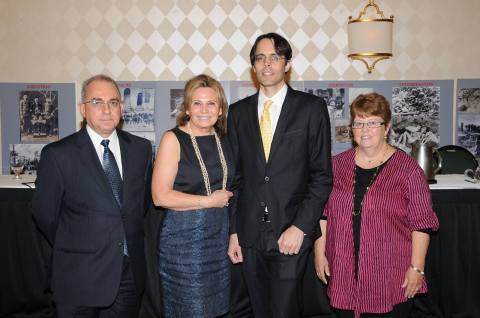
On Saturday, March 14, the Armenian Assembly of America (Assembly) hosted an Armenian Genocide symposium entitled “A Century of Genocide: The 1915 Armenian Genocide and Its Lasting Impact,” during the Assembly’s Annual Members Weekend in South Florida. Over 80 Assembly members, friends, and guests attended the educational presentations and lively question and answer session.
The symposium featured Dr. Rouben Adalian, Director of the Armenian National Institute (ANI) in Washington, DC, Dr. Rosanna Gatens, Director of the Center for Holocaust and Human Rights Education (CHHRE) at Florida Atlantic University (FAU) in Boca Raton, Florida, and Hannibal Travis, Professor of Law at Florida International University (FIU) College of Law in Miami, Florida. The panel was moderated by Assembly Trustee and South Florida community leader Marta Batmasian.
Armenian Assembly of America Board of Trustees President Carolyn Mugar provided welcoming remarks and introduced Marta Batmasian. Batmasian introduced the panel to the audience and recognized members of the audience who have been researching and teaching about the Armenian Genocide in South Florida.
Batmasian introduced Dr. Adalian who presented the topic of “The Armenian Genocide as a Prototype of 20th Century Mass Killings,” detailing the primitive yet effective template of mass killing that was developed by the Ottoman Turkish government. He showed images from the digital exhibit “The First Deportation: The German Railway, the American Hospital, and the Armenian Genocide,” which took the audience back in time to a pivotal location of the deportations. Adalian brought to life the experiences and activities of Dr. Wilfred D. Post who administered the American hospital in Konya, a major station along the Berlin-Baghdad rail line which became the site of a large deportation camp. In defiance of the Ottoman ban on photography of deportees, Dr. Post captured what may have been some of the earliest pictures of deported Armenians.
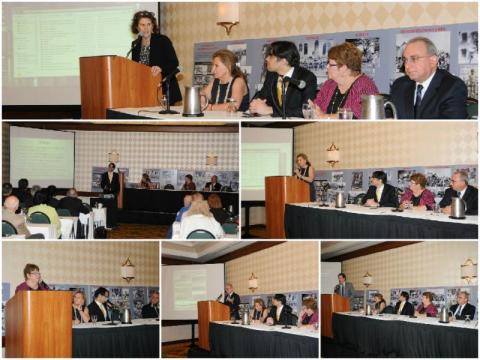
Next, Batmasian introduced Dr. Gatens who discussed “The Impact of the Armenian Genocide on Holocaust Education.” She discussed how the CHHRE at FAU had been working for years to advance Armenian Genocide education on campus and throughout Palm Beach County. Gatens drew parallels between the Jewish and Armenian experiences and highlighted challenges faced in educating the general public about the crime of genocide.
Professor Hannibal Travis gave the final presentation on “The Armenian Genocide as a Political Act and International Crime.” He discussed the illegality of the crime of genocide under international law, including cases where the charge of genocide was applied retroactively. Travis gave an in depth account of crimes against humanity that have been heard in international courts and discussed avenues for Armenian efforts in this context.
Following the presentations, Batmasian opened the floor for questions. Several were asked of the panel leading to a lively and wide-ranging discussion. Armenian Assembly of America Executive Director Bryan Ardouny gave closing remarks and announced the launch of an online petition calling on President Barack Obama to affirm the Armenian Genocide in his upcoming statement commemorating the 100th anniversary. After the symposium, guests were invited up to view a brand new exhibit entitled “Iconic Images of the Armenian Genocide,” that was on full display during and after the discussion.
“We were pleased to bring this expert panel together for the South Florida community,” stated Bryan Ardouny. “The Assembly is grateful to Dr. Adalian, Dr. Gatens, Professor Travis, and Mrs. Batmasian for their insight and compelling presentations,” Ardouny said.
Additional photographs from the Assembly’s Armenian Genocide Symposium in South Florida are available on the Assembly’s Facebook page here.
Established in 1972, the Armenian Assembly of America is the largest Washington-based nationwide organization promoting public understanding and awareness of Armenian issues. The Assembly is a non-partisan, 501(c)(3) tax-exempt membership organization.
###
NR: # 2015-018
Photo Caption 1: (L-R) Dr. Rouben Adalian, Marta Batmasian, Hannibal Travis, Dr. Rosanna Gatens.
Photo Caption 2: Program speakers at the Assembly’s Armenian Genocide Symposium in South Florida.
(Photographs by Bedo Der-Bedrosian on behalf of the Armenian Assembly of America)
Florida Atlantic University Conducts First Public Teacher Workshop on the Armenian Genocide in South Florida
Workshop is Part of a Series of Events in South Florida Commemorating the 100th Anniversary of the Armenian Genocide
By Taniel Koushakjian
FLArmenians Managing Editor

As part of the South Florida commemorations of the Armenian Genocide, the first genocide of the 20th century, Florida Atlantic University (FAU) will conduct a two-part series of events. On January 20th, Dr. Rosanna Gatens, Director of the Center for Holocaust and Human Rights Education (CHHRE) at FAU and Reverend Fr. Paren Galstyan, Pastor of St. David Armenian Church in Boca Raton, Florida, held a workshop at the Alex and Marie Manoogian School. The workshop featured lectures, exhibits, and thought-provoking information and dialogue on the Armenian Genocide. Facilitated by Dr. Mary Johnson, Facing History and Ourselves, the workshop explored the role of World War I in the execution of the Armenian Genocide in the Ottoman Turkish Empire.
Fifteen teachers from Broward and Palm Beach County participated in the FAU workshop. “St. David’s Armenian school was the perfect setting for teachers, not only to learn about the Armenian genocide and how to teach it, but also to begin to understand Armenian identity,” stated Dr. Gatens. “All of us were fascinated by the richness of Armenian culture, but even more by the ancientness of Armenian Christianity,” Dr. Gatens said.

During the workshop instructors examined the exhibit “Witness to the Armenian Genocide: Photographs by the Perpetrators’ German and Austro-Hungarian Allies,” produced by the Armenian National Institute (ANI), the Armenian Genocide Museum of America (AGMA), and the Armenian Assembly of America (Assembly). The ten-poster set includes an introductory page, a detailed timeline, a color-coded map geographically matching the photographs with their location, and seven pages displaying 34 captioned historic photographs. The color-coded map in the exhibit is based on the previously-published ANI map of the 1915 Armenian Genocide in the Ottoman Turkish Empire illustrating the three prevailing aspects of the Genocide: the deportations, the massacres, and the concentration camps.
FAU’s second lecture commemorating the 100th Anniversary of the Armenian Genocide will take place on Sunday, April 19, 2015, as part of the Martin and Edith Stein Community Lecture Series. Dr. Tamar Akçam will discuss his book, “The Young Turks’ Crime Against Humanity: The Armenian Genocide and Ethnic Cleansing in the Ottoman Empire.” Dr. Akçam is the Robert Aram, Marianne Kaloosdian and Stephen and Marian Mugar Chair in Armenian Genocide Studies at Clark University in Worcester, Massachusetts.
Florida Atlantic University Events Commemorating the 100th Anniversary of the Armenian Genocide:
January 20, 2015
Teacher Workshop: The Role of World War I in the Execution of the Armenian Genocide, facilitated by Dr. Mary Johnson, Facing History and Ourselves, FAU, Boca Raton Campus, 8.30-a.m.3.30 p.m. at St. David’s Armenian Church, Boca Raton. Substitute reimbursements available. April 2015 marks the 100th Anniversary of the Armenian Genocide. This program is part of local commemoration of the first genocide of the Twentieth Century.
April 19, 2015
Martin and Edith Stein Community Lecture Series: Dr. Tamar Akçam will discuss his book, “The Young Turks’ Crime Against Humanity: The Armenian Genocide and Ethnic Cleansing in the Ottoman Empire,” Dr. Akçam is Robert Aram, Marianne Kaloosdian and Stephen and Marian Mugar Chair in Armenian Genocide Studies at Clark University. This program is part of south Florida’s commemoration of the 100th Anniversary of the Armenian Genocide. FAU, Boca Campus, 7-9 p.m., location TBA.
Armenian Billboards Put Touchy Topic on the Road

A billboard thanking countires that recognize genocide against Armenians is seen Wednesday, April 17, 2013, along I-95 in Pompano Beach. Photo courtesy of Joe Cavaretta, SunSentinel
By Diane C. Lade
Sun-Sentinel
Four striking billboards, crowded in among beer and cosmetic surgery ads along two South Florida highways, contain one sentence starkly lettered in white on a black background: “Thank you for officially recognizing the Armenian Genocide — April 24, 1915.”
It’s a bold move to bring public attention to an almost century-old tragedy that Armenian Americans say takes a back seat to other large-scale human rights violations: the killing of 1.5 million of their ancestors during World War I in what is now Turkey.
But until now, the identity of those behind the signs was a mystery. Small wording at the bottom of the 672-square-foot billboards states only that they were “paid for by individuals concerned about the plight of Armenians.” They list no names.
(Also on FLArmenians: Armenia Avenue Anyone? The Story of Armenia Venue in Tampa Bay, Florida)
That’s because it’s not about publicity, it’s about bringing larger awareness to the issue, said George Pagoumian, 70, a Fort Lauderdale businessman and philanthropist who came forward only after the Sun Sentinel began researching the signs.
The four billboards are located at Florida’s Turnpike-Interstate 595 interchange; and on Interstate 95 at Southern Boulevard in West Palm Beach, at Atlantic Boulevard in Pompano Beach and at Northwest 79th Avenue in Miami. And the campaign was organized and financed through Armenian community members, said Pagoumian, declining to list the other contributors or how much was donated.
“We don’t want money to dictate this,” said Pagoumian, whose parents were Armenian and who lost his grandmother and other relatives to the killings. “Our grandmothers, our family who died are paying. They are sending checks from heaven.”
Twenty countries have officially recognized the killings as genocide, and those nations’ flags are on the South Florida billboard, under the words “thank you.” The United States is not among them — something Armenian Americans have fought passionately to change for years. They are pressuring President Obama to make an executive declaration.
But calling what happened in Armenia almost 100 years ago a “genocide” is a very touchy subject — especially in South Florida. About 4,000 people of Armenian descent live in Broward and Palm Beach counties, according to the Census, alongside about 5,000 of Turkish descent. Turkey denies that Armenians were targeted because of race or ethnicity.
Fuat Ornarli, past president of the Florida Turkish American Association, has not seen the billboards but dislikes what he considers a politicization of the issue.
“I would like to express my deep sorrow to see such billboards around us, since this subject is so politicized, and so biased,” said Ornarli, of Miami.
Genocide declarations should be made by scholars, not politicians, Ornarli said, adding that not all historians agree the Armenian deaths should be labeled genocide. Like the leaders of his native country, he said the deaths were casualties of war, exacerbated when the Armenians aligned themselves with Russia, Turkey’s enemy.
Rosanna Gatens, director for the Center for Holocaust and Human Rights Education at Florida Atlantic University, said the removal and killing of Armenians by the Turks is taught along with the Holocaust and other modern genocides in the state-mandated human rights education program. Each year, a few teachers get complaints from upset Turkish parents “who think their children are being taught that Turkey is a terrible place,” she said.
“It’s really important for people in our area to understand what happened in Armenia. All scholarly definitions say it was a genocide and we need to quit playing politics,” she said.
(Also on FLArmenians: University of Florida Hillel Raises Genocide Awareness)
Marta Batmasian, a Boca Raton real estate investor and Armenian community leader, agreed.
“This is a human rights issue, not an Armenian issue. We are not going to let history be buried,” said Batmasian, a former educator who sits on the state task force for Holocaust and human rights education.
The South Florida signs are very similar to an effort run by Peace of Art Inc., a nonprofit founded by Armenian American artist Daniel Varoujan Hejinian. Since 1996, Hejinian has created and installed dramatic billboards each April in suburban Boston, his hometown, calling on the United States to recognize the killings as genocide.
Rosario Teixeira, Peace of Art’s executive director, said the organization was not involved in South Florida’s efforts. “I am sure their efforts are well intended and we wish them good luck,” she said.
Armenian churches and peace activists in South Florida every year host prayer or commemoration services on April 24, the day when the Ottoman government arrested 250 Armenian intellectuals and leaders, and began deporting them.
St. Mary Armenian Apostolic Church in Hollywood will have a public service and commemoration Wednesday; St. Mary and St. David Armenian Apostolic Orthodox Church in Boca Raton trade off hosting the event annually.
(Also on FLArmenians: 98th Anniversary Armenian Genocide Commemorations in Florida)
This year, the billboards created a buzz when the signs appeared but no one claimed the credit. Speculation ran wild among South Florida’s Armenians for weeks. “The emails I’m getting! They are saying something like this has never happened,” Batmasian said.
The Rev. Vartan Joulfayan said his St. Mary’s parishioners last week were peppering him with questions about who the anonymous billboard contributors might be. The pastor told them it didn’t matter — that he assumed the donors wanted to stay out of the spotlight.
“So their message can come through,” he said. “A message that is strong and true.”
This story originally appeared in the Sun Sentinel on April 21 and is reprinted with the permission of the author.




 Florida Armenians