Blog Archives
Douglas Kalajian Publishes New Book on Armenian Genocide
By Douglas Kalajian
FLArmenians Contributor
I felt certain of the title the moment I decided to write the book: Stories My Father Never Finished Telling Me.
It represents a dilemma that will be familiar to many Armenian-Americans born after the tumult that dislodged our parents and grandparents from their homeland.

My father, Nishan Kalajian, had the misfortune to be born in Diyarbakir, Turkey in 1912 at the core of the imploding Ottoman Empire. For him, the Armenian Genocide was not a distant, historic event but the defining reality of his life. He lost his mother, his home and everything familiar before being cast into the world alone.
I knew that much from an early age, but I desperately wanted to know more: How he survived, how he kept his wits and his faith, how he moved forward without being consumed by bitterness and hate. My father volunteered none of it. He dealt with his most painful memories in a most Armenian way, by pushing them aside.
My mother understood this better than anyone. She warned me never to ask him about such things and I never did, at least not directly. But every so often when an opportunity presented itself, I’d approach the topic obliquely and with great caution.
When he responded at all, my father often shared only a scrap or two before changing the subject or retreating to his books. It was left to me to figure out the importance of each scrap, and to connect it to whatever had come before or after. This is how my life-long conversation with my father continued, in fits and starts, yielding scattered pieces of a puzzle that I’m still trying to complete more than 20 years after his death.
As a writer, I felt compelled to tell as much of my father’s story as I could because I believe it holds important lessons. But I also wanted to tell my own story about growing up in the shadow of a great cataclysm with a father who would not talk about what he had experienced.
The book’s subtitle, Living With The Armenian Legacy of Loss and Silence, conveys my challenge in learning to appreciate a complex cultural inheritance that is rich and wondrous but also dark and painful to contemplate.
Most important, I wrote the book for my daughter and for her generation in hopes that they’ll figure out how to celebrate the best parts of that inheritance while finally vanquishing the pain.
Stories is my third book, and the first I’ve published independently. It’s available in print and as a Kindle e-book. You won’t find it at your local bookshop but they can order it for you—or you can order one yourself through Amazon or other online booksellers.
Or just click here.
Douglas Kalajian is a regular contributor for FLArmenians.com. Prior to his retirement he worked as an editor, reporter and feature writer for the Palm Beach Post and the Miami Herald. He currently lives in Boynton Beach with his wife Robyn, and together they operate www.TheArmenianKitchen.com.
Armenia, Nagorno Karabakh Flags Raised at Florida International University
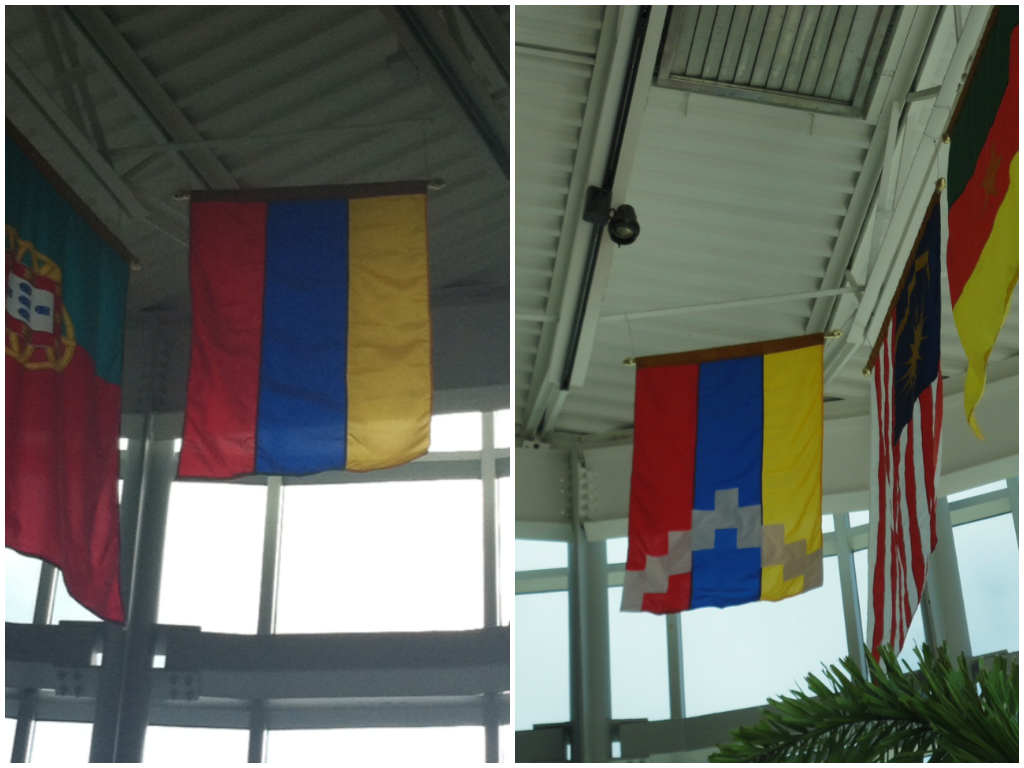
The Flags of Armenia (left) and Nagorno Karabakh (right)
April 8, 2014
By Taniel Koushakjian
Last month, the flags of two tiny South Caucasus countries got their day in the sunlight at one of Florida’s largest universities. We’re talking, of course, about the republics of Armenia and Nagorno-Karabakh, two Christian, land-locked countries that are roughly the size of Maryland and Rhode Island, respectively. On March 11, the two flags were raised in the Atrium of Florida International University (FIU), where the colors of several other countries hang. Tucked away in a far away region known as the South Caucasus, Armenia and Nagorno Karabakh declared their independence after the fall of the Soviet Union.

Lusine Shahbazyan and Gevorg Shahbazyan
FIU Junior Gevorg Shahbazyan led the effort to have the flags raised. “Every time I walked into the Graham Center, I would look up, but never see the [Armenian] flag,” Shahbazyan told FLArmenians.com. “So I decided to do something about it.” After a month of back and forth with school officials he was able to meet with the person responsible and arranged to have the flags procured and hung. “I always wanted to see the Armenian flag with the other flags,” he said.
Originally from Yerevan, Armenia, Gevorg Shahbazyan and his family first moved to Los Angeles, California, before settling in Miami in 2010. An aspiring diplomat, Shahbazyan is currently studying international relations and hopes to attend graduate school.
Although the flags of Armenia and Nagorno Karabakh have been raised, they are smaller in size than the other flags. Shahbazyan said that full sized flags have to be custom made, so they have been ordered and should be up soon. Thanks to the help of Carlos F. Carrasco, the senior director of business and finance, and Ruth Hamilton, executive director of student affairs, Shahbazyan’s efforts were successful.

Gevorg Shahbazyan and Carlos F. Carrasco
Shahbazyan has even been encouraged by faculty and staff to start an Armenian club at FIU. There are only a few students at FIU, but Shahbazyan said he hopes to “introduce our culture to FIU Panthers.” If established, it would be the only active Armenian student club in South Florida.




 Florida Armenians