Blog Archives
New Poll Finds More Armenians Feel Country is Going in the Wrong Direction

By Harut Sassounian
Syndicated Columnist
The Washington-based International Republican Institute’s public opinion poll, conducted November 22-December 5, 2021, measured the Armenian population’s views on political, economic, and security issues. The survey was funded by the U.S. Agency for International Development.
The poll revealed a key finding: 46% of the population thinks that “Armenia is headed in the wrong direction,” while only 34% thinks that the country is headed in “the right direction.” This indicates that Prime Minister Nikol Pashinyan’s often-repeated boast that he enjoys “the people’s mandate” is not necessarily so. This is a significant shift from the 54% of the votes the Prime Minister’s political party received in the June 20, 2021 parliamentary elections. More importantly, the number of those who think that Armenia is headed in the wrong direction increased from 20% in May 21, 2021 to 34% in July 2021 and 46% in December 2021.
However, on another important question, “Do you believe that you or people like you can influence decisions made in our country,” 66% said yes, while 33% said no. This is definitely a positive indication for the authorities.
The next question: “Are you satisfied or dissatisfied with the way democracy is developing in our country?” the country was almost evenly split: 51% yes and 47% no.
To the question: “Do you consider our country to be governed in the interest of the majority of people or in the interest of some groups?” 61% said it was governed in the interest of “some groups,” while only 31% said it was governed in the interest of “the majority.” This reflects negatively on the current government.
On the positive side, 66% of the people surveyed said they are “not afraid of openly expressing their opinions,” while 31% said they were afraid to do so.
To the question: “How satisfied or dissatisfied are you with the work of the following state bodies?” the top approval was given to Pashinyan government’s frequent critic, Human Rights Defender’s (Ombudsman’s) office (68% satisfied vs. 25% dissatisfied); the police (68% vs. 29%); local governments (63% vs. 33%); armed forces (58% vs. 37%); Central Electoral Commission (57% vs. 33%); and National Security Service (50% vs. 41%). The Prime Minister’s office came in 7th place with 49% satisfied vs. 48% dissatisfied. The Armenian Parliament came in 16th place with 31% satisfied and a whopping 67% dissatisfied. This is not surprising as the parliament’s televised sessions frequently show scenes of shouting matches, insults, and physical altercations ending with abrupt orders by the parliament’s leadership representing the Prime Minister’s political party to turn off the TV cameras to hide the disorderly conduct of the rowdy parliamentarians.
Turning to foreign policy issues, those surveyed ranked France on top with 92% as having the best relationship with Armenia. Then came Iran (80%); the United States (77%); China (75%); European Union (69%); Russia (64%); Georgia (58%); UK (47%); other (10%); Turkey (5%); and Azerbaijan at the very bottom with 3%.
When asked “Which two countries were the most important political partners for Armenia?” Russia (57%); France (50%); the U.S. (38%); Iran (23%); European Union (5%); China (5%); Georgia (3%); and India (1%).
In response to “Which two countries are the most important economic partners of Armenia?” Russia again came first with 61%; Iran (40%); (China (29%); the U.S. (16%); France (14%); Georgia (8%); European Union (7%); India (2%); and Turkey (2%).
When asked “Which 2 countries are the most important security partners for Armenia?” the answers were: Russia (64%); France (32%); Iran (31%); the U.S. (26%); European Union (5%); China (4%); Georgia (2%); and India (1%).
“Which 2 countries are the greatest political threat to Armenia?” The survey respondents said: Turkey (90%); Azerbaijan (77%); Russia (15%); UK (3%); Israel (2%); the U.S, (2%); and Georgia (1%).
“Which 2 countries are the biggest economic threat to Armenia?” Survey respondents said: Turkey (68%); Azerbaijan (52%); Russia (17%); Georgia (10%); Iran (4%); the U.S. (1%); China (1%); and European Union (1%).
“Which 2 countries are the greatest security threat to Armenia?” Survey respondents said: Turkey (88%); Azerbaijan (81%); Russia (11%); Iran (2%); the U.S. (2%); Israel (2%); Georgia (1%); France (1%); and UK (1%).
“The relationship with which 2 countries needs to be improved for the development of Armenia?” The survey respondents said: Russia (53%); the U.S. (35%); Iran (29%); France (25%); China (15%); European Union (9%); Georgia (7%); Turkey (5%); Azerbaijan (4%); India (1%); and UK (1%).
The survey then asked if the respondents agreed or disagreed with the following three questions:
- 73% agreed and 25% disagreed that “Armenia should start a dialog with Turkey and normalize bilateral relations, while pursuing the agenda of recognition of the Armenian Genocide by Turkey.”
- 70% agreed and 27% disagreed that “Armenia must establish bilateral relations with Turkey by putting forward its own preconditions such as Turkey’s non-hindrance of peace in Artsakh.”
- 44% agreed and 53% disagreed that “Under no circumstances Armenia should pursue normalization of relations with Turkey.”
Most survey respondents disagreed with Pashinyan that opening roads with Azerbaijan is beneficial to Armenia. When asked: “How will the opening of transport routes with Azerbaijan impact Armenia’s economic development?” 27% gave a positive answer; 59% negative.
The same is true for Turkey. When asked: “How will the opening of transport routes with Turkey impact Armenia’s economic development?” 35% gave a positive answer; 53% negative.
When asked: “How important is the resolution to the Artsakh conflict for the future of Armenia in the next 10 years?” The overwhelming 96 % said “important”; 3% “unimportant.”
The survey asked: “What would be an acceptable solution of the Artsakh conflict?”
- 35% said: “Recognition of Artsakh as an independent state.”
- 34% said: “The unification of Artsakh with Armenia as a region of the Republic of Armenia.”
- 16% said: “Establishment of the status of the Artsakh Autonomous Region within Armenia.”
- 11% said: “Establishment of the status of Artsakh within Russia.”
- 1% said: “Maintaining the current status quo.”
When asked: “Is Armenia able to independently defend its borders with Azerbaijan, without the help of any other country?” 46% said yes; 53% no.
Finally, when asked: “Which country would you prefer to assist Armenia in defending its borders?” 47% said Russia; the U.S. (18%); France (14%); Iran (8%); China (2%); European Union (1%); all three Minsk Group countries of Russia, the U.S., France (1%); and NATO (1%).
Whether we agree or disagree, these are the answers that the people of Armenia gave. It reflects their current mindset.
House of Representatives Passes Five Pro-Democracy Amendments as Part of the FY2022 National Defense Authorization Act
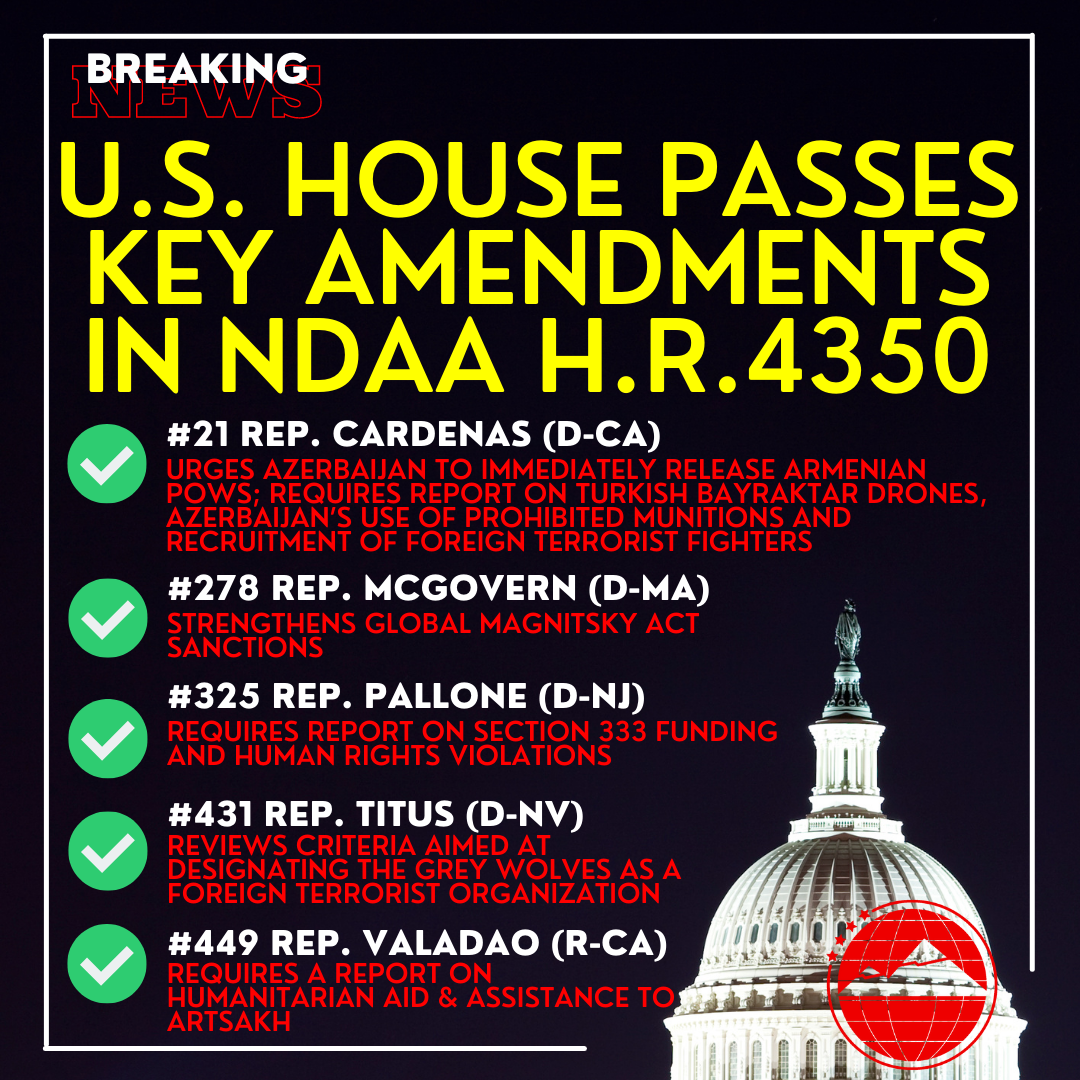
WASHINGTON, DC – On the evening of Thursday, September 23, 2021, five decisive pro-democracy amendments were adopted en bloc by the U.S. House of Representatives as part of the overall National Defense Authorization Act (NDAA) for Fiscal Year 2022, known as bill H.R. 4350.
In the aftermath of last Fall’s 44-day war launched by Azerbaijan with the full support of Turkey against the Armenian people of Artsakh (Nagorno-Karabakh), the Armenian American community strongly advocated for and hailed passage of the following amendments:
- Amendment #21 sponsored by Rep. Tony Cárdenas (D-CA), and cosponsored by Reps. Adam Schiff (D-CA), Jackie Speier (D-CA), Andy Levin (D-MI), Gus Bilirakis (R-FL), Zoe Lofgren (D-CA), Frank Pallone (D-NJ), Jan Schakowsky (D-IL), Brad Sherman (D-CA), David Valadao (R-CA), Judy Chu (D-CA), Anna Eshoo (D-CA), Katie Porter (D-CA), Young Kim (R-CA), Raja Krishnamoorthi (D-IL), and Dina Titus (D-NV): This amendment “creates a report on Azerbaijan’s activities in Nagorno Karabakh in 2020 to be submitted to the relevant congressional committees by the Secretary of Defense in consultation with the Secretary of State. Also expresses the Sense of Congress that the government of Azerbaijan should immediately return all Armenian prisoners of war and captured civilians. Urges the Administration to engage with Azerbaijani authorities, including through the OSCE Minsk Group, to make clear the importance of adhering to their obligations under the November 9 statement and international law to immediately release all prisoners of war and captured civilians.”
- Amendment #278 sponsored by House Rules Committee Chairman James McGovern (D-MA), and cosponsored by Reps. Tom Malinowski (D-NJ), Jamie Raskin (D-MD), Anna Eshoo (D-CA), Gerry Connolly (D-VA), Peter Welch (D-VT), Sheila Jackson Lee (D-TX), Ted Lieu (D-CA), Norma Torres (D-CA), and Don Beyer (D-VA): This amendment “modifies the Global Magnitsky Human Rights Accountability Act (Subtitle F of title XXI of PL 114-328) to authorize sanctions for serious human rights abuse, any violation of internationally recognized human rights, or corruption; adds two new reports to Congress; and repeals the sunset.”
- Amendment #325 sponsored by Rep. Frank Pallone (D-NJ), and cosponsored by Reps. Grace Meng (D-NY), Rashida Tlaib (D-MI), Gus Bilirakis (R-FL), Adam Schiff (D-CA), Jackie Speier (D-CA), Jim Costa (D-CA), Linda Sánchez (D-CA), Zoe Lofgren (D-CA), Anna Eshoo (D-CA), David Valadao (R-CA), Judy Chu (D-CA), and Abigail Spanberger (D-VA): This amendment “requires a report from the Secretary of Defense, in collaboration with the Secretary of State, addressing allegations that some units of foreign countries that have participated in security cooperation programs under section 333 of title 10, U.S.C. may have also committed gross violations of internationally recognized human rights before or while receiving U.S. security assistance. This report also includes recommendations to improve human rights training and additional measures that can be adopted to prevent these types of violations.”
- Amendment #431 sponsored by Rep. Dina Titus (D-NV), and cosponsored by Reps. Zoe Lofgren (D-CA), Young Kim (R-CA), Judy Chu (D-CA), Jim Costa (D-CA), and Anna Eshoo (D-CA): This amendment “requires a report by the Secretary of State on the activities of the Grey Wolves organization (AKA Bozkurtlar & Ülkü Ocaklari) undertaken against U.S. interests, allies, and international partners, including a review of the criteria met for designation as a foreign terrorist organization.”
- Amendment #449 sponsored by Rep. David Valadao (R-CA), and cosponsored by Reps. Brad Sherman (D-CA), Susan Wild (D-PA), Andy Levin (D-MI), Zoe Lofgren (D-CA), Young Kim (R-CA), Judy Chu (D-CA), Jim Costa (D-CA), Abigail Spanberger (D-VA), Raja Krishnamoorthi (D-IL), Katie Porter (D-CA), Frank Pallone (D-NJ), David Schweikert (R-AZ), David Trone (D-MD), and Don Beyer (D-VA): This amendment “requires a report within 180 days of all US humanitarian and developmental assistance programs in Nagorno Karabakh, including an analysis of the effectiveness of such programs and any plans for future assistance.”
Speaking in support of his amendment (#325), Rep. Frank Pallone (D-NJ) stated on the House floor that countries that violate human rights, such as Azerbaijan, which received over $100 million dollars in Fiscal Years 2018 and 2019, along with “equipment and training from the U.S. military,” and launched “a deadly attack against Nagorno-Karabakh/Artsakh on September 27 that led to the death of thousands and the displacement of so many more,” should not receive U.S. funding.
“Passage of this amendment sends a clear signal that the U.S. takes seriously its democratic norms and commitment to peace by ensuring oversight of our security assistance,” said Rep. Pallone, noting that in the future there will be “restraint from aiding and tolerating similar regimes, especially when their actions are aimed at destabilizing a fellow democracy.” This amendment is especially important since Azerbaijan continues to threaten Armenia’s safety and sovereignty. “The United States should not be aiding and abetting reckless, autocratic states with appalling human rights records for any reason,” Rep. Pallone said.
Upon passage, FLArmenians.com Editor Taniel Koushakjian stated, “We commend the House of Representatives for adopting these significant, pro-democracy measures, especially all of the amendment sponsors for taking a strong stand against the war crimes committed by Azerbaijan’s armed forces against peaceful Armenians who are simply defending their right to live in peace. We urge Congress to ensure these measures and kept in the final adoption of the FY2022 NDAA.”
Webinar: Crisis in Armenia’s Russia-Only Security Doctrine Part II
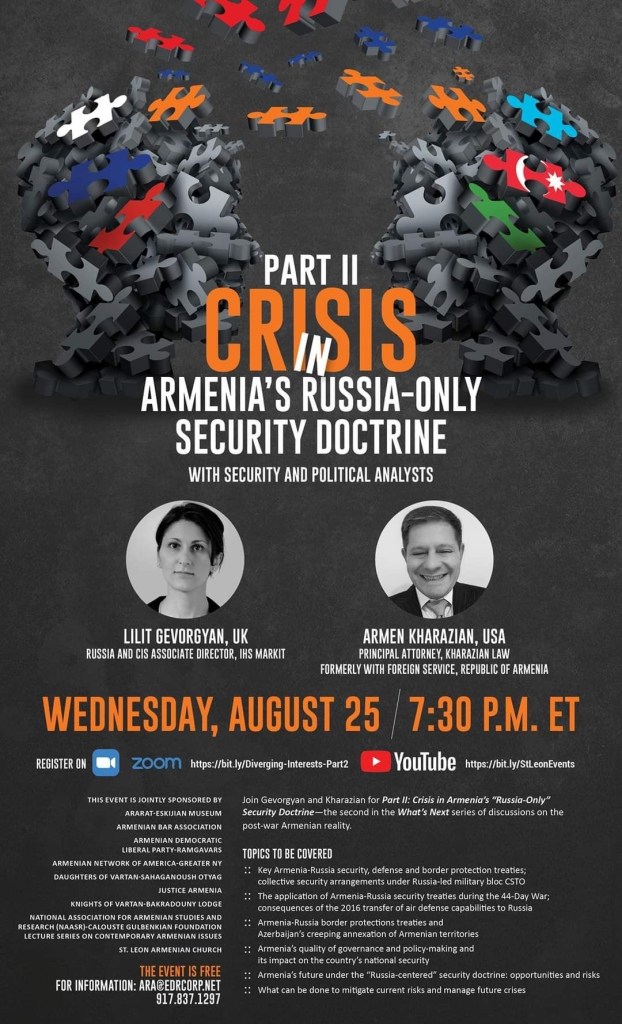
Join regional experts Lilit Gevorgyan and Armen Kharazian for “PART II: CRISIS IN ARMENIA’S RUSSIA-ONLY SECURITY DOCTRINE” – the second in the What’s Next series of discussions on the post-war Armenian reality.
Gevorgyan and Kharazian will frame the 44-day catastrophe and its aftermath within a wider context to help better understand the contours of a world where Russian and Armenian interests might diverge on fundamental issues.
Topics to be covered:
• Key Armenia-Russia security, defense and border protection treaties; collective security arrangements under Russia-led military bloc CSTO
• The application of Armenia-Russia security treaties during the 44-Day War; consequences of the 2016 transfer of air defense capabilities to Russia
• Armenia-Russia border protections treaties and Azerbaijan’s creeping annexation of Armenian territories
• Armenia’s quality of governance and policy-making and its impact on the country’s national security
• Armenia’s future under the “Russia-centered” security doctrine: opportunities and risks
• What can be done to mitigate current risks and manage future crises
Register now to participate in this timely discussion.
This event is sponsored by:
Ararat-Eskijian Museum
Armenian Bar Association
Armenian Democratic Liberal Party-Ramgavars
Armenian Network of America-Greater NY
Daughters of Vartan-Sahaganoush Otyag
Justice Armenia
Knights of Vartan-Bakradouny Lodge
National Association for Armenian Studies and Research (NAASR)-Calouste Gulbenkian Foundation Lecture Series on Contemporary Armenian Issues
St. Leon Armenian Church




 Florida Armenians