Blog Archives
Human Tragedy in Karabakh
By John M. Evans,
Former U.S. Ambassador to Armenia (2004-06)
We Americans are understandably focused on the multiple and interlocking tragedies that have taken place in the last month from Louisiana to Minnesota and most notably in Dallas. But half a world away a human tragedy of a different sort has been unfolding in the unrecognized Armenian-populated enclave of Nagorno-Karabakh, which in Soviet times enjoyed an autonomous status, but, as the USSR was collapsing, voted for independence and fought a terrible war with post-Soviet Azerbaijan that claimed some 30,000 dead on both sides. A fragile cease-fire was signed in 1994 under Russian sponsorship, but the “frozen” conflict has in recent years seen more violations of the Line of Contact, and more victims.
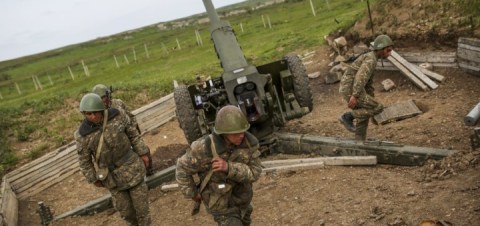
The “four-day war” initiated by Azerbaijan on April 2, 2016 (no close observer of the conflict lays the blame anywhere else) was the largest escalation of military conflict between Azerbaijan and Nagorno-Karabakh since the cease-fire was signed in 1994. Over ninety Armenians were killed, and more than 120, including civilians and children, were wounded. As the Armenian Ambassador to the United States said to me, on a per capita basis, this was equivalent to the U.S. losing 10,000 of its citizens. Thousands of people from the affected villages, mostly children, women and the elderly, were evacuated to the comparative safety of Stepanakert or neighboring communities, or to Armenia proper. I visited Karabakh in late June with Dr. Garo Armen of the Children of Armenia Fund in order to help him determine what COAF might do to ease the suffering of civilians that resulted from the fighting.
The Azerbaijani shelling, much of which was unleashed after the initial attack had already faltered, was most destructive to the border communities of Talish, Madaghis, Mardakert, Hadrout and Martuni. Talish has been entirely abandoned because of the risk of shelling; in fact, further shelling did occur there on June 30 when Azeri soldiers attacked three farmers in the fields. Many families, some of them grieving over their losses, are now internally displaced, still terrified from what they experienced and fearful of the future. Five hotels in Stepanakert were commandeered to house families and individuals who had no other place to go.
Immediately after the cessation of hostilities, the Yerevan office of the Children of Armenia Fund deployed two teams to Karabakh to assess the situation and, in some cases, to provide immediate assistance. The local authorities had attempted to mobilize limited resources to address the most pressing needs, and NGOs and some governmental structures from Armenia also joined in the effort to assist; however, what COAF discovered was that, while some of the emergency needs of the IDPs were partially met, psychological support for the affected people was sorely needed and there was no local capacity to address this issue.
While some efforts were made to address the needs of soldiers with psychosomatic conditions, the majority of the IDPs in the five hotels and elsewhere exhibited signs of trauma, behaving as “ghetto groups,” lost between a terrifying past and an uncertain future, closed inside their shells and praying for God’s help. Children who were enrolled to attend nearby schools feared to venture out to “life-threatening places where shooting and shelling cause death and injuries.” Images of the elderly Talish couple whose ears were cut off by the attackers, of the Yezidi soldier who was decapitated, and of other soldiers tortured and/or mutilated have not helped calm these people down. Some of the atrocities committed by the Azeris clearly were in the category of war crimes and played on the Armenians’ well-founded fear of genocide.
While we Americans have much to do to “fix our own country”, one of the responsibilities of great-power status is to prevent the world from becoming a jungle. Together with Russia and France, the United States has been attempting to mediate the Armenian-Azerbaijani dispute through the Minsk Group of the Organization for Security and Cooperation in Europe. In my view and that of many others, it is high time for the Karabakh authorities, unrecognized as they may be under international law, to be brought into the peace process. The Armenians of Karabakh, or, as they call it, Artsakh, are there to stay and deserve to live in peace in their towns, cities and mountains.
John Evans was recalled from his post as U.S. Ambassador to Armenia in 2006 for publicly breaking with the Bush Administration over the Armenian Genocide. He recently published Truth Held Hostage: America and the Armenian Genocide–What Then? What Now? London: Gomidas Institute, 2016.
This article originally appeared in the California Courier and is reproduced with the expressed written consent of the author.
Action Alert: Denounce Azerbaijan, Defend Artsakh
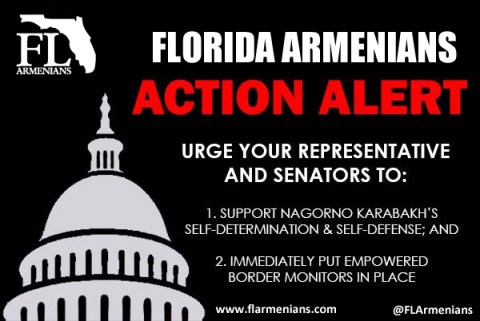
Florida Armenians joins the Armenian Assembly of America in urging Armenian Americans in Florida and all human rights activists to TAKE ACTION to denounce Azerbaijan’s latest attacks on Armenia and Nagorno Karabakh and to urge Members of Congress to defend the self-determination and freedom of Nagorno Karabakh, as well as its right to self-defense.
So far, the latest Azeri cease-fire violations have resulted in over 20 reported deaths, including a 12-year-old boy, and over 70 wounded. In addition, Azerbaijan continues to target villagers in the Tavush region of Armenia, including a kindergarten. This is unacceptable and Azerbaijan must be held accountable for these gross violations of human rights and international law. Further, the United States should stand with the citizens of the Nagorno Karabakh Republic in their struggle for self-determination as they defend themselves from another genocidal act.
We cannot stand on the sidelines as one of the most corrupt dictators in the world continues to blatantly violate the 1994 OSCE brokered cease-fire and takes aim at our brothers and sisters in Armenia and Nagorno Karabakh.
The United States has an important role to play and must stand in solidarity with the people of Artsakh and their right to defend themselves.
CLICK HERE TO TAKE URGENT ACTION TODAY!
Armenian Americans Should Support Marco Rubio for President of the United States
By Taniel Koushakjian
FLArmenians Political Contributor
As the race for the White House heats up, Armenian Americans across the country are beginning to look more closely at who will best represent their interests as President of the United States. For many Armenian Americans, the 2016 election cycle concludes a chapter in the worst administration on Armenian American issues in modern presidential history. With the broken promises of Barack Obama, whether to acknowledge the Armenian Genocide as President or to increase U.S. assistance to Armenia, the Armenian American community has learned that campaign promises are no true indicator of support after the election. However, one can and should look to a candidates record, votes, statements, and over-all positions in order to arrive at an informed decision as to whether or not that candidate deserves your support.
When looking through the Armenian American lens, the Republican Party has the stronger track record and Marco Rubio is the top choice of all the candidates running for President of the United States of America.
The Race as it Stands
As of this writing, Donald Trump currently leads the Republican Party’s nomination contest with 82 pledged delegates, followed by Senator Marco Rubio (R-FL) and Senator Ted Cruz (R-TX) who are tied with 17, Governor John Kasich (R-OH) with 6, and retired neurosurgeon Ben Carson with 4. There are a total 2,340 delegates available and 1,237 are needed to secure the Republican nomination.
The race for the Republican Party’s nomination could very well be determined in less than 30 days. Super Tuesday, March 1, will see 11 states hold primary votes. For Republicans, 595 delegates are up for grabs, including Cruz’s home state of Texas, about 48% of the total delegates required to win the nomination.
Florida and Ohio will hold their “winner-take-all” primaries on March 15, along with Illinois, Missouri, and North Carolina. In the month of March, 1,398 delegates will be awarded, enough to secure the nomination.
Heading into Super Tuesday, emphasis will be on the ability of each candidate to sweep a large number of delegates and if Cruz, Rubio, and Kasich win their home states. If it doesn’t become a two-man race by the end of March simple arithmetic suggests that Trump will likely be the Republican nominee.
Rubio’s Record
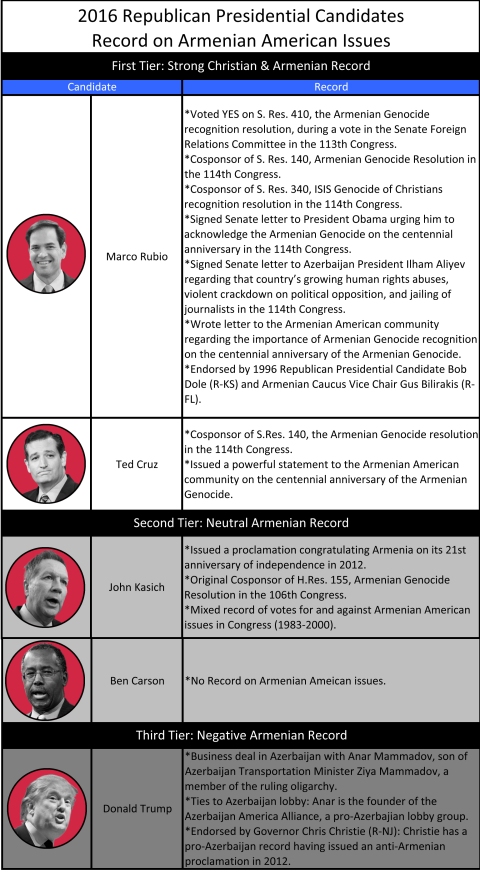
During his tenure in the United States Senate, Marco Rubio (R-FL) has established the strongest record in support of Christian and Armenian American issues of all the candidates in the field, including but not limited to genocide recognition, and not just in Armenia.
On Armenian American legislation, Rubio voted YES on the Armenian Genocide recognition resolution, S.Res. 410, in the Senate Foreign Relations Committee (SFRC) in 2014. The bill passed 12-5; the first time an Armenian Genocide resolution has ever passed this committee.
In 2015, Rubio cosponsored S.Res. 140, the Armenian Genocide resolution, which is currently pending in the Senate with 21 signatories. “As your United States Senator, and as a member of the Senate Committee on Foreign Relations, I was proud to co-sponsor S.Res. 140 in support of an Armenian-Turkish relationship following the 100th Anniversary of the Armenian Genocide. We must continue to fight as an international community with passion and dignity in defense of human rights,” Rubio said in a letter to the Armenian American community to mark the centennial anniversary of the Armenian Genocide. “Please know that you have my full support for your cause,” Rubio said.
Senator Marco Rubio reinforced his position in support of U.S. reaffirmation of the Armenian Genocide when he joined Senator Cory Gardner (R-CO) and 13 other Senators in a letter urging President Obama to acknowledge the Armenian Genocide on the centennial anniversary and to attend the commemorative events in Yerevan, Armenia. Obama did not attend the ceremonies in Yerevan, and sent Secretary of the Treasury Jack Lew in his place.
Also in 2015, Senator Rubio signed a letter to Azerbaijan President Ilham Aliyev regarding the regime’s violent crackdown on political and human rights activists, imprisonment of journalists, and general turn toward authoritarian rule. Rubio’s position on the side of individual liberties, freedom of the press, and democracy is an important element to consider.
Those watching the Republican presidential debates have noticed that, unlike other candidates on either stage, Rubio has repeatedly and unequivocally called out the Islamic State’s barbaric violence against Christians, Yezidis, and other religious minorities in the Middle East as genocide. He also does not hesitate to discuss his Christian heritage and faith, whether it’s his views on life or where his children go to school. As such, he joined Senator Mark Kirk (R-IL), a champion of Armenian American issues, as an original cosponsor of S.Res. 340, a bill that would label as genocide ISIS attacks on Armenians, Assyrians, Yezidis, and other ethnicities of religious antiquity in the Middle East.
In addition to his unparalleled record, Marco Rubio has the backing of key political figures. Former Republican Presidential nominee Senator Robert Dole (R-KS), who led the charge on the Senate floor for Armenian Genocide recognition in 1991, endorsed Rubio. “I’m supporting Rubio,” Dole told ABC News last week, “he wants to grow the party.”
Vice Chair of the Congressional Armenian Caucus Rep. Gus Bilirakis (R-FL) also endorsed Rubio last week. “Having served with Marco in the Florida Legislature and in Congress, I know him to be a leader that inspires hope and instills in all of us a love of country that we felt under another inspirational leader – Ronald Reagan. Marco Rubio’s life story is proof positive that American exceptionalism is real, but we need to fight to preserve it and expand it to more people. His story teaches us that the son of immigrant parents, who came to this country for freedom and opportunity, can achieve anything, including holding the highest office in the land, where I know Marco will work every day to give back to the country that changed his family’s history.”
Cruz’s Calling
In 2015, Senator Ted Cruz (R-TX) also cosponsored S.Res. 140, the Armenian Genocide resolution. Although Cruz is currently a member of the SFRC, he was not on the committee in 2014, and therefore has never had an opportunity to vote on the Armenian Genocide resolution.
Senator Cruz also issued a powerful statement to the Armenian American community to commemorate the centennial anniversary. “100 years ago, the world was too silent as the Armenian people suffered a horrific genocide,” Cruz said in his letter. “Today, we commemorate more than a million souls who were extinguished by the Ottoman Government. Let the terrors of those events awaken in us the courage to always stand for freedom against evil forces. As Pope Francis rightly said, ‘Concealing or denying evil is like allowing a wound to keep bleeding without bandaging it.’ The massacre of the Armenian, Assyrian and other Christian people should be called what it is: genocide.”
Kasich’s Case
Governor John Kasich (R-OH) has a mixed record on Armenian American issues over his career in Congress (1983-2000). Like Cruz, he has never faced a vote on the Armenian Genocide resolution. However, Kasich’s most recent record shows him as an original cosponsor of H.Res. 155, the genocide recognition bill of 1999. As governor, Kasich issued a proclamation in 2012 congratulating Armenia on its 21st anniversary of independence.
Carson and Trump
As a retired neurosurgeon, Ben Carson has no record in support or opposition to Armenian American issues.
Although Donald Trump has never held elective office, he has a record of questionable business practices, one of which should seriously concern Armenian Americans. According to a Eurasia.net report last year:
“Trump lent his name and management know-how to an upcoming, sail-shaped skyscraper in Baku that is owned by billionaire Anar Mammadov, Mother Jones magazine reported on July 29. Mammadov is a son of the country’s powerful transportation minister, Ziya Mammadov, a man whose family has been long accused of battening on privileged access to government contracts for infrastructure development.
“The deal and Mammadov’s role as a champion of Azerbaijani interests in the US — he heads the Azerbaijan America Alliance — exemplify the two parallel worlds of US-Azerbaijani relations. Baku now bitterly rebukes Washington’s criticism of its dismal human rights records, even as its insiders actively lobby and sweet-talk US politicians.
“And, apparently, investors like Trump.”
Trump’s pro-Azerbaijan leaning is reinforced by the support of Governor Chris Christie (R-NJ). In 2012, Governor Christie issued a proclamation on the so-called “Khojaly massacre” which ridiculously accuses Armenians of committing ethnic cleaning against Azerbaijanis during the 1991-94 Nagorno Karabakh War. The growing Muslim Azerbaijan lobby in Washington, led by the Azerbaijan American Alliance, with who’s founder Trump has a business relationship, has shopped around such anti-Armenian proclamations and resolutions in order to cover up and divert attention from Azerbaijan’s Sumgait, Kirovabad, and Baku pogroms against Christian Armenians in 1988-90.
Christie came to Trump’s rescue in an endorsement on Friday after Rubio used the same attack wielded by the New Jersey Governor against Rubio on Trump. “I watched you repeat yourself five times four weeks ago,” Trump exclaimed at the Republican Presidential debate on Thursday night in Houston, TX. “I watched you repeat yourself five times five seconds ago,” Rubio rebuffed after Trump failed to articulate a healthcare plan.
The Right Choice
Armenian Americans focusing on November must remain mindful of the historical record of the individual, statements made, and tough votes cast in order to make an informed decision about the person and the party accordingly. While there are and have always been genuine, ardent, and steadfast Democratic supporters of Armenian American interests, the historical record reveals that Republican leadership has been more successful. When viewed through the Armenian American lens, it would be foolish for Armenian Americans to continue to reward a party and a President that has been unable to deliver when it mattered most.
There are plenty of issues on the Armenian American agenda. U.S. reaffirmation of the Armenian Genocide, defending the rights of Nagorno Karabakh citizens to live freely, and Christian persecution in the Middle East are the most compelling for Armenian Americans in 2016. How legislators act when in power and vote when it counts is what reveals true leadership.
Like other minority groups in America, Armenians are not a monolithic voting block, nor should we be. But we must wake up the political consciousness of our constituency and make the right choice in this election-and that choice is Marco Rubio.
*Updated at 11:15 pm with the addition of Senator Rubio’s signature on the Senate letter to President Obama on the Armenian Genocide centennial anniversary.




 Florida Armenians