Category Archives: Armenian Genocide
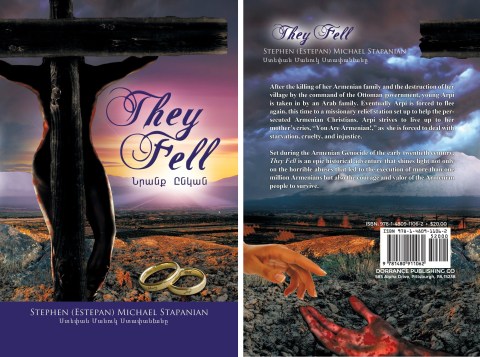
Stapanian Hopes to Change Minds with Historical Novel on the Armenian Genocide
By Mike Jeknavorian
FLArmenians Lifestyle Contributor
FORT LAUDERDALE, FL – The novel is called They Fell, and the title is appropriate. Drawing on Charles Aznavour’s “Ils Sont Tombes,” the author uses graphic imagery to convey the historically based horrors and is stretched over 35 character-experiences in the midst of the Armenian Genocide.
Author Stephen Stapanian of Tampa, FL sets the story in the dying days of the Ottoman Empire during World War I. As it’s read, one is reminded that a story can allow a direct communion with another era, and ultimately, with the era’s deceased.
In a response to questions submitted via email from FLArmenians.com, Mr. Stapanian says that the novel “represents a gift to the Armenian people globally, and to send a message to all of those who suffered . . . that they were not alone as victims of genocide.”
Stapanian says that he was originally inspired to write the novel after watching genocide-themed TV miniseries’ in the 1980s, such as Roots, Holocaust, and Shogun. Over time Stapanian worked on his approach and finally published They Fell on August 1, 2015.
The novel uses a love-story conceit, along with excerpts of song lyrics and poems, to draw the reading into the larger context of Ottoman Armenian life in 1915. It was written to evoke a strong emotional response about the genocide, and, fundamentally, to elicit change, he says.
But what change could he bring? The Armenian Genocide is officially recognized by over 20 nations, such as Canada, France, Russia, Germany, Austria, Argentina, the Vatican, and others. At the same time, the Ottoman Empire’s successor, Turkey, refuses to accept it’s own history and continues a decades-long campaign of genocide denial.
Historians mark the beginning of the Armenian Genocide on April 24, 1915, when the Ottoman Turkish government rounded up over 200 Armenian academics, doctors, businessmen, and religious and community leaders in Constantinople.
The lack of accountability or prosecution of the perpetrators makes recollection of the genocide sting that much more, for many, as it does Stapanian.
Historians estimate that over one million Armenians were ethnically cleansed in a systematic campaign orchestrated by the Ottoman Turkish government in what is widely considered the first genocide in modern times.
The majority of published works about the Armenian Genocide have been memoir or historical, whereas They Fell is fiction based on a historical event.
But given that the novel is predicated on something as gruesome as genocide, should the public only expect to experience a limited amount of entertainment from it?
Hopefully, readers will truly connect with the characters, and in so doing learn something from those who fell and perished in one of man’s darkest chapters.
Armenian Church Primate Barsamian to Visit Orlando

Florida Armenians is pleased to report that Archbishop Khajag Barsamian, Primate of the Eastern Diocese of the Armenian Church of America, will visit Soorp Haroutiun Armenian Church in Orlando, Florida this Sunday, January 17, 2016. Service will begin promptly at 10:00 AM.
2015 was a sad year for the Armenians across the globe-we commemorated the 100th anniversary of the Armenian Genocide while our spiritual leader, Catholicos Karekin II, consecrated 1.5 million of our martyrs as new saints.
2016 will be a happy and proud year for the Orlando Armenian American community. Soorp Haroutiun will celebrate their 30th anniversary of their establishment and the 5th anniversary of the consecration of the sanctuary. We ask you to join us and come together to welcome His Eminence and celebrate the monumental accomplishments of our small but growing parish.
A special luncheon and program with His Eminence will follow the Service.
Soorp Haroutiun Armenian Church of Orlando is located at 9274 Winter Garden Vineland Road, Orlando, FL 32836.
Luncheon seating is limited. Suggested luncheon donations are $15 for adults and $5 for children under 12. Please call 407-876-2616 or 407-679-7231 to reserve your seat today.
ANI Genocide Website Announces Expansion
50 Official Records Affirming the Armenian Genocide Added; 30 Monuments Added to Memorials Database

WASHINGTON, D.C. – The Armenian National Institute (ANI) announced the completion of a major expansion of its heavily-used website. ANI updated one of the central features of the site which is widely consulted and provides an extensive catalogue of affirmation records from around the world.
As the spate of recognition and affirmation of the Armenian Genocide picked up pace with the centennial commemorations, ANI focused on obtaining the official documents attesting to this new international reality.
The documents from countries that entered the list formally recognizing the Armenian Genocide in 2015 were also augmented with official copies of declarations from prior years allowing the public to view the actual documents as well as have easy access to their text.
The current list of countries that have historically recognized the Armenian Genocide include Argentina, Austria, Belgium, Bolivia, Brazil, Bulgaria, Canada, Chile, Cyprus, France, Germany, Greece, Italy, Lebanon, Lithuania, Luxembourg, Netherlands, Paraguay, Poland, Russia, Slovakia, Sweden, Switzerland, United States, Uruguay, Vatican City, and Venezuela. The list of 27 countries is supported by 55 official documents available under the section Resolutions, Laws and Declarations.
Under the category of States and Provinces, the ANI website provides dozens of state-level resolutions and declarations from nine countries, including Argentina, Australia, Brazil, Canada, Italy, Spain, Switzerland, United Kingdom, and the United States. For the U.S., records from 44 states referencing the Armenian Genocide are reproduced, while countries like Spain and the UK are represented even as their central governments remain off record.
With important statements issued in April by heads of states and major religious and public institutions, these have been organized into new categories for easy access, such as International Organizations, Religious Institutions, and Heads of States, Parliaments, and Presidential Statements. A separate page reproduces all the April 24 and related statements issued by presidents of the United States from Woodrow Wilson to Barack Obama.
Many other sections of the ANI website were expanded including Education, Press Coverage, and the Memorials database. Some 200 Armenian Genocide memorials in 32 countries are identified, along with basic information about their location, designers, sponsors, and other features .
As previously announced, ANI notes the rapid expansion of scholarship on the Armenian Genocide and the numerous publications issued on the occasion of the centenary. These are featured under the section Armenian Genocide Resource Guide, and are grouped according to topic under Armenian Genocide and America, Armenian Genocide Studies, The Problem of Genocide, and other categories for easy identification. Over 100 publications are listed in the Resource Guide, with many others offered under the broader Educational Resources section.
The ANI website also features four large exhibits including the 10-panel Witness to the Armenian Genocide: Photographs by the Perpetrators’ German and Austro-Hungarian Allies issued in 2013; the 20-panel exhibit The First Refuge and the Last Defense: The Armenian Church, Etchmiadzin, and the Armenian Genocide released in 2014; the 24-panel exhibit The First Deportation: The German Railroad, The American Hospital, and the Armenian Genocide released in January 2015, and the 22-panel Iconic Images of the Armenian Genocide in March 2015; and a one-page poster depicting survivors in April 2015.
Because of popular interest in the exhibits which display hundreds of historic photographs, they have been made available through the Armenian Genocide Museum of America (AGMA) and Armenian Assembly of America (Assembly) websites as well. The digital exhibits are being continuously utilized and some quarter million copies have been downloaded to date.
The success of these new products has continued to sustain ANI as the leading institution providing information about the Armenian Genocide. Moreover, the combined addition of new resources on the ANI website has exponentially expanded the number of visitors. In 2013, the statistics jumped from 2 million hits to 3 million. In 2014, over 3 million hits were registered, and in 2015, over 4 million hits have been reached.
Through the ANI website visitors can also see the online museum launched by AGMA on April 24, 2015. The new interactive site includes an introductory video and a dynamic narrative that features survivors, background music, and significant imagery. The AGMA site is slated for expansion in 2016 and the second phase of the project will include mobile-friendly access for visitors. The site is envisioned to contain the entire story of the Armenian Genocide through expandable galleries.
The ANI website also served as a major resource for media from around the world to help provide coverage of the centennial commemorations. Nearly all global media paid close attention to the meaning of the centenary of the Armenian Genocide, with The Daily Mail in England, as an example, which has a circulation of 1.4 million and is believed to have a readership of 3 million, making extensive use of the historic images available from ANI.
“We want to thank all those who have sent ANI information about developments in their countries, whether new recognitions, the construction of memorials, or the release of noteworthy publications,” stated ANI chairman Van Z. Krikorian. “They all help maintain the ANI website as a central location for making this valuable data available to students, teachers, and the general public. The work that Rouben Adalian has done from the inception of this website is truly remarkable, and the fact that it is cited so prominently and often is a real achievement.”
“I especially need to thank the Armenian Genocide Museum-Institute in Yerevan and the Armenian Foreign Ministry for being helpful in retrieving many of the valuable documents posted on the ANI site where the collective effort of the Armenian people on the occasion of the of the centennial of the Armenian Genocide can be viewed and appreciated,” added ANI Director Dr. Rouben Adalian. “I also want to note the contributions of interns and volunteers who pitched in at ANI, most notably Karina Demircyan and Mariam Khaloyan for their dedication and participation in this effort by helping to expand the ANI website, and our longtime webmaster Mark Malkasian for his standing commitment to our goals,” Adalian said.
Founded in 1997, the Armenian National Institute (ANI) is a 501(c)(3) educational charity based in Washington, DC, and is dedicated to the study, research, and affirmation of the Armenian Genocide.




 Florida Armenians