Blog Archives
South Florida Armenian American Community Commemorates 98th Anniversary of the Armenian Genocide
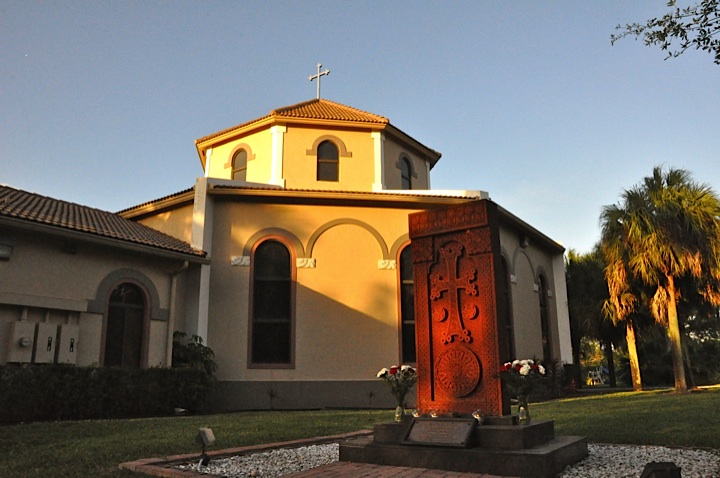
HOLLYWOOD, FL —On Wednesday April 24, several hundred members of the South Florida Armenian American Community gathered at St Mary Armenian Church to commemorate the 98th anniversary of the Armenian Genocide, reported Florida Armenians (FLArmenians).
The evening began with a hokehankist (memorial service), which was offered for the victims of the Armenian Genocide by the V. Rev. Fr. Nareg Berberian of St. David Armenian Church and Rev. Fr. Vartan Joulfayan of St. Mary Armenian Church.

After the service, a cross-cultural, multimedia program began delving into the history surrounding the Armenian genocide, as well as the emotions that are shared not only by the survivors and descendants of survivors, but also the survivors of many of the numerous other genocides of the 20th century.
(PHOTOS: 98th Anniversary Armenian Genocide Commemoration in South Florida)
Armenians worldwide commemorate the genocide on April 24 of each year, the day when, in 1915, Ottoman authorities arrested 250 Armenian intellectuals and community leaders in Constantinople. Soon after, the Ottoman military ripped Armenians from their homes and began a systematic extermination of Armenians which was implemented in two phases: the killing of the able-bodied male population through massacre and forced labor, and the deportation of women, children, the elderly and infirm on death marches to the Syrian Desert. The total number of Christian Armenians who perished as a result between 1915 and 1923 has been estimated at around 1.5 million. The Turkish government has yet to formally acknowledge that the genocide even occurred.
Mr. Raffy Yaghdjian, member of the St Mary Armenian Church parish council, served as master of ceremonies. In Yaghdjian’s opening words he stated, “We are gathered here today to remind ourselves that the struggle is not over. The world did not learn. There were many more genocides following ours. The Assyrians, the Greeks, the Jews, the Cambodians, Rwandans, and those in Darfur. So we continue with the struggle. We must continue to educate. We must continue to publicize. We must continue to publish books and write papers. We must continue to make the effort. We must continue to be creative in how we do it. After all, and I quote, ‘all that is necessary for the triumph of evil is for good men to do nothing.’”
(Also on FLArmenians: Armenian Billboards Put Touchy Topic on the Road)

As the program continued, Mr. Harry Pilafian, a survivor of the genocide who was in attendance, was recognized with standing applause. Lilit Mnatsakanyan and Tanya Lusararian read papers they had composed regarding their perspectives on the genocide, and Roubina Majarian of St David Armenian Church presented Armenian poetry. Guest speaker Professor Hannibal Travis of the Florida International University (FIU) College of Law addressed the audience about his ongoing study of the Armenian Genocide, particularly how it has been addressed by the United States. Professor Travis is the author of the first comprehensive history of physical and cultural genocide in the Middle East and North Africa, entitled Genocide in the Middle East: The Ottoman Empire, Iraq, and Sudan. A short screening from the documentary “Orphans of the Genocide” was also presented by south Florida film producer Bared Maronian. A musical interlude followed, with Alique Mazmanian performing “Karouna” by Komitas on piano, Mrs. Audrey Pilafian performing “Manoushak” and “Yeraz” on cello, Joseph Yenikomshian playing “Lord have mercy” on clarinet, and Sage McBride performing “Krounk” by Komitas, on violin.

(Also on FLArmenians: Florida State Senate Recognizes April 24 as Armenian Martyrs Remembrance Day)
Before the conclusion of the program, Mr. Yaghdjian unexpectedly once more approached the podium to excitedly say, “I was just given a note that the Florida State Senate just passed a resolution recognizing April 24 as Armenian Martyrs Remembrance Day for the first time in Florida history,” to a round of thunderous applause.
Fr. Joulfayan offered in closing, “Many thanks to you, dear South Floridians, families, youth, and children. But, in a way, I should not be thanking you. We do not thank each other on this day. Today, we simply come to remember and never forget.”
The South Florida Armenian Genocide Commemoration was held under the auspices of St. David Armenian Church of Boca Raton, St. Mary Armenian Church of Hollywood and Florida Armenians, together with the Armenian Assembly of America, the Armenian National Committee, and the Knights of Vartan.
###
PR# 2013-04
Photo Caption 1: St. Mary Armenian Apostolic Church of Hollywood, Florida.
Photo Caption 2: Florida Armenians joined by human rights and anti-genocide activists to commemorate the 98th anniversary of the Armenian Genocide and all genocides of the 20th Century.
Photo Caption 3: FIU Professor Hannibal Travis presents his studies on the Armenian Genocide.
Photo Caption 4: Armenian Genocide survivor Harry Pilafian recognized by South Florida Armenian American community.
Photos courtesy of Michele Kevorkian McBride for FLArmenians.com.
Armenian Billboards Put Touchy Topic on the Road

A billboard thanking countires that recognize genocide against Armenians is seen Wednesday, April 17, 2013, along I-95 in Pompano Beach. Photo courtesy of Joe Cavaretta, SunSentinel
By Diane C. Lade
Sun-Sentinel
Four striking billboards, crowded in among beer and cosmetic surgery ads along two South Florida highways, contain one sentence starkly lettered in white on a black background: “Thank you for officially recognizing the Armenian Genocide — April 24, 1915.”
It’s a bold move to bring public attention to an almost century-old tragedy that Armenian Americans say takes a back seat to other large-scale human rights violations: the killing of 1.5 million of their ancestors during World War I in what is now Turkey.
But until now, the identity of those behind the signs was a mystery. Small wording at the bottom of the 672-square-foot billboards states only that they were “paid for by individuals concerned about the plight of Armenians.” They list no names.
(Also on FLArmenians: Armenia Avenue Anyone? The Story of Armenia Venue in Tampa Bay, Florida)
That’s because it’s not about publicity, it’s about bringing larger awareness to the issue, said George Pagoumian, 70, a Fort Lauderdale businessman and philanthropist who came forward only after the Sun Sentinel began researching the signs.
The four billboards are located at Florida’s Turnpike-Interstate 595 interchange; and on Interstate 95 at Southern Boulevard in West Palm Beach, at Atlantic Boulevard in Pompano Beach and at Northwest 79th Avenue in Miami. And the campaign was organized and financed through Armenian community members, said Pagoumian, declining to list the other contributors or how much was donated.
“We don’t want money to dictate this,” said Pagoumian, whose parents were Armenian and who lost his grandmother and other relatives to the killings. “Our grandmothers, our family who died are paying. They are sending checks from heaven.”
Twenty countries have officially recognized the killings as genocide, and those nations’ flags are on the South Florida billboard, under the words “thank you.” The United States is not among them — something Armenian Americans have fought passionately to change for years. They are pressuring President Obama to make an executive declaration.
But calling what happened in Armenia almost 100 years ago a “genocide” is a very touchy subject — especially in South Florida. About 4,000 people of Armenian descent live in Broward and Palm Beach counties, according to the Census, alongside about 5,000 of Turkish descent. Turkey denies that Armenians were targeted because of race or ethnicity.
Fuat Ornarli, past president of the Florida Turkish American Association, has not seen the billboards but dislikes what he considers a politicization of the issue.
“I would like to express my deep sorrow to see such billboards around us, since this subject is so politicized, and so biased,” said Ornarli, of Miami.
Genocide declarations should be made by scholars, not politicians, Ornarli said, adding that not all historians agree the Armenian deaths should be labeled genocide. Like the leaders of his native country, he said the deaths were casualties of war, exacerbated when the Armenians aligned themselves with Russia, Turkey’s enemy.
Rosanna Gatens, director for the Center for Holocaust and Human Rights Education at Florida Atlantic University, said the removal and killing of Armenians by the Turks is taught along with the Holocaust and other modern genocides in the state-mandated human rights education program. Each year, a few teachers get complaints from upset Turkish parents “who think their children are being taught that Turkey is a terrible place,” she said.
“It’s really important for people in our area to understand what happened in Armenia. All scholarly definitions say it was a genocide and we need to quit playing politics,” she said.
(Also on FLArmenians: University of Florida Hillel Raises Genocide Awareness)
Marta Batmasian, a Boca Raton real estate investor and Armenian community leader, agreed.
“This is a human rights issue, not an Armenian issue. We are not going to let history be buried,” said Batmasian, a former educator who sits on the state task force for Holocaust and human rights education.
The South Florida signs are very similar to an effort run by Peace of Art Inc., a nonprofit founded by Armenian American artist Daniel Varoujan Hejinian. Since 1996, Hejinian has created and installed dramatic billboards each April in suburban Boston, his hometown, calling on the United States to recognize the killings as genocide.
Rosario Teixeira, Peace of Art’s executive director, said the organization was not involved in South Florida’s efforts. “I am sure their efforts are well intended and we wish them good luck,” she said.
Armenian churches and peace activists in South Florida every year host prayer or commemoration services on April 24, the day when the Ottoman government arrested 250 Armenian intellectuals and leaders, and began deporting them.
St. Mary Armenian Apostolic Church in Hollywood will have a public service and commemoration Wednesday; St. Mary and St. David Armenian Apostolic Orthodox Church in Boca Raton trade off hosting the event annually.
(Also on FLArmenians: 98th Anniversary Armenian Genocide Commemorations in Florida)
This year, the billboards created a buzz when the signs appeared but no one claimed the credit. Speculation ran wild among South Florida’s Armenians for weeks. “The emails I’m getting! They are saying something like this has never happened,” Batmasian said.
The Rev. Vartan Joulfayan said his St. Mary’s parishioners last week were peppering him with questions about who the anonymous billboard contributors might be. The pastor told them it didn’t matter — that he assumed the donors wanted to stay out of the spotlight.
“So their message can come through,” he said. “A message that is strong and true.”
This story originally appeared in the Sun Sentinel on April 21 and is reprinted with the permission of the author.




 Florida Armenians