Blog Archives
ANI Genocide Website Announces Expansion
50 Official Records Affirming the Armenian Genocide Added; 30 Monuments Added to Memorials Database

WASHINGTON, D.C. – The Armenian National Institute (ANI) announced the completion of a major expansion of its heavily-used website. ANI updated one of the central features of the site which is widely consulted and provides an extensive catalogue of affirmation records from around the world.
As the spate of recognition and affirmation of the Armenian Genocide picked up pace with the centennial commemorations, ANI focused on obtaining the official documents attesting to this new international reality.
The documents from countries that entered the list formally recognizing the Armenian Genocide in 2015 were also augmented with official copies of declarations from prior years allowing the public to view the actual documents as well as have easy access to their text.
The current list of countries that have historically recognized the Armenian Genocide include Argentina, Austria, Belgium, Bolivia, Brazil, Bulgaria, Canada, Chile, Cyprus, France, Germany, Greece, Italy, Lebanon, Lithuania, Luxembourg, Netherlands, Paraguay, Poland, Russia, Slovakia, Sweden, Switzerland, United States, Uruguay, Vatican City, and Venezuela. The list of 27 countries is supported by 55 official documents available under the section Resolutions, Laws and Declarations.
Under the category of States and Provinces, the ANI website provides dozens of state-level resolutions and declarations from nine countries, including Argentina, Australia, Brazil, Canada, Italy, Spain, Switzerland, United Kingdom, and the United States. For the U.S., records from 44 states referencing the Armenian Genocide are reproduced, while countries like Spain and the UK are represented even as their central governments remain off record.
With important statements issued in April by heads of states and major religious and public institutions, these have been organized into new categories for easy access, such as International Organizations, Religious Institutions, and Heads of States, Parliaments, and Presidential Statements. A separate page reproduces all the April 24 and related statements issued by presidents of the United States from Woodrow Wilson to Barack Obama.
Many other sections of the ANI website were expanded including Education, Press Coverage, and the Memorials database. Some 200 Armenian Genocide memorials in 32 countries are identified, along with basic information about their location, designers, sponsors, and other features .
As previously announced, ANI notes the rapid expansion of scholarship on the Armenian Genocide and the numerous publications issued on the occasion of the centenary. These are featured under the section Armenian Genocide Resource Guide, and are grouped according to topic under Armenian Genocide and America, Armenian Genocide Studies, The Problem of Genocide, and other categories for easy identification. Over 100 publications are listed in the Resource Guide, with many others offered under the broader Educational Resources section.
The ANI website also features four large exhibits including the 10-panel Witness to the Armenian Genocide: Photographs by the Perpetrators’ German and Austro-Hungarian Allies issued in 2013; the 20-panel exhibit The First Refuge and the Last Defense: The Armenian Church, Etchmiadzin, and the Armenian Genocide released in 2014; the 24-panel exhibit The First Deportation: The German Railroad, The American Hospital, and the Armenian Genocide released in January 2015, and the 22-panel Iconic Images of the Armenian Genocide in March 2015; and a one-page poster depicting survivors in April 2015.
Because of popular interest in the exhibits which display hundreds of historic photographs, they have been made available through the Armenian Genocide Museum of America (AGMA) and Armenian Assembly of America (Assembly) websites as well. The digital exhibits are being continuously utilized and some quarter million copies have been downloaded to date.
The success of these new products has continued to sustain ANI as the leading institution providing information about the Armenian Genocide. Moreover, the combined addition of new resources on the ANI website has exponentially expanded the number of visitors. In 2013, the statistics jumped from 2 million hits to 3 million. In 2014, over 3 million hits were registered, and in 2015, over 4 million hits have been reached.
Through the ANI website visitors can also see the online museum launched by AGMA on April 24, 2015. The new interactive site includes an introductory video and a dynamic narrative that features survivors, background music, and significant imagery. The AGMA site is slated for expansion in 2016 and the second phase of the project will include mobile-friendly access for visitors. The site is envisioned to contain the entire story of the Armenian Genocide through expandable galleries.
The ANI website also served as a major resource for media from around the world to help provide coverage of the centennial commemorations. Nearly all global media paid close attention to the meaning of the centenary of the Armenian Genocide, with The Daily Mail in England, as an example, which has a circulation of 1.4 million and is believed to have a readership of 3 million, making extensive use of the historic images available from ANI.
“We want to thank all those who have sent ANI information about developments in their countries, whether new recognitions, the construction of memorials, or the release of noteworthy publications,” stated ANI chairman Van Z. Krikorian. “They all help maintain the ANI website as a central location for making this valuable data available to students, teachers, and the general public. The work that Rouben Adalian has done from the inception of this website is truly remarkable, and the fact that it is cited so prominently and often is a real achievement.”
“I especially need to thank the Armenian Genocide Museum-Institute in Yerevan and the Armenian Foreign Ministry for being helpful in retrieving many of the valuable documents posted on the ANI site where the collective effort of the Armenian people on the occasion of the of the centennial of the Armenian Genocide can be viewed and appreciated,” added ANI Director Dr. Rouben Adalian. “I also want to note the contributions of interns and volunteers who pitched in at ANI, most notably Karina Demircyan and Mariam Khaloyan for their dedication and participation in this effort by helping to expand the ANI website, and our longtime webmaster Mark Malkasian for his standing commitment to our goals,” Adalian said.
Founded in 1997, the Armenian National Institute (ANI) is a 501(c)(3) educational charity based in Washington, DC, and is dedicated to the study, research, and affirmation of the Armenian Genocide.
Assembly to Hold Armenian Genocide Symposium at Annual Members Meeting in Florida
Symposium Will Take Place in Boca Raton on Saturday, March 14, 2015
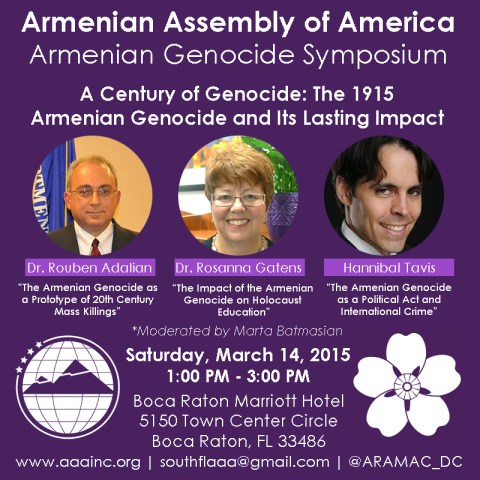
WASHINGTON, DC – The Armenian Assembly of America (Assembly) is pleased to announce the speakers for the Armenian Genocide Symposium that will take place during the Assembly’s Annual Members Meeting weekend in Boca Raton, Florida, March 13-14, 2015. Entitled, “A Century of Genocide: The 1915 Armenian Genocide & Its Lasting Impact,” the symposium will feature Dr. Rouben Adalian, Dr. Rosanna Gatens, and Hannibal Travis.
Dr. Adalian will present on the topic “The Armenian Genocide as a Prototype of 20th Century Mass Killings.” Dr. Gatens will discuss “The Impact of the Armenian Genocide on Holocaust Education,” and Hannibal Travis will present “The Armenian Genocide as a Political Act and International Crime.” Assembly Trustee Marta Batmasian will moderate the discussion.
The Symposium will take place on Saturday, March 14, 2015 from 1:00 PM to 3:00 PM.
Dr. Rouben P. Adalian is the Director of the Armenian National Institute (ANI) in Washington, DC. He is the editor of The Armenian Genocide in the U.S. Archives 1915-1918 and its accompanying Guide and associate editor of the Encyclopedia of Genocide. Adalian is also the author of From Humanism to Rationalism: Armenian Scholarship in the Nineteenth Century and Historical Dictionary of Armenia and has contributed to Genocide in Our Time; Studies in Comparative Genocide; America and the Armenian Genocide; and Centuries of Genocide: Critical Essays and Eyewitness Accounts. He is a specialist on the Caucasus and the Middle East, and has taught at a number of universities, including George Washington University, Georgetown University and Johns Hopkins University. He received a Ph.D. in history from the University of California, Los Angeles.
Dr. Rosanna M. Gatens is the Director of the Center for Holocaust and Human Rights Education (CHHRE) at Florida Atlantic University (FAU) in Boca Raton, Florida. Dr. Gatens is a specialist in the social and intellectual history of Germany, especially during the era of the Weimar Republic and the Third Reich. Dr. Gatens has written about the collapse of academic freedom in German universities during the 1920s, the anti-fascist and anti-militarist campaigns of the German League for Human Rights during the interwar years, and racism as a component of National Socialism. Her research and writing in the area of Holocaust education focuses on the effectiveness of particular teaching and learning strategies for high school and college students. Dr. Gatens is a member of the Florida Task Force on Holocaust Education and a member of the Save Darfur Coalition of South Palm Beach.
Hannibal Travis is a Professor of Law at Florida International University (FIU) College of Law in Miami, Florida. He has published widely on Ottoman Turkey’s Christian genocide, freedom of expression, religious freedom in the contemporary Middle East, and human rights in Africa. Travis wrote the first comprehensive legal history of genocide in the Middle East and North Africa, entitled Genocide in the Middle East: The Ottoman Empire, Iraq, and Sudan. His second book, entitled Genocide, Ethnonationalism, and the United Nations: Exploring the Causes of Mass Killing Since 1945, undertakes the first in-depth exploration of the causes of genocide and politicide using the U.N. archives.
The Assembly’s Armenian Genocide Symposium will be held at the Marriott Hotel at Boca Town Center, 5150 Town Center Circle, Boca Raton, FL 33486 on Saturday, March 14, 2015 from 1:00 to 3:00 PM. Guests that are traveling from out of town should call (561) 392-4600 to reserve a room at the Armenian Assembly’s reduced rate of $169.00 per night.
Online registration for the Symposium is available here. For additional information please contact Assembly South Florida Regional Council Chair Carol Norigian at southflaaa@gmail.com.
Established in 1972, the Armenian Assembly of America is the largest Washington-based nationwide organization promoting public understanding and awareness of Armenian issues. The Assembly is a non-partisan, 501(c)(3) tax-exempt membership organization.
Florida Atlantic University Conducts First Public Teacher Workshop on the Armenian Genocide in South Florida
Workshop is Part of a Series of Events in South Florida Commemorating the 100th Anniversary of the Armenian Genocide
By Taniel Koushakjian
FLArmenians Managing Editor

As part of the South Florida commemorations of the Armenian Genocide, the first genocide of the 20th century, Florida Atlantic University (FAU) will conduct a two-part series of events. On January 20th, Dr. Rosanna Gatens, Director of the Center for Holocaust and Human Rights Education (CHHRE) at FAU and Reverend Fr. Paren Galstyan, Pastor of St. David Armenian Church in Boca Raton, Florida, held a workshop at the Alex and Marie Manoogian School. The workshop featured lectures, exhibits, and thought-provoking information and dialogue on the Armenian Genocide. Facilitated by Dr. Mary Johnson, Facing History and Ourselves, the workshop explored the role of World War I in the execution of the Armenian Genocide in the Ottoman Turkish Empire.
Fifteen teachers from Broward and Palm Beach County participated in the FAU workshop. “St. David’s Armenian school was the perfect setting for teachers, not only to learn about the Armenian genocide and how to teach it, but also to begin to understand Armenian identity,” stated Dr. Gatens. “All of us were fascinated by the richness of Armenian culture, but even more by the ancientness of Armenian Christianity,” Dr. Gatens said.

During the workshop instructors examined the exhibit “Witness to the Armenian Genocide: Photographs by the Perpetrators’ German and Austro-Hungarian Allies,” produced by the Armenian National Institute (ANI), the Armenian Genocide Museum of America (AGMA), and the Armenian Assembly of America (Assembly). The ten-poster set includes an introductory page, a detailed timeline, a color-coded map geographically matching the photographs with their location, and seven pages displaying 34 captioned historic photographs. The color-coded map in the exhibit is based on the previously-published ANI map of the 1915 Armenian Genocide in the Ottoman Turkish Empire illustrating the three prevailing aspects of the Genocide: the deportations, the massacres, and the concentration camps.
FAU’s second lecture commemorating the 100th Anniversary of the Armenian Genocide will take place on Sunday, April 19, 2015, as part of the Martin and Edith Stein Community Lecture Series. Dr. Tamar Akçam will discuss his book, “The Young Turks’ Crime Against Humanity: The Armenian Genocide and Ethnic Cleansing in the Ottoman Empire.” Dr. Akçam is the Robert Aram, Marianne Kaloosdian and Stephen and Marian Mugar Chair in Armenian Genocide Studies at Clark University in Worcester, Massachusetts.
Florida Atlantic University Events Commemorating the 100th Anniversary of the Armenian Genocide:
January 20, 2015
Teacher Workshop: The Role of World War I in the Execution of the Armenian Genocide, facilitated by Dr. Mary Johnson, Facing History and Ourselves, FAU, Boca Raton Campus, 8.30-a.m.3.30 p.m. at St. David’s Armenian Church, Boca Raton. Substitute reimbursements available. April 2015 marks the 100th Anniversary of the Armenian Genocide. This program is part of local commemoration of the first genocide of the Twentieth Century.
April 19, 2015
Martin and Edith Stein Community Lecture Series: Dr. Tamar Akçam will discuss his book, “The Young Turks’ Crime Against Humanity: The Armenian Genocide and Ethnic Cleansing in the Ottoman Empire,” Dr. Akçam is Robert Aram, Marianne Kaloosdian and Stephen and Marian Mugar Chair in Armenian Genocide Studies at Clark University. This program is part of south Florida’s commemoration of the 100th Anniversary of the Armenian Genocide. FAU, Boca Campus, 7-9 p.m., location TBA.




 Florida Armenians