Blog Archives
Armenian National Institute Website Now Includes 795 Official Records Affirming the Armenian Genocide
WASHINGTON, DC – The Armenian National Institute (ANI) has completed a massive expansion of its widely-consulted website containing extensive information on the Armenian Genocide. The 2019 resolutions adopted by the U.S. House and Senate expressly “encourage education and public understanding of the facts of the Armenian Genocide, including the United States role in the humanitarian relief effort, and the relevance of the Armenian Genocide to modern-day crimes against humanity.’ President Joe Biden’s April 24, 2021, remembrance day statement called for a “world unstained by the daily evils of bigotry and intolerance, where human rights are respected, and where all people are able to pursue their lives in dignity and security.”
The Affirmation section of the ANI website, that contains a collection of official documents pertaining to the international recognition of the Armenian Genocide, was thoroughly updated. The Affirmation records are now organized in 14 distinct categories covering resolutions, laws, and declarations by federal level governments, U.S. presidential statements, statements by heads of states, international organizations, religious organizations, official reports, public petitions, and other relevant documents.

Eighty-six new records were added to the Affirmation page, especially updating the sections on ‘Resolutions, Laws, and Declarations,’ ‘State and Provincial Governments,’ and ‘Municipal Governments.’
With strong community support promoting instruction in human rights and genocide prevention, state educational curricula are now mandated in some 10 states across the United States, including Massachusetts, Nevada, Ohio, Connecticut, Michigan, Rhode Island, Illinois, California, New York, and New Jersey. The relevant pieces of legislation are all accessible under ‘Curriculum Mandates.’
As for the 31 countries that formally acknowledge the Armenian Genocide, they include: Argentina, Austria, Belgium, Bolivia, Brazil, Canada, Chile, Cyprus, Czechia, Denmark, France, Germany, Greece, Italy, Latvia, Lebanon, Lithuania, Luxembourg, Netherlands, Paraguay, Poland, Russia, Slovakia, Sweden, Switzerland, Syria, Vatican City, Venezuela, United States, and Uruguay.
In all, the ANI website presently holds 795 affirmation records from around the world.
The ANI collection of affirmation records was developed with the collaborative support of the Armenian Genocide Museum-Institute (AGMI) in Yerevan. A new cooperation agreement reached between AGMI and ANI allowed for extensive research in the AGMI holdings in order to reverify and update the records posted on the ANI website. The agreement was signed in Yerevan by AGMI Director Dr. Harutyun Marutyan and ANI Chairman Van Z. Krikorian on August 5, 2021. AGMI in Armenia and ANI in the United States have become two important depositories of official affirmation records, AGMI holding an international collection, and ANI holding a considerable American collection of original documents.
Robert Arzoumanian, who joined ANI as assistant to the director, conducted the research at AGMI where additional records were identified that have been mounted on the ANI website for easy access by the public. Arzoumanian, a Brown University graduate, interned at ANI and in Congressman Frank Pallone’s office in 2016 and returned the following year as the Armenian Assembly’s summer intern program coordinator. He also has experience working with Armenia-based media. Arzoumanian undertook the challenge of standardizing the presentation of the full scope of international records identified by ANI in order to facilitate their usage by an international audience.
Since its founding in 1997, the Armenian National Institute has been working closely with AGMI, and over the years has supported several conferences and joint projects. Continuing this long-standing cooperation with AGMI, ANI sent a video message on April 16, 2021, welcoming the release by the museum of the volumes prepared by Ara Ketibian and Father Vahan Ohanian titled, “Armenian Genocide: Prelude and Aftermath as Reported in the U.S. Press, The Washington Post (1890-1922),” to which ANI Director Dr. Rouben Adalian contributed an introduction.
Earlier in 2021, AGMI also released the fourth edition of Dr. Adalian’s essay, “Remembering and Understanding the Armenian Genocide,” which AGMI originally issued in 1995.
In 2021, ANI also continued to expand its online presence by launching the Arabic version of the popular ANI website. The announcement was issued in Arabic as well. Soon after its launch on April 17, the site was being consulted in countries ranging from Lebanon to United Arab Emirates, Egypt, Saudi Arabia, Jordan, Iraq, Kuwait, Syria, Qatar, Oman and Morocco.
The Arabic-language site represents the third translated edition of the ANI website. The Spanish-language edition appeared in 2020 and the Turkish version in 2017. In light of U.S. President Biden’s affirmation and general media coverage, interest remains high on the subject of the Armenian Genocide. Following the disruptions associated with the shutdown precipitated by the pandemic, with the reopening of educational institutions, a large number of visitors are returning to the ANI website, which registered 4 million hits in 2021.
The process of international recognition remains an ongoing concern for Armenian communities around the world. Efforts are presently under way in England, Israel, and Australia. In 2021, Latvia formally adopted recognition on May 6. Dr. Adalian, along with Dr. Ronald Suny and Armenia’s Ambassador to the Baltic states Tigran Mktchyan, was invited on April 20, to testify in front of the Foreign Affairs Committee of the Latvian Parliament that was considering the resolution recognizing the Armenian Genocide.
Founded in 1997, the Armenian National Institute (ANI) is a 501(c)(3) educational charity based in Washington, D.C., and is dedicated to the study, research, and affirmation of the Armenian Genocide. The ANI website can be consulted in English, Turkish, Spanish, and Arabic. ANI also maintains the online Armenian Genocide Museum of America (AGMA).
Armenian National Institute Exhibit Opens at Republic of Armenia’s Ministry of Defense

Major General Lee Tafanelli of the Kansas Army National Guard with U.S. military delegation, U.S. Ambassador Lynne Tracy, Dr. Ashot Melkonian of the Armenian Academy of Sciences, and Defense Minister Davit Tonoyan at the Republic of Armenia’s Defense Ministry for the opening of the ANI exhibit.
YEREVAN, ARMENIA – United States Ambassador to Armenia Lynne Tracy and Kansas Army National Guard Adjutant-General, Major General Lee Tafanelli, joined Armenia’s Minister of Defense Davit Tonoyan for the opening of the exhibit “The United States Military in the First Republic of Armenia 1919-1920” on January 27 at the Republic of Armenia’s Ministry of Defense in Yerevan.
Created by the Washington, D.C.-based Armenian National Institute, the new exhibit focuses on the enormous extent of humanitarian assistance rendered by the United States to Armenia in the aftermath of World War I through the services of American military missions sent to Armenia.
In his opening remarks, Minister Tonoyan thanked Ambassador Tracy for the support extended by the United States in recent years to Armenia. Reflecting on the historical exhibit, Tonoyan noted that: “For many, U.S. assistance during those years was critical, especially the new opportunities created to provide education thanks to which many Armenians received schooling during that difficult time and went on to make impressive achievements.”
Ambassador Tracy delivered welcoming remarks congratulating those present on the occasion of the 28th anniversary of the Armenian Army and spoke about the important work done over the past 100 years.
U.S. General Tafanelli along with his delegation of officers viewed the exhibit and are in Yerevan as part of the U.S.-Armenia military partnership program.

U.S. Ambassador Lynne Tracy, Major General Lee Tafanelli, and Babken Vartanian at the Republic of Armenia’s Defense Ministry for the opening of the ANI exhibit.
Regional Director Arpi Vartanian, speaking on behalf of the Armenian Assembly of America and the Armenian National Institute, pointed out the importance of the high level military mission that U.S. President Woodrow Wilson dispatched to Armenia and stressed their effective intervention in stabilizing the humanitarian crisis in the country despite the small size of the American contingents. She thanked as well Armenia’s servicemen on the occasion of the 28th anniversary of the founding of Armenia’s modern-day army.
The 27-panel exhibit documents the tremendous importance of the U.S. humanitarian intervention during the most difficult years in the life of the newly-formed Armenian state. Based upon the photographic collection of an American medical officer, Dr. Walter P. Davenport, the exhibit reveals the depth and breadth of measures taken by U.S. military personnel to stabilize the humanitarian crisis in Armenia, and especially the caretaking of the most vulnerable part of the population through hospitals, orphanages, food distribution points, and other facilities.
Subtitled “The American Relief Administration and Walter Davenport of the U.S. Army Medical Corps,” the exhibit reveals how in 1919, U.S. military personnel and civilian aid workers cared for tens of thousands of children. As Dr. Davenport reported: “At the present time we are furnishing food and medical relief to 75,000 children daily, this work being done through the medium of orphanages, orphanage hospitals, soup kitchens, cocoa kitchens, milk stations, bread distributing points, orphanage infirmaries, and public dispensaries.”
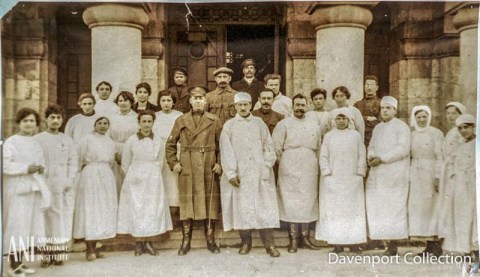
Dr. Walter P. Davenport with local Armenian medical staff.
The Davenport collection of photographs not only documents the humanitarian crisis unfolding in Armenia, but also the measurable difference American relief efforts made in the span of only a few months. The exhibit displays official and personal records related to Dr. Davenport’s activities in Armenia, which he subsequently reported in The Military Surgeon journal. With 103 photographs, 3 maps, 14 documents, and several newspaper articles, the exhibit pictorially reconstructs the conditions that U.S. military personnel witnessed in Armenia.
The digital version of the ANI exhibit is available on online and free to download from the ANI website where five other exhibits may be viewed. Designed for instructional purposes, the exhibits explain several aspects of the Armenian Genocide that were well documented photographically.
YMCA Features Armenian National Institute Exhibit on American Humanitarians During the First Republic of Armenia
WASHINGTON, DC – The YMCA welcomed the April release of the special digital exhibit issued by the Armenian National Institute (ANI) exploring the role of two exceptional individuals, who volunteered to stay in Armenia during the critical year of 1918 when fellow American relief workers were withdrawn in view of the intensification of warfare in the region.
The ANI exhibit profiles the two Americans, John Elder and James O. Arroll, sent to Armenia by the YMCA, and explains their numerous contributions towards relieving the humanitarian crisis in April and May 1918 when the armed forces of Ottoman Turkey invaded the country. Based on John Elder’s photographs and testimony, as well as additional material from the YMCA Archives, the exhibit pays tribute to the extraordinary efforts of these two men, whose achievements were widely recognized at the time.
Ryan Bean, Reference and Outreach Archivist at the YMCA Archives, who supported the project, remarked: “The Armenian National Institute has done a fantastic job telling this story. It is both tragic and heartbreaking on the one hand, and inspiring and humbling on the other. The timeliness of this exhibit is very appropriate, and I believe we could all learn a lesson from Elder and Arroll.”
In its April 24 posting on its Facebook page, where the exhibit could be viewed, the YMCA Archives extends “Congratulations to Dr. Rouben Adalian and the Armenian National Institute on the release of the digital exhibit ‘The Critical Role of the YMCA and American Relief in Armenia a Century Ago.’ This exhibit both illuminates a tragic humanitarian disaster as well as highlights the capacity of the human spirit to persevere and do good in the face of a seemingly hopeless situation.”
YMCA Europe, which encompasses 43 countries, also highlights the exhibit titled “American Relief in the First Republic of Armenia 1918-1920: John Elder and James Arroll in Yerevan, Gyumri, Sevan & Etchmiadzin,” on its website.
Vardan Hambardzumyan, who heads the YMCA in Armenia and presently serves as Executive Secretary of YMCA Europe, wrote that he was “absolutely grateful to ANI for disclosing so eloquently the story of the YMCA in the Republic of Armenia back in 1918.”
Elder and Arroll were in Armenia when the critical Battle of Sardarabad was waged in May 1918 securing the independence of the country. Working in Yerevan, Elder and Arroll focused on caring for orphans and refugees. Their contributions were recognized as critical under the circumstances, and their personal heroism, taking the risks that they did by remaining at their posts, was widely appreciated by Armenians. Celebrating their special role, a memorial postcard was issued in Yerevan featuring the two young Americans.
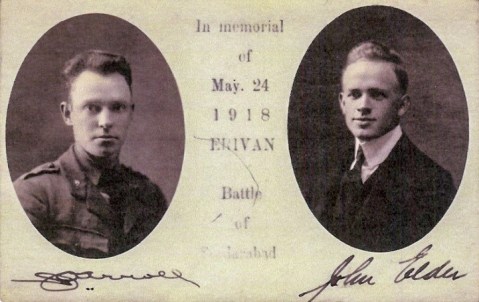
James O. Arroll (left) and John Elder (right)
John Elder recorded the hair-raising news from the battlefront in his journal, describing, blow by blow, the major developments of the day. On April 30, he wrote: “Discouraging news from Tillis. The British staff preparing to leave. We were advised to leave at once.” On May 16, he asked: “Has the end come at last? Official telegrams report that the Turks are bombarding Alexandropol [Gyumri]…The Turks have cut the railroad on both sides of Alexandropol, which means we are cut off from funds.” On May 21, he reported: “Alexandropol has fallen. The Turks demand the railroad to Julfa in order to transport their troops, and the Armenians are prepared to give it.” Two days later, on May 23, he gloomily wrote: “The storm clouds are rapidly approaching Igdir, only 25 miles away is reported in Turkish hands, so things look desperate.”
On May 26, he jotted down a different kind of news: “Well you never can tell what may happen. Just as the end seems at hand the pendulum swings the other way and the terrible Turk is in full retreat…After a two day battle at Sardarabad the Turks have been completely routed.”
With the establishment of peace, John Elder witnessed the momentous event of the restoration of government, which he appreciated for its historic importance, recording on August 11: “I had the thrill of attending the opening session of the Parliament of the Republic of Armenia. What an exciting time it was. A free and independent Armenia for the first time in 600 years or more! There was a great crowd present, and through an interpreter I gave an address of congratulations on the historic occasion.”

After more than a year of strenuous effort, described in detail in the exhibit, John Elder received a letter from John R. Mott, General Secretary of the International Committee of the YMCA in New York, applauding his outstanding record of service and expressing concern for his well-being. The letter begins with reference to Dr. Clarence D. Ussher “testifying to the very high value of the service which you have rendered in Armenia.” The story of Dr. Ussher was covered in a digital exhibit previously issued by ANI under the title “The First Refuge and the Last Defense: The Armenian Church, Etchmiadzin, and the Armenian Genocide.”
All of the digital exhibits posted on the ANI website are freely downloadable, and are provided to the public in high resolution to be readily printable anytime and anywhere from standard-size up to poster-size.
Founded in 1997, the Armenian National Institute (ANI) is a 501(c)(3) educational charity based in Washington, D.C., and is dedicated to the study, research, and affirmation of the Armenian Genocide.




 Florida Armenians