Blog Archives
Are We on the Right Side of History?

A gay activist waves a gay pride American flag outside the Supreme Court on March 26 | Reuters
By Michael Toumayan
FLArmenians Guest Contributor
In a landmark ruling for Gay, Lesbian, Bisexual and Transgender (LGBT) rights, the Supreme Court of the United States on Wednesday struck down the Defense of Marriage Act (DOMA), the 1996 law signed by then President Bill Clinton blocking federal recognition of same-sex marriages. In a separate case, the court ruled that it could not take up a challenge to Proposition 8, the California law that banned same-sex marriage in that state. That decision means that marriage equality will once again be legal in California.
This is a watershed moment in the fight for equality with the Supreme Court delivering justice to millions of Americans and to the thousands of LGBT Armenian-Americans who have been denied their rights under the U.S. Constitution.
Yet it is increasingly clear that we now have two Americas – one where our relationships are recognized and we are protected from discrimination in 13 States and the District of Columbia, and another that has yet to feel the effects of our progress and LGBT people remain second-class citizens, including in the State of Florida.
Sadly, we find many LGBT Armenian-Americans living under this same pretext for far too long – in an America that celebrates and protects who we are as Armenians and the other in our community centers and churches that marginalize and stigmatize LGBT Armenians for whom they love. No one should choose between who they are and whom they love.
I recognize that there are deeply held views on this issue and deeply fierce opposition by the Armenian Church hierarchy. But we cannot pretend to be a nation seeking restorative justice and recognition of our painful history and add the word “but” if we are truly genuine in our collective quest for justice for all.
This is a debate about equal rights under the law. It is about freedom from discrimination and stigmatization the way we were once discriminated and stigmatized as Christians in the Ottoman Empire. It is about the legal protections and responsibilities, and more than 1,100 rights, obligations and benefits afforded by the legal institution of marriage that, prior to the DOMA ruling, were denied to same-sex Armenian American couples. It is also about real people: your sons, daughters, brothers, sisters, and neighbors. And finally, it is about witnessing and reflecting the love and commitment between two people.
Given our 1,700 years of Christian heritage, I’d like to sum up the whole law in a single commandment, “You shall love your neighbor as yourself” Galatians 5:15.
For if truly we, as the Armenian nation, are on a quest to bend the arc of the moral universe towards justice for all, then surely we must stand on the right side of history by resisting all forms of bigotry and dedicating ourselves to the advancement of social justice and human dignity of both the living and the deceased.
And if truly we belong to the body of our Lord Jesus Christ through the One, Holy, Catholic (Universal) and Apostolic Church, then surely we are commanded to love, treat with respect and defend our LGBT Armenian sisters and brothers and any other marginalized groups both in the U.S. and in our beloved Hairenik (fatherland), no matter what your Biblical conviction is on homosexuality. This we know as absolute: Christ’s ministry was inclusive and he said that if we commit hate in our hearts we have committed murder – thus, we should take discrimination, hate-talk and the bullying of any marginalized group very seriously. If our tragic history hasn’t taught us anything, then I do not know what will. To learn more specifics on how the Supreme Court rulings on DOMA and Prop 8 might affect you, please visit www.hrc.org/SCOTUS.
Michael Toumayan is a program assistant at the Human Rights Campaign and an independent political commentator on the Caucasus and Middle East. A graduate of Florida Atlantic University in Boca Raton, Florida, he holds a master’s degree in conflict resolution and mediation from Tel Aviv University in Tel Aviv, Israel. He can be reached at michael.toumayan@hrc.org.
2013 Clergy Conference & Diocesan Assembly

BOCA RATON, FL – On April 29, St. David Armenian Church warmly welcomed 47 clergy to the 2013 Clergy Conference presided by His Eminence Archbishop Khajag Barsamian, Primate of the Eastern Diocese of the Armenia Church of America, at the Our Lady of Florida Spiritual Center in North Palm Beach, Florida. Situated on 26 beautiful acres of waterfront property on Little Lake Worth, it offered an ideal setting for spectacular sunrises, while the beautiful gardens of unusual natural beauty staged a contemplative and peaceful environment for meditation. The Conference began with a Dinner Cruise on the Intracoastal Waterway, and ended with dinner at St. David Church banquet hall on Wednesday, May 1st. A faithful friend and church neighbor, Fr. Mark Leondis, Pastor of St. Mark Greek Orthodox Church, was one of the guest speakers who stressed loving God and our neighbor is not only our dream and vision, but most importantly it is Our Lord’s commandment.
On Thursday, May 2nd, through Saturday, May 4th, the 111th Annual Diocesan Assembly was held at the Boca Marriott Hotel, where various programs were presented and discussed.
At a lavish banquet on Friday, May 3rd, awards were presented to Edward and Janet Mardigian for “Armenian of the Year,” and to former Florida Governor Jeb Bush as “Friend of the Armenians.”
On Saturday morning, a requiem service was held for His Beatitude Archbishop Torkom Manoogian, the late 96th Armenian Patriarch of Jerusalem, and long-serving former Primate of the Eastern Diocese.
The Assembly opened with a reading of the message of His Holiness Karekin II, the Supreme Patriarch and Catholicos of All Armenians. Fr. Nareg welcomed the representatives from various parishes of our Diocese. In his closing remarks, His Eminence Archbishop Khajag Barsamian thanked the Assembly officers and expressed his appreciation to Very Reverend Fr. Nareg Berberian, and to Carol Norigian and to St. David parish for their warm hospitality in making this Assembly a splendid and memorable occasion.
ST. DAVID ARMENIAN CHURCH HONORS DEPARTING PASTOR, VERY REVEREND FR. NAREG BERBERIAN
On Saturday evening, May 4th, Fr. Nareg was enthusiastically greeted by old and new friends in the Diocese, St. David community members, as well as Delegates and Clergy who attended the 111th Diocesan Assembly to express their warm sentiments and best wishes on his imminent assignment as Locum Tenens to Sao Paulo, Brazil. Having served eleven years as Pastor of St. David Armenian Church in Boca Raton, Florida, Fr. Nareg was honored with a very-well attended Farewell Reception at the Marriott Hotel where many successful events of the 2013 Diocesan Assembly took place.

His Eminence Archbishop Khajag Barsamian, Primate presided over the event and eloquently articulated Fr. Nareg’s many accomplishments in the service of Our Lord. Rev. Fr. Mardiros Chevian, Dean of St. Nersess Armenian Seminary spoke about the academic achievements of Fr. Nareg. His Eminence Archbishop Vicken Aykazian, the Ecumenical Director, spoke about his pastorate at St. David. The Parish Council Chair, R. Carol Norigian, who also chaired the Diocesan Assembly, spoke on behalf of St. David Church to express their appreciation for making this a vibrant community and for Hayr Soorp’s steadfast commitment and support in ensuring that our youth as well as our seasonal and year-round parishioners are engaged in the life of the church in meaningful ways. Fr. Nareg was very touched by this wonderful tribute and expressed his heartfelt gratitude for the beautiful Bishop’s Panagia, which will be presented to him at his last Badarak at St. David.
FIVE WOMEN HONORED AT THE ASSEMBLY
On Thursday, May 2, at the 4th Annual Woman of Wonder (WOW) Luncheon during the 27th Annual Women’s Guild Assembly, Carol Norigian, Claudette Sarian, Nina Stapan and Rose Kazanjian of St. David Armenian Church, and Naomi Davitian of St. Mary Armenian Church, were honored by the Women’s Guild Central Council for their many years of devoted service and dedication to the Women’s Guild and the Diocese of the Armenian Church of America. His Eminence Archbishop Khajag Barsamian presented special certificates to them for their many years of faithful service, and wishing that they continue their love for Christ and His church with the same zeal and dedication.

FAREWELL COFFEE HOUR SUNDAY JUNE 2
This Sunday, June 2nd, there will be a special farewell coffee hour following the Badarak in honor of Fr. Nareg. This is the perfect opportunity for you to express your best wishes to him before he leaves for Brazil. On behalf of St. David Armenian Church a special appreciation gift will be presented to him.
South Florida Armenian American Community Commemorates 98th Anniversary of the Armenian Genocide
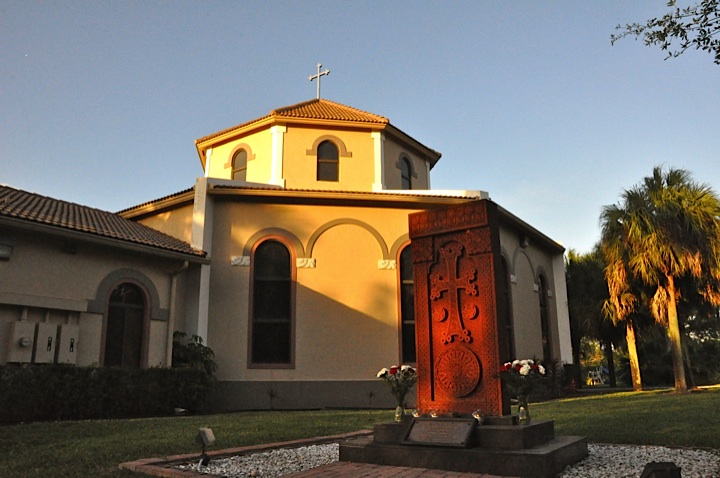
HOLLYWOOD, FL —On Wednesday April 24, several hundred members of the South Florida Armenian American Community gathered at St Mary Armenian Church to commemorate the 98th anniversary of the Armenian Genocide, reported Florida Armenians (FLArmenians).
The evening began with a hokehankist (memorial service), which was offered for the victims of the Armenian Genocide by the V. Rev. Fr. Nareg Berberian of St. David Armenian Church and Rev. Fr. Vartan Joulfayan of St. Mary Armenian Church.

After the service, a cross-cultural, multimedia program began delving into the history surrounding the Armenian genocide, as well as the emotions that are shared not only by the survivors and descendants of survivors, but also the survivors of many of the numerous other genocides of the 20th century.
(PHOTOS: 98th Anniversary Armenian Genocide Commemoration in South Florida)
Armenians worldwide commemorate the genocide on April 24 of each year, the day when, in 1915, Ottoman authorities arrested 250 Armenian intellectuals and community leaders in Constantinople. Soon after, the Ottoman military ripped Armenians from their homes and began a systematic extermination of Armenians which was implemented in two phases: the killing of the able-bodied male population through massacre and forced labor, and the deportation of women, children, the elderly and infirm on death marches to the Syrian Desert. The total number of Christian Armenians who perished as a result between 1915 and 1923 has been estimated at around 1.5 million. The Turkish government has yet to formally acknowledge that the genocide even occurred.
Mr. Raffy Yaghdjian, member of the St Mary Armenian Church parish council, served as master of ceremonies. In Yaghdjian’s opening words he stated, “We are gathered here today to remind ourselves that the struggle is not over. The world did not learn. There were many more genocides following ours. The Assyrians, the Greeks, the Jews, the Cambodians, Rwandans, and those in Darfur. So we continue with the struggle. We must continue to educate. We must continue to publicize. We must continue to publish books and write papers. We must continue to make the effort. We must continue to be creative in how we do it. After all, and I quote, ‘all that is necessary for the triumph of evil is for good men to do nothing.’”
(Also on FLArmenians: Armenian Billboards Put Touchy Topic on the Road)

As the program continued, Mr. Harry Pilafian, a survivor of the genocide who was in attendance, was recognized with standing applause. Lilit Mnatsakanyan and Tanya Lusararian read papers they had composed regarding their perspectives on the genocide, and Roubina Majarian of St David Armenian Church presented Armenian poetry. Guest speaker Professor Hannibal Travis of the Florida International University (FIU) College of Law addressed the audience about his ongoing study of the Armenian Genocide, particularly how it has been addressed by the United States. Professor Travis is the author of the first comprehensive history of physical and cultural genocide in the Middle East and North Africa, entitled Genocide in the Middle East: The Ottoman Empire, Iraq, and Sudan. A short screening from the documentary “Orphans of the Genocide” was also presented by south Florida film producer Bared Maronian. A musical interlude followed, with Alique Mazmanian performing “Karouna” by Komitas on piano, Mrs. Audrey Pilafian performing “Manoushak” and “Yeraz” on cello, Joseph Yenikomshian playing “Lord have mercy” on clarinet, and Sage McBride performing “Krounk” by Komitas, on violin.

(Also on FLArmenians: Florida State Senate Recognizes April 24 as Armenian Martyrs Remembrance Day)
Before the conclusion of the program, Mr. Yaghdjian unexpectedly once more approached the podium to excitedly say, “I was just given a note that the Florida State Senate just passed a resolution recognizing April 24 as Armenian Martyrs Remembrance Day for the first time in Florida history,” to a round of thunderous applause.
Fr. Joulfayan offered in closing, “Many thanks to you, dear South Floridians, families, youth, and children. But, in a way, I should not be thanking you. We do not thank each other on this day. Today, we simply come to remember and never forget.”
The South Florida Armenian Genocide Commemoration was held under the auspices of St. David Armenian Church of Boca Raton, St. Mary Armenian Church of Hollywood and Florida Armenians, together with the Armenian Assembly of America, the Armenian National Committee, and the Knights of Vartan.
###
PR# 2013-04
Photo Caption 1: St. Mary Armenian Apostolic Church of Hollywood, Florida.
Photo Caption 2: Florida Armenians joined by human rights and anti-genocide activists to commemorate the 98th anniversary of the Armenian Genocide and all genocides of the 20th Century.
Photo Caption 3: FIU Professor Hannibal Travis presents his studies on the Armenian Genocide.
Photo Caption 4: Armenian Genocide survivor Harry Pilafian recognized by South Florida Armenian American community.
Photos courtesy of Michele Kevorkian McBride for FLArmenians.com.




 Florida Armenians