Blog Archives
Dr. Susan Harper to Present ‘Genocide and American Humanitarianism: Lessons from World War I and Its Aftermath’ in Sarasota
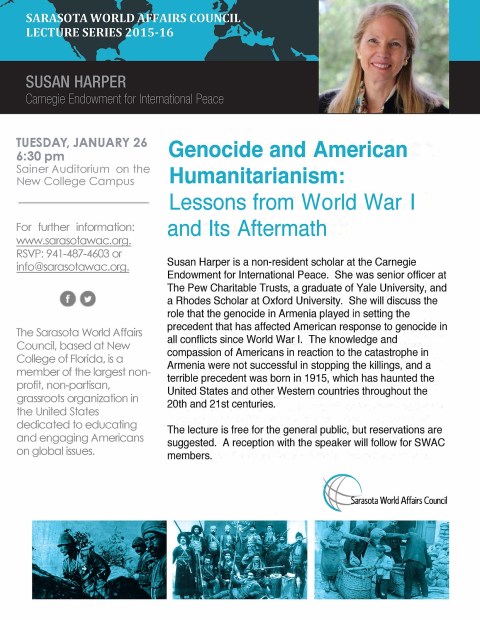
The Sarasota World Affairs Council (SWAC) will host Dr. Susan Harper for an informative presentation on the Armenian Genocide entitled ‘Genocide and American Humanitarianism: Lessons from World War I and Its Aftermath’ at New College of Florida, in Sarasota, FL. The event will take place on Tuesday, January 26 at 6:30 PM in the Sainer Auditorum.
Susan Harper is a non-resident scholar at the Carnegie Endowment for International Peace. She was Senior Officer at The Pew Charitable Trusts, a graduate of Yale University, and a Rhodes Scholar at Oxford University. She will discuss the role that the genocide in Armenia played in setting the precedent that has affected American response to genocide in all conflicts since World War I. The knowledge and compassion of Americans in reaction to the catastrophe in Armenia were not successful in stopping the killings, and a terrible precedent was born in 1915, which has haunted the United States and other Western countries throughout the 20th and 21st centuries.
Harper has researched and presented on the Armenian Genocide for almost two decades.
During the 19th Library of Congress Vardanants Day Armenian Lecture Series at the Library of Congress last year, Dr. Harper presented “American Humanitarianism in the Armenian Crucible, 1915-1923.”
During that presentation, Harper reported her findings about physician missionaries who as part of the overall Near East Relief effort traveled to Armenia and other countries to deliver medical aid in the aftermath of the Armenian Genocide. Harper’s presentation focused on the contributions of Dr. Mabel Elliott who tended to the medical needs of refugees in Armenia, Turkey and Greece, and who authored one of the compelling accounts of the era, “Beginning Again at Ararat.”
Held on May 7, 2015 the Vardanants Day lecture coincided with the opening day of events organized by the National Commemoration of the Armenian Genocide Centennial Committee and the Ecumenical Service held at the National Cathedral in Washington, D.C. later that evening.
In addition, Dr. Harper previously participated in the conference organized in September, 2000 by the Armenian National Institute and the Library of Congress where she presented a paper on the missionary Mary Louise Graffam who witnessed the Armenian Genocide. Her and other presenters’ papers were published by Cambridge University Press in “America and the Armenian Genocide of 1915,” under the editorship of Dr. Jay Winter.
The Sarasota World Affairs Council lecture with Dr. Susan Harper is free for the general public, but reservations are suggested. RSVP to 941-487-4603 or info@sarasotawac.org. A reception with the speaker will follow for SWAC members.
From Tallahassee to Yerevan: My First Trip to Armenia
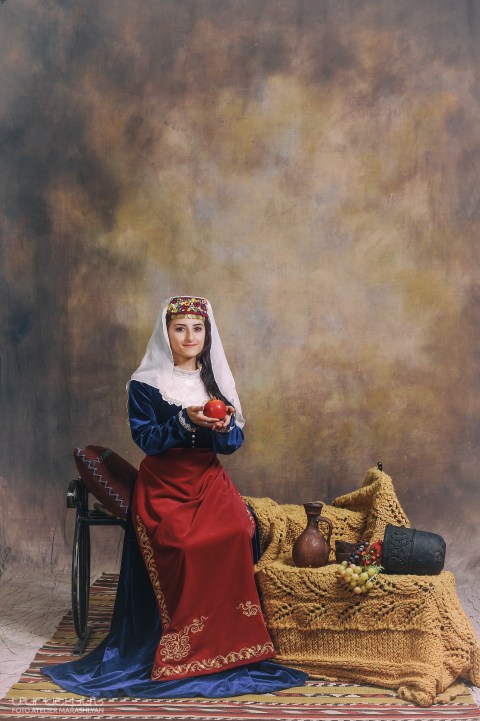
Margaret Atayants in traditional Armenian clothing. Photo credit: Photo Atelier Marashlyan.
By Margaret Atayants
FLArmenians Tallahassee Contributor
It took me a while to sit down and write out all of the feelings and thoughts that I had gathered after my first trip to Armenia. I am blessed to be an Armenian that was born and raised in America, a country that allows me to have everything right at arms reach. Growing up, my parents never really talked about Armenia because they were born and raised in Baku, Azerbaijan and the only thing that really connected them to Armenia was the blood that flowed within their veins. As I grew older, the more I began to feel what it meant to be Armenian. I started reading and learning more about my culture. I befriended Armenians who grew up in the homeland and other families who came from Western Armenia, descendants of survivors of the Armenian Genocide. I read more; I watched more; I listened more; but never in my life did I imagine to see what I saw when I arrived in Mother Armenia.
I had been planning my trip for three years, not really knowing how it would all play out. I imagined arriving at the airport, falling to my knees, crying and kissing the ground that my ancestors built. Instead, I arrived at the airport and a spirit that was greater than me took over and held me up stronger than I have ever felt in my life. It was an uplifting emotional experience. I retrieved my bags and as I approached the exit the sliding doors opened, and I smelled the heavy air. It filled my lungs and fed my soul.
The ride from the airport was long and confusing. I thought that I would be riding into a city straight from the airport but I was riding through a ghetto of homes that were left unbuilt from after the fall of the Soviet Union. It’s amazing how after 24 years of independence some parts still look like it happened yesterday. When you arrive to Armenia, you’re stepping into the past. It’s a land that hasn’t been touched by the hands of modern men. Granted there are modernized buildings standing in Yerevan, but I never felt the air change.
I was blessed to travel from the northern edges of Armenia in Alaverdi, down to the south where we rode over the mountains to Tatev Monastery. I had the privilege to smell and feel Lake Sevan. It was cold but delightful because I could hear the sounds of the Armenian duduk in the wind as it blew through my hair.

An Armenian villager in Garni.
I always knew that our people were hospitable and generous, kind with hearts and souls as wide as the ocean. But never did I imagine it to be so pure.
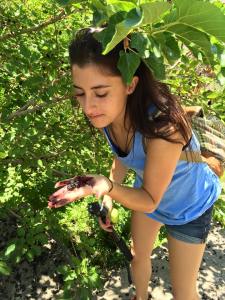
Margaret Atayants eating mulberries.
I will never forget the moment I was in Garni and we walked by a woman sitting down at her stand, selling homemade jam and molasses made from pomegranates; apricots that drip with juices that tasted as sweet as honey. As I bit into the apricot I looked up into the sky to thank God for these people who were filling the emptiness that has been in my soul for so long. As I looked away from the sky, my eyes slowly came down and stopped at the mulberry tree. As I child, I remember laying down a blanket and shaking the tree to collect the berries that I didn’t even understand at such a young age, why they tasted to good. Without thinking, I yelled out, “Tout!” (the Armenian word for mulberry), and the woman turned around and said to me, “Climb up my life, and pick the mulberries and eat them. This is my mulberry tree and I want to share with you.” So I did. I climbed up and as I was picking the berries off of the tree, they were melting into my hands, staining them black. Never in my life had I tasted something so delicious, something so sweet, something so full of life. I had my camera in one hand and the mulberries in the other as I was climbing back down the stairs from the tree. I didn’t know what to do with my dirty hand and this is the moment that I would never forget. The woman who’s tree I was eating from, saw that I was struggling, and told me to wait. She ran into her home to get a cup of water to wash my hands. Then a stranger grabbed my hand and washed it so gently that no matter how deep the stain it would be clean because this is what this woman had wished.
A stranger? They were no strangers. They are my family.
If Mother Armenia is calling you, go. Do not question her calls. She will pave the ground that you walk on. She will show you beauty that you cannot paint or write. She will pull your soul out of your body and with her majestic beauty and land show you what your own soul looks like. The whole country is filled with music and art, love and kindness, purity and faith, joy and sorrow. Go and understand why you love the way you love, why you cry the way you cry, why you care the way you care and why you breath the way you breath. Armenia changed my life like nothing else in this world ever had. Many people are poor; some people have nothing; some people are hungry; some people are waiting and praying, but they are the happiest to see you and love you and offer you all that they have.

Margaret Atayants looking towards Mount Ararat.
Today, when I listen to the duduk, images flash of the family I never knew I had in Armenia. Wait for me, my brothers and sisters. I will be back very soon to give you all that I have and more. Armenia, you have changed me and I will forever fall to my knees and love you.
Armenian Americans Congratulate New House Speaker Paul Ryan

Congressman Paul Ryan (R-WI) Speaking at the Armenian Assembly of America 2009 National Advocacy Conference and Banquet in Washington, D.C. (Photograph courtesy of Armenian Assembly of America)
By Taniel Koushakjian
FLArmenians Managing Editor
Yesterday, Representative Paul D. Ryan (R-WI) was elected the 54th Speaker of the U.S. House of Representatives. The Armenian Assembly of America (Assembly) and Florida Armenians congratulate Speaker Ryan on his new leadership role and look forward to working with him in the months and years to come.
“I am very pleased with what this means for Republican leadership in Washington,” stated Florida Armenians Miami Chair Harout Samra. “Paul Ryan’s elevation to Speaker of the House is a welcome event and turns the page on some of the key challenges the Republican caucus in the House has faced over the last several years. At least in the short term, we should expect a more unified and ideas-driven caucus. Florida Armenians congratulate Speaker Ryan and we look forward to working with him and his leadership team to address issues of mutual concern,” Samra said.
Ryan began his political career as a congressional intern after college, went on to work as an aide for then-U.S. Senator Sam Brownback (R-KS), and later as a speech writer for 1996 Republican Vice Presidential nominee Jack Kemp. In 1998, Ryan was elected to his first term in the U.S. House of Representatives. Ryan, known as a policy and budget wonk, has ascended through the House Republican leadership, assuming the Chairmanship of the Budget Committee in 2011, and most recently as the Chairman of the powerful House Ways & Means Committee. Ryan received national attention when he was tapped by Governor Mitt Romney to be the Republican Vice Presidential nominee in 2012.
Speaker Ryan has a strong record in support of Armenia, Armenian American issues including genocide affirmation, and the safety and security of the people of Nagorno Karabakh. Paul Ryan represents the 1st district of Wisconsin, which is home to St. Mesrob Armenian Apostolic Church, in Racine.
During his first term in the House, Ryan was a cosponsor of H.Res.398, the Armenian Genocide resolution in the 106th Congress, and cosponsored subsequent Armenian Genocide reaffirmation resolutions, namely: H.Res.316 in the 109th Congress, H.Res.106 in the 110th Congress, H.Res.252 in the 111th Congress, and H.Res.304 in the 112th Congress. In addition to cosponsoring these resolutions, he signed five letters to President George W. Bush urging him to acknowledge the Armenian Genocide in 2001, 2002, 2004, 2005, and 2006.
“By properly recognizing the atrocities committed against the Armenian people as ‘genocide’ in your statement, you will honor the many Americans who helped launch our first international human rights campaign to end the carnage and protect the survivors. The official U.S. response mirrored the overwhelming reaction by the American public to this crime against humanity, and as such, constitutes a proud, irrefutable and groundbreaking chapter in U.S. diplomatic history,” reads the 2004 letter to President Bush signed by Ryan.

Rev. Fr. Hovsep Karapetyan, Rep. Paul Ryan (R-WI), Taniel Koushakjian on Capitol Hill, March 3, 2009.
Having joined the Congressional Caucus on Armenian Issues in 2003, Ryan’s support of human rights issues extended beyond Armenia. That same year, Ryan cosponsored H.Res.193 in the 108th Congress, which stated U.S. policy “Reaffirming support of the Convention on the Prevention and Punishment of the Crime of Genocide and anticipating the 15th anniversary of the enactment of the Genocide Convention Implementation Act of 1987 (the Proxmire Act) on November 4, 2003.”
Speaker Ryan was also a proponent of a stronger U.S.-Armenia relationship and increased bilateral trade and investment. He cosponsored H.Res.528 in the 108th Congress, “To authorize the extension of nondiscriminatory treatment (normal trade relations treatment) to the products of Armenia,” which extended U.S. Permanent Normal Trade Relations (PNTR) to Armenia.
Following the assassination of Turkish-Armenian journalist Hrant Dink, Ryan cosponsored the Assembly-backed H.Res.102 in the 110th Congress, “Condemning the assassination of human rights advocate and outspoken defender of freedom of the press, Turkish-Armenian journalist Hrant Dink on January 19, 2007.”
Speaker Ryan also signed a letter to Secretary of State Condoleezza Rice on February 15, 2008 urging the U.S. “to hold the government of Azerbaijan accountable for recent vitriolic comments made by Azeri President Ilham Aliyev in regard to the conflict over Nagorno-Karabakh,” and to “condemn these comments that go directly against the United State stated policy in the South Caucus region.”
Given his years of work with the Armenian Assembly of America, and decade-long record in support of Armenian American issues, Ryan agreed to serve as the co-master of ceremonies of the Assembly’s 2009 National Advocacy Conference & Banquet in Washington, D.C.
“At a time when Azerbaijan continues to violate international law, and Turkey’s international campaign of genocide denial continues, we look forward to the opportunity to work with the incoming Speaker to address these and other critically important issues,” stated Armenian Assembly Executive Director Bryan Ardouny.