Blog Archives
Congressional Letter Calls for Removal of Snipers, Additional Observers, Investigative Mechanisms Along Karabakh-Azerbaijan Border
By Taniel Koushakjian
Florida Armenians Managing Editor
House Foreign Affairs Committee Chairman Ed Royce (R-CA) and Ranking Member Eliot Engel (D-NY) are circulating a bipartisan letter asking their Congressional colleagues to support renewed U.S. leadership in the South Caucasus.
The two senior legislators are currently collecting signatures on a letter addressed to Ambassador James Warlick, U.S. representative to the OSCE’s Minsk Group which is responsible for mediating a resolution of the conflict over Nagorno Karabakh. The Royce-Engel letter specifically calls for the U.S. and OSCE to abandon the failed policy of false parity in responding to acts of aggression, noting that: “The longstanding U.S. and OSCE practice of responding to each new attack with generic calls upon all parties to refrain from violence has failed to de-escalate the situation. Instead, this policy of artificial evenhandedness has dangerously increased tensions. There will be no peace absent responsibility.”
The legislators propose three concrete steps that would, “in the short-term, save lives and help to avert war. Over the longer term,” the letter says, “these steps could contribute to a comprehensive and enduring peace for all the citizens of the region:”
Specifically, the Royce-Engel letter calls for:
- An agreement from all sides not to deploy snipers along the line of contact;
- The placement of OSCE-monitored, advanced gunfire-locator systems and sound-ranging equipment to determine the source of attacks along the line of contact; and
- The deployment of additional OSCE observers along the line of contact to better monitor cease-fire violations.
According to sources familiar with the negotiations, the governments of Armenia and Nagorno Karabakh have both pledged their support for these confidence-building measures, while Azerbaijan has repeatedly opposed them.
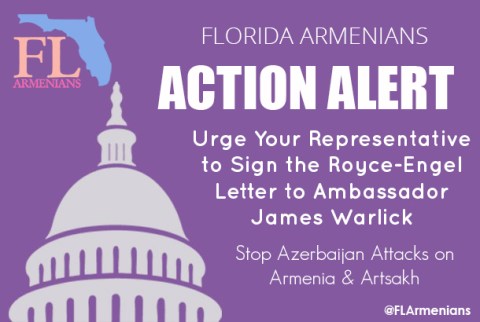
Click on the image to send an email to your Representative urging them to sign the Royce-Engel letter.
TAKE ACTION NOW
Thirty-five members of Congress have signed the Royce-Engel letter to Ambassador Warlick, including Armenian Caucus Vice-Chair Rep. Gus Bilirakis (R-FL). In addition to the House Foreign Affairs Committee leadership, House Permanent Select Committee on Intelligence Chairman Rep. Devin Nunes (R-CA) and Ranking Member Adam Schiff (D-CA) are also supportive.
In fact, Congressman Schiff wrote a separate letter to Ambassador Warlick last week warning that “unwillingness to speak plainly about the aggressor in this conflict sends the message to Azerbaijan that it can act with impunity.” “I do not believe the cause of peace is served by ignoring Azerbaijan’s increasing belligerence and the suggestion that both parties are equally to blame for violence along the Line of Contact when that is not the case,” Schiff’s letter states.
TEXT OF THE ROYCE-ENGEL LETTER TO AMBASSADOR WARLICK:
The Honorable James Warlick
U.S. Co-Chair
OSCE Minsk Group
Dear Ambassador Warlick:
We are writing out of concern over the escalation of violence in Nagorno-Karabakh, resulting in deaths on both sides of the conflict. It is our hope that the United States, through its role in the Organization for Security and Cooperation in Europe’s (OSCE) Minsk Group, as well as through direct diplomacy with both Armenia and Azerbaijan, will immediately advocate for several steps to promote peace in the region.
We believe that securing the full and public support of Azerbaijan, Armenia, and Nagorno-Karabakh for the following steps would, in the short-term, save lives and help to avert war. Over the longer term, these steps could contribute to a comprehensive and enduring peace for all the citizens of the region.
- An agreement from all sides not to deploy snipers along the line of contact.
- The placement of OSCE-monitored, advanced gunfire-locator systems and sound-ranging equipment to determine the source of attacks along the line of contact.
- The deployment of additional OSCE observers along the line of contact to better monitor cease-fire violations.
We also urge you to publicly condemn specific acts of aggression along the line of contact. The longstanding U.S. and OSCE practice of responding to each new attack with generic calls upon all parties to refrain from violence has failed to de-escalate the situation. Instead, this policy of artificial evenhandedness has dangerously increased tensions. There will be no peace absent responsibility.
Thank you for your consideration of these recommendations. We continue to support your efforts to reach a durable and just resolution to this conflict and look forward to your response.
Sincerely,
Ed Royce (R-CA); Eliot Engel (D-NY); Gus Bilirakis (R-FL); Madeleine Z. Bordallo (D-GU0); Dave Brat (R-VA); Tony Cárdenas (D-CA); Judy Chu (D-CA); David N. Cicilline (D-RI); Katherine Clark (D-MA); Jim Costa (D-CA); Jeff Denham (R-CA); Robert J. Dold (R-IL); Anna G. Eshoo (D-CA); Scott Garrett (R-NJ); Richard L. Hanna (R-NY); Joe Heck (R-NV); Jim Langevin (D-RI); Dan Lipinski (D-IL); Zoe Lofgren (D-CA); James P. McGovern (D-MA); Grace Napolitano (D-CA); Devin Nunes (R-CA); Frank Pallone (D-NJ); Mike Quigley (D-IL); Dana Rohrabacher (R-CA); Peter Roskam (R-IL); Linda T. Sanchez (D-CA); Loretta Sanchez (D-CA); John P. Sarbanes (D-MD); Adam Schiff (D-CA); Brad Sherman (D-CA); Jackie Speier (D-CA); Dina Titus (D-NV); Dave Trott (R-MI); David G. Valado (R-CA); Chris Van Hollen (D-MD); Peter Welch (D-VT)
How John Boehner Checked Two Opposing Lobby Groups, and the Tea Party, With One Bill

Speaker John Boehner (R-OH) / AP Photo
By Taniel Koushakjian
FLArmenians Editor
As is routine in Armenian American politics, an Armenian Genocide resolution was introduced in the US House of Representatives at the beginning of the 114th Congress. Once again leading the charge are Reps. Robert Dold (R-IL), Adam Schiff (D-CA), David Valadao (R-CA), and Frank Pallone, Jr. (D-NJ). Together, they introduced H. Res. 154, aka the Armenian Genocide Truth and Justice Resolution, on March 18, 2015. This bill differs significantly from the bipartisan Armenian Genocide recognition resolution which passed committee in 2000, 2005, 2007, and 2010. As of this writing, H. Res. 154 boasts 62 cosponsors and has been referred to the House Foreign Affairs Committee.
Given the significance of 2015, the Turkish government ramped up its denial campaign in the United States and sought to introduce an opposing bill in Congress. In the weeks after the introduction of H. Res. 154, Rep. Curt Clawson (R-FL) circulated a letter to his House colleagues asking them to support a different resolution. Clawson’s bill, which planned to use language proposed by the newly-formed Turkish Institute for Progress (TIP), would use text from H. Res. 154, strike reference to the Armenian Genocide, and create a 100-year congressional task force aimed at bringing the Turkish and Armenian people together. “Unite us, not divide us,” a reference to the full-page advertisements that ran in The Washington Post and POLITICO, is political speak for Turkey’s latest genocide denial lobbying campaign.
Then, on April 28, 2015, H. Res. 226, a resolution calling on the President “to work toward equitable, constructive, stable, and durable Armenian-Turkish relations,” was introduced by Pete Sessions (R-TX). Sessions’ bill not only omitted reference to the Armenian Genocide, it also left out the Turkish proposal for a joint taskforce. Pete Sessions is the Chairman of the House Rules Committee, which is commonly referred to as the “Speaker’s Committee.” H. Res. 226 currently has 2 cosponsors.
Clawson has yet to introduce his Turkish denial resolution.
For House Republican leadership this scenario played right into their hands. John Boehner has voiced his objection to a congressional resolution acknowledging the Armenian Genocide on more than one occasion and Rep. Clawson was one of 25 congressmen to vote against Boehner for the Speakership. What Speaker John Boehner has effectively done is introduce a bill, stripping the specific language for which each opposing lobby group was advocating, rendering the issue legislatively moot, and check his Tea Party foes in the process.
Campaign 2012: A Look Through the Armenian-American Lens
Campaign 2012: A Look Through the Armenian-American Lens
By Taniel Koushakjian
FLArmenians Political Contributor
We are now less than a year away from the 2012 elections and the campaign trail is already heating up. The race for the white house has catapulted various GOP candidates to the top of the mountain, only to see them tumble from its peak. So far we have seen some historic debate gaffes, incredibly bold policy proposals and unorthodox candidates try to distinguish themselves from each other, all in an effort to be the anti-Romney; the presumptive GOP nominee. But this election season is going to be unlike any other. Fresh campaign tactics, new technologies, redistricting and the latest player in the political arena, the SuperPAC, are all poised to dramatically change the way Americans vote in 2012. And these factors will impact not only the presidential race. What we see in the presidential contest will be evident in congressional races as well.
So what does this all mean for the Armenian-American community? Let’s take a look.
In congressional elections, for decades Armenian-Americans have been active in raising Armenian issues and concerns, upon which politicians compete for our vote. In recent years, the small but growing Turkish-American community has followed suit. From its peak in the 110th Congress, the Congressional Armenian Caucus boasted over 160 Members of Congress. Today it stands at 135 Members strong. At the same time, the Congressional Turkish Caucus grew its ranks from just over 60 in 2006, to 126 Members today, a 200 percent growth rate.
So far this year, 17 House Democrats and 9 House Republicans have announced their retirement or will not be seeking re-election in their present seat. The number of outright retirements can be attributed in large part to the redistricting process, a once a decade phenomenon. The announced retirement of Rep. Barney Frank (D-MA), a strong leader on Armenian issues, is a prime example. Additional retirement announcements can be expected in the coming weeks.
As of this writing, the Armenian Caucus is set to lose 9 Members: Representatives Lynn Woolsey (D-CA), Dennis Cardoza (D-CA), Jerry Costello (D-IL), John Olver (D-MA), Barney Frank (D-MA) and Dale Kildee (D-MI) have all announced retirement. Congressman Kildee’s nephew, Dan Kildee, is a candidate for his uncle’s seat. In addition, three Armenian Caucus Members are running for other office: Rep. Bob Filner (D-CA) is running for mayor of San Diego, Rep. Chris Murphy (D-CT) is running to replace Joe Lieberman (I-CT) in the Senate and Rep. Shelly Berkeley (D-NV) is also running for the Senate. As of this writing, the Congressional Turkish Caucus is set to lose 7 Members: Reps. Mike Ross (D-AR), Dan Boren (D-OK) and Geoff Davis (R-KY) are retiring outright, while Reps. Connie Mack (R-FL), Denny Rehberg (R-MT) and Jeff Flake (R-AZ) are running for the Senate. Rep. Mike Pence (R-IN) is running for Governor. Mack, Flake and Pence all sit on the House Foreign Affairs Committee where they voted against the Armenian Genocide resolution in 2007 and 2010.
Redistricting has resulted in some of the above retirements, but it is also putting pro-Armenian incumbents in head-to-head battles and making re-election much more difficult for others. Looking at congressional champions of Armenian issues, Armenian Caucus Co-Chair Frank Pallone, Jr. (D-NJ) and Armenian Genocide resolution sponsor Adam Schiff (D-CA) have not been adversely affected by redistricting. However, Armenian Caucus Co-Chair Ed Royce (R-CA) and Armenian Genocide resolution sponsor Robert Dold (R-IL) are not as fortunate. Redistricting has made Dold’s seat bluer, and given his narrow victory in 2010, he is a top target for Democrats in 2012. Congressman Ed Royce has also been victimized by redistricting, putting him in a dual-incumbent battle with Armenian Caucus Rep. Gary Miller (R-CA). In New Jersey, reports indicate that Armenian Caucus Member Steven Rothman (D-NJ) has decided to challenge his colleague, fellow Armenian Caucus member Bill Pascrell (D-NJ) in the redrawn 9th Congressional district, setting up a costly dual-incumbent primary.
 The most prominent tete-a-tete battle to result from redistricting has put two pro-Armenian (and pro-Israel) incumbents in the same district: House Foreign Affairs Committee Ranking Member Howard Berman (D-CA) and House Foreign Affairs member Brad Sherman (D-CA), both champions on Armenian issues. Rep. Sherman has a decades-long record on Armenian issues, particularly the Armenian Genocide. Congressman Berman has a similarly strong record and as Chairman of the Foreign Affairs Committee in 2010, ensured the successful passage of H. Res. 252, the Armenian Genocide resolution. Berman is the favorite in the race, having ratcheted up over 30 endorsements, and enjoys the backing of three SuperPACs. A product of the 2010 Citizens United vs. FEC Supreme Court ruling, SuperPACs are independent expenditure only committee’s that can raise and spend unlimited amounts of money.
In addition to working with our friends in Congress, electing Armenian-Americans is long overdue. This year we saw a new face emerge, Oregon Labor Commissioner Brad Avakian who sought the Democratic nomination for the 1st Congressional district. Although unsuccessful, he was able to garner 22% of the vote in the primary, no small feat. As of this writing, only one Armenian-American has officially filed papers to run for Congress, while another is preparing to jump in: David Krikorian and Danny Tarkanian, respectively.
David Krikorian is no stranger to Armenians, having unsuccessfully challenged Rep. Jean Schmidt (R-OH) in 2008 and 2010. Schmidt, the top recipient of Turkish PAC money, filed a complaint against Krikorian with the Ohio Elections Commission (OEC) after Krikorian accused her of taking Turkish “blood money” on campaign advertisements in the 2010 race. The OEC ruled in Schmidt’s favor. However, following the election, the House Ethics Committee began an investigation into the free legal services provided to Rep. Schmidt by the Turkish American Legal Defense Fund and the Turkish Coalition of American. Although the House Ethics Committee found no wrong doing on Schmidt’s part, she was ordered to repay the $500,000 legal bill and amend her financial forms to reflect this in-kind contribution. According to a December report in Roll Call, Schmidt “has yet to amend her financial disclosures or begin repaying the debt.”
Danny Tarkanian, the son of former University of Las Vegas basketball coach Jerry Tarkanian, is preparing to run in the new 4th district of Nevada. According to a December poll by the conservative Pubic Opinion Strategies, Tarkanian overwhelmingly leads his primary challenger (73% to 9%) and when matched up with the Democratic front-runner, he holds an 11-point advantage. Tarkanian has not officially filed and has stated that he will announce his intentions in January.
Turning to the presidential race, we have President Obama, whose record on Armenian issues is not unfamiliar. Obama deserves acknowledgement for his audacity to speak about the Armenian Genocide inside the Turkish Parliament, something no U.S President has ever dared, and for overseeing the signing of historic Protocols by Turkey and Armenia. However, his broken promise of employing the proper term, Armenian Genocide, in the annual April 24 statement, as well his policies toward Azerbaijan, from disproportionate military funding to Ambassador Bryza’s recess appointment, leaves many Armenian-Americans skeptical.
Looking at the GOP field today, we have two front-runners: Mitt Romney and Newt Gingrich. Neither can be viewed as favorable through the Armenian-American lens. During President Bill Clinton’s second term, then-Speaker Gingrich built a leadership team that consisted of Dick Armey, Robert Livingston, and Dennis Hastert; all of who went on to lobby on behalf of Turkey against U.S. reaffirmation of the Armenian Genocide. Turning to Mitt Romney, it was positive to see pro-Armenian officials, such as former Senator Robert Dole (R-KS), Senator Mark Kirk (R-IL) and former Congresswoman Susan Molinari (R-NY), endorse Romney for the GOP nomination. However, from a legislative standpoint, it is cause for concern that Senator Roy Blunt (R-MO) is his Congressional liaison. In 2007, Blunt, then-House Republic Whip, was appointed by President Bush to the Foreign Affairs Committee the day before a vote on the Armenian Genocide resolution, in order to whip his Republican colleagues to vote against the bill. Recently, Senator Blunt won a top post, securing his position within the Republican Senate leadership, and is working to rake up Congressional support for Romney.
It’s definitely too early to say what is going to happen between now and November 6, especially in the race to the White House. While the focus is on the Republican primaries, Democrats are activating their grassroots in what is likely to become one of the nastiest and most expensive campaign seasons ever. In politics, anything is possible and there is certainly a long road ahead. In the meantime, it is critical that Armenian-Americans know where our elected officials stand, with whom they are associated, and their record in support or opposition to Armenian issues.
Taniel Koushakjian is an independent political commentator for Florida Armenians. He received his bachelor’s degree in political science from Florida Atlantic University in Boca Raton, Florida, and is currently enrolled at the George Washington University Graduate School of Political Management in Washington, D.C.
This article originally appeared in Massis Post.
*Correction: An earlier version mistakenly referenced Dan Kildee as his uncle, current Rep. Dale Kildee and misattributed Ranking Member Howard Berman’s 30 endorsements to his challenger Rep. Brad Sherman.
Updated January 9 at 6:00 pm.




 Florida Armenians
