Gulf Coast Armenian American Community Announces Armenian Genocide Centennial Commemorations
PINELLAS PARK, FL – On Friday, April 24, 2015, Gulf Coast Armenians centered in Tampa/St. Petersburg will join Armenians around the world in solemnly commemorating the Armenian Genocide.
Beginning in 1915, the Ottoman Turkish government launched a premeditated campaign of genocide against their Armenian citizens. Approximately 1.5 million Armenians—75% of the Armenian population of the Ottoman Empire—were killed. This was the first modern example of genocide in the 20th century. Indeed, the very word genocide (denoting the destruction of an entire people) was originally coined in 1944 to describe the policy of systematic extermination used by the Young Turks regime against the Armenian people, and that the Nazis subsequently waged on European Jews.
This year marks the 100th anniversary of this dark chapter in world history and a series of specially orchestrated events are taking place around the world. On the Gulf Coast of Florida Armenian Americans have planed a diverse program of religious, academic, and physical activities to commemorate the lives of those lost a century ago. Below is the listing of events in the Tampa/St. Petersburg area on and around April 24th:
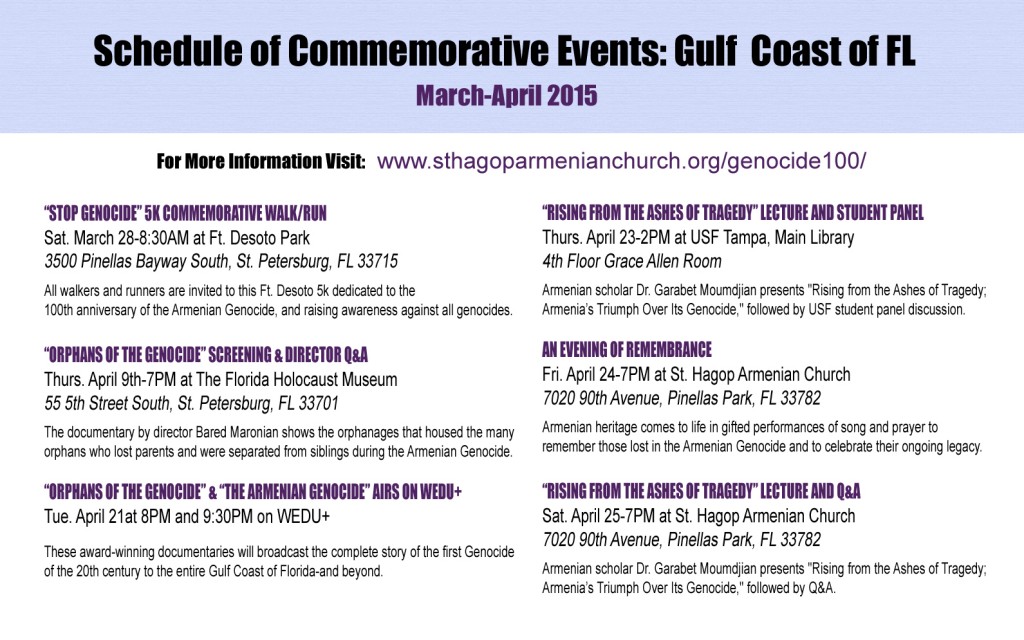
“Stop Genocide” 5K Commemorative Walk/Run
Saturday, March 28, 2015 at 8:30AM
Ft. Desoto Park
3500 Pinellas Bayway South, St. Petersburg, FL 33715
All walkers and runners are invited to participate in Tampa’s first-ever 5K dedicated to the Armenian Genocide and towards raising awareness about all genocides. Interested participants can register on Active.com. Guests can also connect with other runners on the Stop Genocide 5K Facebook event page.
Orphans of the Genocide Screening & Director Q&A
Thursday, April 9, 2015 at 7:00PM
The Florida Holocaust Museum
55 5th Street South, St. Petersburg, FL 33701
Hear from South Florida film director Bared Maronian as he presents his documentary on the orphanages that housed the many orphans who lost parents and were separated from siblings during the Armenian Genocide.
Orphans of the Genocide & The Armenian Genocide Airing on WEDU+
Tuesday, April 21, 2015 at 8:00PM, and 9:30PM on WEDU+
Orphans of the Genocide is a documentary by South Florida film director Bared Maronian showing the orphanages that housed thousands of orphans who lost their parents and were separated from siblings during the Armenian Genocide. Film starts at 8:00 PM (90 minutes).
The Armenian Genocide is the complete story of the first Genocide of the 20th century. It features interviews with Pulitzer Prize-winning author Samantha Power, and best-selling author Peter Balakian, and contains historical footage of the events.
Narrated by Julianna Margulies, it also includes narrations by Ed Harris, Natalie Portman and Laura Linney, among others. Film starts at 9:30PM (60 minutes).
“Rising from the Ashes of Tragedy” Lecture and Student Panel Discussion
Thursday, April 23, 2015 at 2:00PM
University of South Florida (USF)
Tampa, Main Library
4th Floor Grace Allen Room
The USF Libraries Holocaust and Genocide Studies Center host Armenian scholar Dr. Garabet Moumdjian for a presentation entitled “Rising from the Ashes of Tragedy – Armenia’s Triumph Over Its Genocide.” A panel discussion by USF students will follow the presentation.
FEATURED EVENT: An Evening of Remembrance
Friday, April 24, 2015 at 7:00PM
St. Hagop Armenian Church
7020 90th Avenue, Pinellas Park, FL 33782
Armenian heritage comes to life in gifted performances of song and prayer to remember those lost in the Armenian Genocide and to celebrate their ongoing legacy.
“Rising from the Ashes of Tragedy” Lecture and Q&A
Saturday, April 25, 2015 at 7:00PM
St. Hagop Armenian Church
7020 90th Avenue, Pinellas Park, FL 33782
Armenian scholar Dr. Garabet Moumdjian presents “Rising from the Ashes of Tragedy – Armenia’s Triumph Over Its Genocide,” followed by Q&A.
For a full listing of Armenian Genocide 100th anniversary commemorative events in Florida, please visit our Florida Armenians 2015 Page.
Florida Armenians Urge Members of Congress to Sign the Letter to President Obama
Contact Congress Today!
Florida Armenians calls on all Floridians to contact their Representative and urge them to sign the Congressional letter to President Obama calling on him to properly recognize the Armenian Genocide.
Armenian Caucus Co-Chairs Rep. Robert Dold (R-IL) and Rep. Frank Pallone, Jr. (D-NJ) are spearheading the letter. They have already circulated it for signature, so your Congressman has received the request to sign. But it is up to us as constituents to ensure that they do. So please take a moment and send a pre-written letter to your Member of Congress today.
On this, the 100th anniversary of the Armenian Genocide, Congress and the President can play an important role in genocide prevention by reaffirming the Armenian Genocide and America’s proud record.
Click here or on the image below to send a quick email to your Representative.

Armenian Assembly Announces Sponsors for Annual Members Meeting in Florida
Annual Members Meeting Will Take Place in Boca Raton, March 13-14, 2015
WASHINGTON, DC – The Armenian Assembly of America (Assembly) is pleased to announce the sponsors of this year’s annual members meeting in Boca Raton, Florida. Current Gold sponsors include: Hirair and Anna Hovnanian Foundation, Edele Hovnanian, Harry and Edna Keleshian, Carolyn Mugar, Lu Ann and Bruce Ohanian, Gail and Richard O’Reilly, George Pagoumian, Toros Sahakian, Joyce Stein, and Peter and Irene Vosbikian. Michael and Marie Haratunian, and Virginia Ohanian are Silver sponsors. George M. Jamgochian, James Kalustian, Oscar Tatosian, and Thomas G. Varbedian, M.D. are Bronze sponsors. Sponsorship opportunities are still available and will be displayed throughout the weekend.
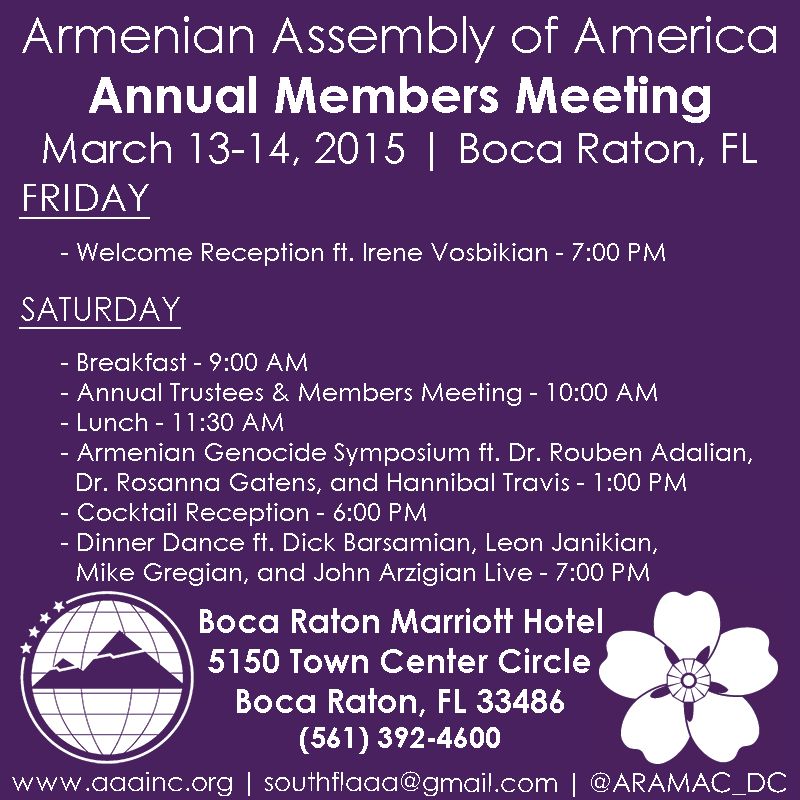
The Assembly’s annual members weekend will kick-off with a complimentary welcome reception on Friday, March 13 at 7:00 PM with select hors d’oeuvres and open bar. Author Irene Vosbikian will present her new book BEDROS at the welcome reception and sign copies that will be available for purchase with all proceeds benefiting the Assembly. On Saturday, March 14, guests are invited to a complimentary continental breakfast at 9:00 AM, with the annual trustees and members meeting starting at 10:00 AM. Lunch will be available from 11:30 AM to 12:30 PM for $35.00. The Assembly’s Armenian Genocide Symposium featuring Dr. Rouben Adalian, Dr. Rosanna Gatens, and Hannibal Travis, will take place from 1:00 PM to 3:00 PM. The symposium is free and open to the public. On Saturday night, guests are invited to a cocktail reception at 6:00 PM, followed by a dinner dance with live music at 7:00 PM. Tickets to the Saturday cocktail reception and dinner dance are available for $100 per person.
“This year’s annual members weekend in Florida is gearing up to be an exciting series of events for the Assembly,” stated Assembly Board Member Lu Ann Ohanian. “We’d like to thank our current sponsors for their generous support and also encourage others to join us as an official sponsor,” Ohanian said.
Individuals can sponsor the Assembly’s Annual Members Meeting at Gold ($2,500), Silver ($1,250), and Bronze ($750) levels. Bronze sponsors will receive access to the welcome reception, breakfast, symposium and two tickets to the Saturday dinner dance. Silver sponsors will receive access to all events for two people. Gold sponsors will receive access to all events for four people.

All events of the Assembly’s annual members weekend will be held at the Marriott Hotel at Boca Town Center, 5150 Town Center Circle, Boca Raton, FL 33486. Guests that are traveling from out of town should call (561) 392-4600 to reserve a room at the Armenian Assembly’s reduced rate of $169.00 per night. To register for the annual members weekend please contact Assembly South Florida Regional Council Chair Carol Norigian at southflaaa@gmail.com. Online registration for the Armenian Genocide Symposium is available here.
Established in 1972, the Armenian Assembly of America is the largest Washington-based nationwide organization promoting public understanding and awareness of Armenian issues. The Assembly is a non-partisan, 501(c)(3) tax-exempt membership organization.




 Florida Armenians