
Jack Latvala Announces Bid for Florida Governor

Senator Jack Latvala announces his campaign for Governor of Florida in Clearwater, FL.
By Taniel Koushakjian
Florida Armenians Editor
On a bright and sunny August day at the Clearwater Marine Aquarium, State Senator Jack Latvala (R-Pinellas) made a highly anticipated announcement; he if officially running for Governor of Florida.
Surrounded by family, friends, and supporters, Senator Latvala made his campaign official, and told a riled up crowd why he says he is the best candidate.
“I will be the candidate who tells it to you straight. Who, when he gives you his word, will keep my word,” he said. “Anyone who I have ever served with will tell you that if you don’t think Jack Latvala keeps his word than you don’t know jack.”
Latvala is term-limited in the State Senate, as is Governor Rick Scott, whom he is seeking to replace in Tallahassee.
Jack Latvala joins Florida Agriculture Commissioner Adam Putnam (R-Bartow) in the race for the Republican nomination. State House Speaker Richard Corcoran (R-Pasco), and Rep. Ron DeSantis (R-FL-6) are also expected to join the Florida primary race for Governor.
Prior to his 2010 election as Florida’s Commissioner of Agriculture, Adam Putnam represented Florida’s 12th Congressional District (2000-2010). He did not support or oppose any Armenian American issues or legislative initiatives during his 10-year career in Congress. A former U.S. Navy JAG officer, Rep. DeSantis, was elected to Congress in 2012 and also has no record in support of or opposition to Armenian American issues. However, it is noteworthy that Rep. DeSantis joined about a dozen of his colleagues in condemning Turkish President Recep Tayip Erdogan and his “goon squad,” after the Turkish President’s security service brutally assaulted several peaceful American demonstrators outside of the Turkish Ambassador’s residence in Washington, D.C. this past May.
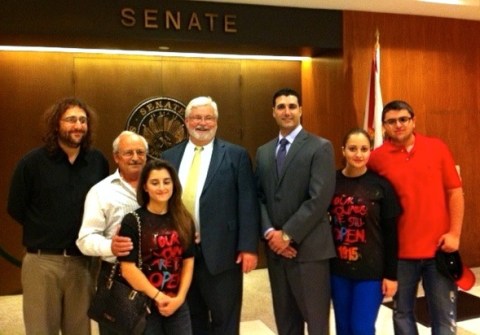
Armenian Americans at the Florida Capitol in Tallahassee with Senator Jack Latvala (R-Pinellas) following passage of the Armenian Genocide resolution outside the Senate Chambers, April 24, 2013.
As Florida Armenians reported in 2013, Senator Latvala introduced SR 1878, recognizing “Armenian Martyrs Remembrance Day.” It was the first Armenian Genocide resolution ever passed in the Florida Senate. Armenian Americans from Tallahassee and across the state of Florida were on hand to witness the historic occasion. Latvala is the only Republican running for Governor of Florida with a positive record in support of Armenian American issues, and his leadership on genocide affirmation and human rights education in the state could be an important factor for the state’s 30,000+ Armenian Americans.
Announced Democrats for Governor of Florida include former one-term Congresswoman Gwen Graham (D-Tallahassee), Tallahassee Mayor Andrew Gillum, and Winter Park businessman Chris King. Gwen Graham is the daughter of former Senator Bob Graham (D-FL) who withdrew his cosponsorship of an Armenian Genocide recognition resolution and then voted against breaking a filibuster in a historic Senate cloture vote in 1990. The younger Graham, however, had no record in support of or opposition to Armenian American issues during her short time in Congress. Miami Beach Mayor Philip Levine (D-Miami) and Orlando attorney John Morgan are also expected to run for the Democratic nomination for Florida Governor.
Primary elections will be held in Florida on August 28, 2018.
Why is October “Armenian Cultural Month”?
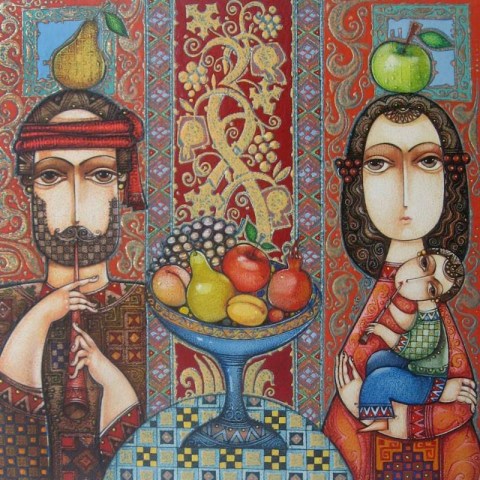
“Wistfulness” (2013) by Sevada Grigoryan
(Eastern Diocese) – To Armenians in the United States, “Armenian Cultural Month” has been a feature of community life for as long as they can remember. It arrives each October—and with it a flurry of lectures, readings, exhibits, sacred celebrations, and events intended to remind Armenians of the richness of their cultural heritage.
But how and when did it begin? And why was October chosen as the annual showcase for Armenian culture?
Surprisingly, Armenian Cultural Month originated in the Eastern Diocese, and this month marks its 75th anniversary.
Credit for launching the observance goes to Archbishop Karekin Hovsepian: the late Primate of the Diocese (1939-1944), who went on to become the Catholicos of Cilicia (1945-1952).
An Armenian intellectual figure of international reputation, a stirring orator, and one of the great churchmen of the 20th century, Hovsepian was responsible for many of the enduring developments of the Armenian Church in America. It was Archbishop Hovsepian who conceived of building a “national home” for the Armenians of America—an idea which would eventually evolve into the St. Vartan Cathedral project. Among his innovations was the official Diocesan publication, Hayastanyaitz Yegeghetzi, which later prospered under the English title, The Armenian Church.
An old edition of that publication reveals that Archbishop Hovsepian named October as a month for celebrating Armenian culture in an encyclical dated August 14, 1942.
The Primate’s encyclical (yes—diocesan primates, and not just the catholicos, could issue encyclicals in those days), written in Armenian, was titled “To Our Faithful People and Diocesan Parish Organizations.” It explained that on August 6, Archbishop Hovsepian had presided over a gathering of Diocesan leaders—among them the executive council (precursor to the Diocesan Council), officials of the Diocesan educational and organizational bodies, and the editors of Hayastanyaitz Yegeghetzi.
In the course of the meeting the basic idea of Armenian Cultural Month was born. A series of what we today would call “action items” describe how the observance would be realized:
- All parishes would celebrate the Divine Liturgy on Tarkamantchats—the Feast of the Holy Translators—and pastors would sermonize on the saints who devised the Armenian alphabet, translated the Scriptures, and laid the foundation for the flowering of Armenian literature.
- A special collection would be done in every parish, with proceeds used to help needy Armenian schools, or for the promotion of cultural events.
- Cultural activities like plays, readings, and art exhibits would be organized at the parish and Diocesan levels.
- The observance would begin in October of 1942, and would thereafter become an annual event, celebrated every October.
- The Diocesan center would publish a special issue of Hayastanyaitz Yegeghetzi dedicated to Armenian culture; Armenian newspapers would be asked to publish articles on cultural month, and to help promote the observance.
In introducing the idea to the public, Archbishop Hovsepian emphasized that “culture” broadly understood—literature, language, music and art—had always found a welcoming home in the Armenian Church, alongside the church’s mission to preach the Gospel of Christ to its people. Hovsepian noted that the church had been a “school” to the nation, encouraging literacy among the people and broadening their awareness of history and the larger world.
In the greatest expression of this “cultural” role, the written Armenian language had begun as a sacred undertaking of the church, to translate the Bible into Armenian. Indeed, October was chosen as the candidate for Armenian Cultural Month because it includes that most distinctive of Armenian holy days, the Feast of the Holy Translators, celebrated every year on the Saturday before the 5th Sunday after Khatchveratz (the Feast of the Exaltation of the Holy Cross).
With characteristically poetic words, Archbishop Hovsepian concluded his encyclical by taking a larger view of the importance of culture to the enduring story of the Armenian people. (The extract below is translated from Armenian):
“We have to enlighten our people so they can understand and appreciate the value of our Armenian language, literature, and culture. These are the treasures of the Armenian Church and nation—our foundation, and the things that will ensure our continuance.”
These points, presented in the encyclical and reproduced in the September 1942 issue of Hayastanyaitz Yegeghetzi, remain the essential outlines of Armenian Cultural Month, 75 years later.
—Fr. Krikor Maksoudian (adapted from his original Armenian essay by C. H. Zakian)




 Florida Armenians