
Category Archives: News
The Only Armenian on the Ballot in Florida

By Arsine Kaloustian
FLArmenians Managing Editor
After a decade spent in Washington, D.C., the Armenian Assembly of America’s former Director of Communications, Taniel Shant, is now the Republican nominee for Palm Beach County Commission District 5, in South Florida. He is also the only Armenian to appear on the ballot in Florida.
Taniel has spent his entire adult life in public service. One year after he moved to Washington, D.C. he found himself battling the Turkish Lobby and the Azerbaijani Lobby. He worked with our friends in Congress to hold the Bush and Obama Administrations accountable. Throughout his tenure, he advanced various pieces of legislation in Congress and at the state level dealing with Armenian Genocide recognition and Holocaust education, global human rights abuses, international religious freedom, anti-genocide initiatives (Darfur, Sudan; Syria; Iraq), protection of Christians in the Middle East, appropriations, U.S. foreign assistance, and many others.
He holds a Bachelor’s degree in Political Science from Florida Atlantic University and a Master’s degree in Political Management from The George Washington University. Mr. Shant possesses an impressive pedigree – particularly when gazed at through the lens of the Armenian American community. Not only was Mr. Shant the founder of Florida Armenians, the largest statewide Armenian organization in Florida, but he successfully led the effort to pass a resolution in the Florida State Senate recognizing the Armenian Genocide in 2013.
Armenian American political candidates have always been sparse – and too often, they have proved to be unviable. Mr. Shant’s first time candidacy, however, is proving itself as a force to be reckoned with, having raised over $40,000 in four month’s time – officially the most money ever raised by a Republican candidate in this seat. Mr. Shant is rapidly garnering the backing of Armenian communities throughout the country – Florida, New Jersey, New York, California, New Hampshire, Virginia, Maryland, Washington D.C., Georgia, Massachusetts, and more.
Time after time, I’ve heard Armenians complain that U.S. leaders are not doing enough for Armenian issues, and that we need more Armenians in government. Today, I’m pleased to tell you that we have a tried and tested community leader stepping up to the stage for us, and for all the people in Palm Beach County. Taniel fought on Capitol Hill on behalf of the Armenian American community; and now the Armenian American community has a chance to have one of our own represent us as an elected official. It is time to let our actions speak louder than our words, and show him our support.
If you would like to volunteer for Taniel Shant’s campaign, learn more about his platform, or make a contribution, please visit www.tanielshant.com or email info@tanielshant.com.
Human Tragedy in Karabakh
By John M. Evans,
Former U.S. Ambassador to Armenia (2004-06)
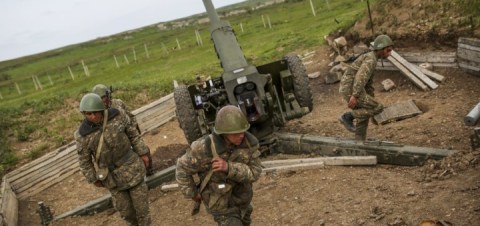
We Americans are understandably focused on the multiple and interlocking tragedies that have taken place in the last month from Louisiana to Minnesota and most notably in Dallas. But half a world away a human tragedy of a different sort has been unfolding in the unrecognized Armenian-populated enclave of Nagorno-Karabakh, which in Soviet times enjoyed an autonomous status, but, as the USSR was collapsing, voted for independence and fought a terrible war with post-Soviet Azerbaijan that claimed some 30,000 dead on both sides. A fragile cease-fire was signed in 1994 under Russian sponsorship, but the “frozen” conflict has in recent years seen more violations of the Line of Contact, and more victims.
The “four-day war” initiated by Azerbaijan on April 2, 2016 (no close observer of the conflict lays the blame anywhere else) was the largest escalation of military conflict between Azerbaijan and Nagorno-Karabakh since the cease-fire was signed in 1994. Over ninety Armenians were killed, and more than 120, including civilians and children, were wounded. As the Armenian Ambassador to the United States said to me, on a per capita basis, this was equivalent to the U.S. losing 10,000 of its citizens. Thousands of people from the affected villages, mostly children, women and the elderly, were evacuated to the comparative safety of Stepanakert or neighboring communities, or to Armenia proper. I visited Karabakh in late June with Dr. Garo Armen of the Children of Armenia Fund in order to help him determine what COAF might do to ease the suffering of civilians that resulted from the fighting.
The Azerbaijani shelling, much of which was unleashed after the initial attack had already faltered, was most destructive to the border communities of Talish, Madaghis, Mardakert, Hadrout and Martuni. Talish has been entirely abandoned because of the risk of shelling; in fact, further shelling did occur there on June 30 when Azeri soldiers attacked three farmers in the fields. Many families, some of them grieving over their losses, are now internally displaced, still terrified from what they experienced and fearful of the future. Five hotels in Stepanakert were commandeered to house families and individuals who had no other place to go.
Immediately after the cessation of hostilities, the Yerevan office of the Children of Armenia Fund deployed two teams to Karabakh to assess the situation and, in some cases, to provide immediate assistance. The local authorities had attempted to mobilize limited resources to address the most pressing needs, and NGOs and some governmental structures from Armenia also joined in the effort to assist; however, what COAF discovered was that, while some of the emergency needs of the IDPs were partially met, psychological support for the affected people was sorely needed and there was no local capacity to address this issue.
While some efforts were made to address the needs of soldiers with psychosomatic conditions, the majority of the IDPs in the five hotels and elsewhere exhibited signs of trauma, behaving as “ghetto groups,” lost between a terrifying past and an uncertain future, closed inside their shells and praying for God’s help. Children who were enrolled to attend nearby schools feared to venture out to “life-threatening places where shooting and shelling cause death and injuries.” Images of the elderly Talish couple whose ears were cut off by the attackers, of the Yezidi soldier who was decapitated, and of other soldiers tortured and/or mutilated have not helped calm these people down. Some of the atrocities committed by the Azeris clearly were in the category of war crimes and played on the Armenians’ well-founded fear of genocide.
While we Americans have much to do to “fix our own country”, one of the responsibilities of great-power status is to prevent the world from becoming a jungle. Together with Russia and France, the United States has been attempting to mediate the Armenian-Azerbaijani dispute through the Minsk Group of the Organization for Security and Cooperation in Europe. In my view and that of many others, it is high time for the Karabakh authorities, unrecognized as they may be under international law, to be brought into the peace process. The Armenians of Karabakh, or, as they call it, Artsakh, are there to stay and deserve to live in peace in their towns, cities and mountains.
John Evans was recalled from his post as U.S. Ambassador to Armenia in 2006 for publicly breaking with the Bush Administration over the Armenian Genocide. He recently published Truth Held Hostage: America and the Armenian Genocide–What Then? What Now? London: Gomidas Institute, 2016.
This article originally appeared in the California Courier and is reproduced with the expressed written consent of the author.




 Florida Armenians