
Author Archives: Florida Armenians
Koushakjian Talks Armenia, Christian Persecution in the Middle East with Republican Presidential Candidate Marco Rubio
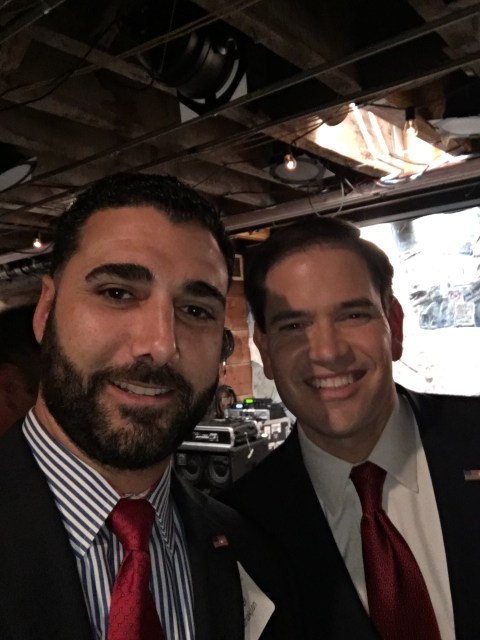
On Tuesday, January 12, Florida Armenians Editor Taniel Koushakjian spoke with Florida Senator and Republican presidential candidate Marco Rubio in Washington, D.C. Koushakjian thanked Rubio for his cosponsorship of S. Res. 140, the Armenian Genocide resolution currently pending in the Senate.
[RELATED: How Florida Representatives Voted to on the Bill to Pause the Syrian Refugee Program]
They also discussed the plight of Christians in the Middle East and the need for the U.S. to declare Islamic State (aka ISIS or ISIL) attacks on Christians as genocide. Rubio pointed out that he is also an original cosponsor of S. Res. 340, which would label ISIS attacks on Armenians, Assyrians, Yezidis, and other religious minority groups in Iraq and Syria as genocide. ISIS “is conducting genocide against Christians, Yezidis, and others in region,” Rubio said two days later at the Republican presidential debate on Thursday, January 14.
Dr. Susan Harper to Present ‘Genocide and American Humanitarianism: Lessons from World War I and Its Aftermath’ in Sarasota
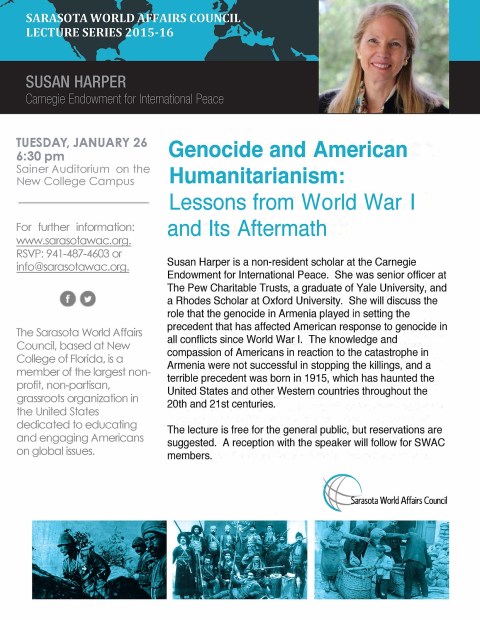
The Sarasota World Affairs Council (SWAC) will host Dr. Susan Harper for an informative presentation on the Armenian Genocide entitled ‘Genocide and American Humanitarianism: Lessons from World War I and Its Aftermath’ at New College of Florida, in Sarasota, FL. The event will take place on Tuesday, January 26 at 6:30 PM in the Sainer Auditorum.
Susan Harper is a non-resident scholar at the Carnegie Endowment for International Peace. She was Senior Officer at The Pew Charitable Trusts, a graduate of Yale University, and a Rhodes Scholar at Oxford University. She will discuss the role that the genocide in Armenia played in setting the precedent that has affected American response to genocide in all conflicts since World War I. The knowledge and compassion of Americans in reaction to the catastrophe in Armenia were not successful in stopping the killings, and a terrible precedent was born in 1915, which has haunted the United States and other Western countries throughout the 20th and 21st centuries.
Harper has researched and presented on the Armenian Genocide for almost two decades.
During the 19th Library of Congress Vardanants Day Armenian Lecture Series at the Library of Congress last year, Dr. Harper presented “American Humanitarianism in the Armenian Crucible, 1915-1923.”
During that presentation, Harper reported her findings about physician missionaries who as part of the overall Near East Relief effort traveled to Armenia and other countries to deliver medical aid in the aftermath of the Armenian Genocide. Harper’s presentation focused on the contributions of Dr. Mabel Elliott who tended to the medical needs of refugees in Armenia, Turkey and Greece, and who authored one of the compelling accounts of the era, “Beginning Again at Ararat.”
Held on May 7, 2015 the Vardanants Day lecture coincided with the opening day of events organized by the National Commemoration of the Armenian Genocide Centennial Committee and the Ecumenical Service held at the National Cathedral in Washington, D.C. later that evening.
In addition, Dr. Harper previously participated in the conference organized in September, 2000 by the Armenian National Institute and the Library of Congress where she presented a paper on the missionary Mary Louise Graffam who witnessed the Armenian Genocide. Her and other presenters’ papers were published by Cambridge University Press in “America and the Armenian Genocide of 1915,” under the editorship of Dr. Jay Winter.
The Sarasota World Affairs Council lecture with Dr. Susan Harper is free for the general public, but reservations are suggested. RSVP to 941-487-4603 or info@sarasotawac.org. A reception with the speaker will follow for SWAC members.