Blog Archives
Armenians and the Purple Heart
By Taniel Koushakjian
August 8, 2013
Yesterday marked the 231st anniversary of the establishment of the “Badge of Military Merit,” known today as the Purple Heart, by General George Washington on August 7, 1782. When I first heard this news, I was drawn to the memory of my grandfather, U.S. Army Sergeant Ara Odabachian. Although a well-decorated soldier in his own right, he did not receive a Purple Heart, but there had to have been some Armenians who did. After all, thousands of Armenians have fought valiantly in the U.S. Armed Forces, with verified records dating as far back as the Civil War.
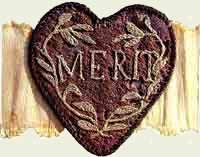 According to Professor Ray Raymond, upon his victory at Yorktown, General Washington’s “officers were on the verge of mutiny because of lack of pay, rations and supplies withheld by a corrupt and negligent Congress. Worse, Congress had taken away the authority of his general officers to recognize their soldiers’ courage and leadership by awarding commissions in the field. Congress simply could not afford to pay their existing officers let alone any new ones. As a result, faithful service and outstanding acts of bravery went unrecognized and unrewarded. George Washington was determined to end that. So from his headquarters perched 80 feet above the Hudson, he issued a general order establishing the ‘Badge of Distinction’ and ‘Badge of Merit.’”
Although not a national holiday, the great State of Florida is one of a few states that recognize August 7 as Purple Heart Day.
Our country’s oldest military award, the Badge of Military Merit was intended to be permanent; however, the end of the Revolutionary War marked the end of the award. That is until 1932, one hundred and fifty years after its inception. On the bicentennial of George Washington’s birth:
…By order of the President of the United States, the Purple Heart, established by General George Washington at Newburgh, August 7, 1782, during the War of the Revolution is hereby revived out of respect to his memory and military achievements.
By order of the Secretary of War:
Douglas MacArthur
General, Chief of Staff
So that morning I thought to myself, “How many Armenians have received the Purple Heart? Somebody has to know!” To my astonishment, no such list existed, until today.
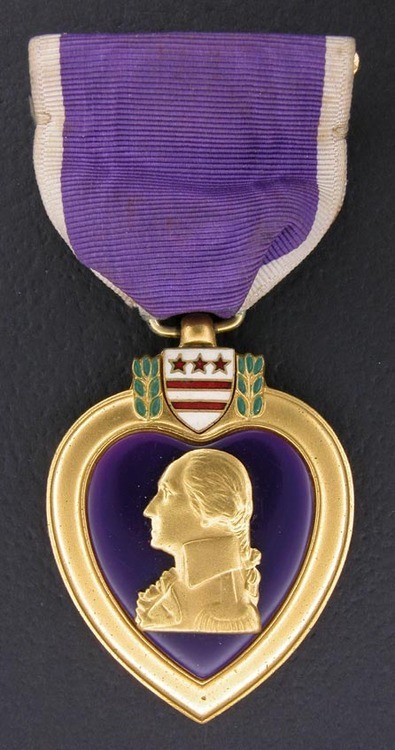
With the assistance of the Assembly’s ARAMAC-Pennsylvania Vice Chair Paul Sookiasian, who is active with his local Pennsylvania Armenian-American Veterans Association (PAAVA), he directed me to the National Purple Heart Hall of Honor registry. There I was able to search and compile a list of nearly 80 confirmed Armenian recipients of the Purple Heart. In addition to this list, I consulted one of the most important publications on Armenian-American military figures, the 1996 “Triumph and Glory: Armenian World War II Heroes,” by Richard N. Demirjian. I found one name that was not in the registry and there has got to be potentially more Armenians who have served that do not carry the “ian.”
Florida Armenians would be proud to know that two of our very own are on this list. First is Barkef Assarian (1922-2004) from Clearwater who received three Purple Hearts for his service in World War II. 92-year-old Middleton Mustian from Tallahassee, the father of former Tallahassee City Commissioner Mark Mustian, is the second. “My father, Middleton Mustian, served in the medical corps of the Third Army under General Patton, and was wounded near the town of Koblenz in 1945,” Mark Mustian told FLArmenians. “He still bears shrapnel in his leg to this day from it. He told me that, after he recovered from his injury, he was recalled to the front but didn’t want to go back. When he returned to the front he asked his commanding officer why he had called him back, and the officer told him his replacements had been ‘too scared.’ When my father told him that he was scared, too, the officer said, ‘Yes, but you can get the job done.’ It’s still difficult to get him to talk a whole lot about it,” Mustian said.
From the Assembly’s 2006 National Advocacy Conference, to the designation of the Colonel George Juskalian United States Post Office in Centreville, Virginia in 2010, and other activities honoring our service men and women, the Armenian Assembly of America has a strong record of raising awareness of and honoring Armenian veterans of the United States.
I know this list is incomplete. Therefore, I am asking anyone with more information about Armenian-Americans who have received the Purple Heart to contact the Assembly at info@aaainc.org or 202-393-3434. With the help of the Armenian-American community we can complete this list and together raise awareness of the proud Armenian presence in the U.S. Armed Forces.
Please click here to view the Assembly’s list of Armenian Purple Heart recipients.
This article originally appeared on the Armenian Assembly’s Blog and has been edited for FLArmenians readers.
Are We on the Right Side of History?

A gay activist waves a gay pride American flag outside the Supreme Court on March 26 | Reuters
By Michael Toumayan
FLArmenians Guest Contributor
In a landmark ruling for Gay, Lesbian, Bisexual and Transgender (LGBT) rights, the Supreme Court of the United States on Wednesday struck down the Defense of Marriage Act (DOMA), the 1996 law signed by then President Bill Clinton blocking federal recognition of same-sex marriages. In a separate case, the court ruled that it could not take up a challenge to Proposition 8, the California law that banned same-sex marriage in that state. That decision means that marriage equality will once again be legal in California.
This is a watershed moment in the fight for equality with the Supreme Court delivering justice to millions of Americans and to the thousands of LGBT Armenian-Americans who have been denied their rights under the U.S. Constitution.
Yet it is increasingly clear that we now have two Americas – one where our relationships are recognized and we are protected from discrimination in 13 States and the District of Columbia, and another that has yet to feel the effects of our progress and LGBT people remain second-class citizens, including in the State of Florida.
Sadly, we find many LGBT Armenian-Americans living under this same pretext for far too long – in an America that celebrates and protects who we are as Armenians and the other in our community centers and churches that marginalize and stigmatize LGBT Armenians for whom they love. No one should choose between who they are and whom they love.
I recognize that there are deeply held views on this issue and deeply fierce opposition by the Armenian Church hierarchy. But we cannot pretend to be a nation seeking restorative justice and recognition of our painful history and add the word “but” if we are truly genuine in our collective quest for justice for all.
This is a debate about equal rights under the law. It is about freedom from discrimination and stigmatization the way we were once discriminated and stigmatized as Christians in the Ottoman Empire. It is about the legal protections and responsibilities, and more than 1,100 rights, obligations and benefits afforded by the legal institution of marriage that, prior to the DOMA ruling, were denied to same-sex Armenian American couples. It is also about real people: your sons, daughters, brothers, sisters, and neighbors. And finally, it is about witnessing and reflecting the love and commitment between two people.
Given our 1,700 years of Christian heritage, I’d like to sum up the whole law in a single commandment, “You shall love your neighbor as yourself” Galatians 5:15.
For if truly we, as the Armenian nation, are on a quest to bend the arc of the moral universe towards justice for all, then surely we must stand on the right side of history by resisting all forms of bigotry and dedicating ourselves to the advancement of social justice and human dignity of both the living and the deceased.
And if truly we belong to the body of our Lord Jesus Christ through the One, Holy, Catholic (Universal) and Apostolic Church, then surely we are commanded to love, treat with respect and defend our LGBT Armenian sisters and brothers and any other marginalized groups both in the U.S. and in our beloved Hairenik (fatherland), no matter what your Biblical conviction is on homosexuality. This we know as absolute: Christ’s ministry was inclusive and he said that if we commit hate in our hearts we have committed murder – thus, we should take discrimination, hate-talk and the bullying of any marginalized group very seriously. If our tragic history hasn’t taught us anything, then I do not know what will. To learn more specifics on how the Supreme Court rulings on DOMA and Prop 8 might affect you, please visit www.hrc.org/SCOTUS.
Michael Toumayan is a program assistant at the Human Rights Campaign and an independent political commentator on the Caucasus and Middle East. A graduate of Florida Atlantic University in Boca Raton, Florida, he holds a master’s degree in conflict resolution and mediation from Tel Aviv University in Tel Aviv, Israel. He can be reached at michael.toumayan@hrc.org.
Meat Boregs – Detroit Style
By Robyn and Doug Kalajian
FLArmenians Cuisine Contributors
After two years of preparation and anticipation, the 111th Diocesan Assembly and Clergy Conference in beautiful Boca Raton concluded on Sunday, May 5, 2013.

Boreg-Lahmajoun Table
It was a whirlwind week of events with hundreds of attendees from Mid-Western, East Coast, and Southern states. In addition to the planned sessions and meetings, guests participated in luncheons, kef time (featuring the music of Johnny Berberian), area sightseeing, and a gala banquet honoring Armenians of the Year – Janet and Edward Mardigian, and Friend of the Armenians – former Florida Governor Jeb Bush. The week-long gathering culminated with a lavish farewell Sunday brunch for departing Very Rev. Fr. Nareg Berberian of St. David Armenian Church.
I had a mini part in the grand scheme of things, but it was exciting just the same. Many of our seasonal visitors rolled up their sleeves alongside local parishioners to help create the massive menu for the farewell brunch.
Serving stations were set with assorted salads, yalanchi, lahmajoun, cheese boregs, meat boregs, and hummus. A carving station offered sliced-to-order roast beef, ham and turkey. Desserts included kourabia cookies, paklava, semolina cakes, fruit kabobs, and more. The beverage station served-up Mimosas (orange juice and champagne), plain orange juice, and coffee to help wash everything down.
Weeks before the brunch, I was at church working on another aspect of the preparation while a group of seasonal parishioners from Detroit were in the kitchen making the meat boregs. They made Dolly Matoian’s recipe which came from St. John Armenian Church (Detroit) cookbook. This is not a ‘home version’ recipe as it yields 375 to 400 boregs, and requires 20 workers over a 2-day period to complete.
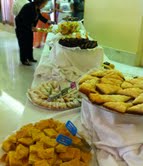
Desert Table
Instead of using phyllo dough or puff pastry, the dough was more chorag-like. The meat filling had a nice ‘kick’ from the blend of black pepper and cayenne pepper in the filling. I got to sample a test boreg as it came out of the oven – it was soft, warm, and so delicious!
I have made an attempt to break down the large-group recipe for the home kitchen, but be warned – I have not tested this version. The new ingredient amounts represent 1/8th the original recipe measurements.
The smaller recipe should yield about 45 to 50 boregs, and I would suggest having one or two extra pairs of hands to assist. Oh yes, it’s important to prepare the meat mixture one day in advance.
Please don’t be discouraged by the lengthy recipe. One thing is for sure, I can certainly appreciate the time and effort the Detroit ladies put into this recipe, and I truly did savor every bite!
Here’s the (untested) home version recipe…
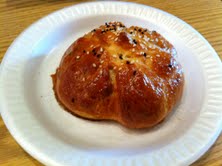
Detroit-Style Meat Boreg
Meat Boreg (Beoreg)
Yield: 45 to 50 pieces
Filling Ingredients:
1 lb. chopped onions
3 Tbsp. vegetable oil
1 ¾ lbs. ground lamb
1 ¾ lb. ground sirloin (or chuck)
¾ tsp. salt
¼ tsp. black pepper
¼ tsp. cayenne pepper
½ tsp. paprika
¾ lb. (3 sticks) butter
¾ c. dried parsley (or 1 cup fresh, chopped parsley)
Dough Ingredients:
¼ lb. (1 stick) butter
¼ cup vegetable shortening
1¼ c. milk
5 eggs
1 Tbsp. sugar
1 Tbsp. plus 2 tsp. dry granular yeast
½ cup warm water
2 ¼ tsp. sugar
1 ½ tsp. salt
3 ¼ lb. all-purpose flour (approx. 12 cups)
Egg wash:
2 eggs, beaten
Topping:
Regular or black sesame seeds
Directions:
Day 1:
1. Heat vegetable oil in a skillet. Saute onions until soft, but not mushy. Strain onions in a colander, pressing firmly to remove any liquid. Set aside until ready to use.
2. In a large frying pan, cook lamb and beef over medium heat until brown. Break meat down with a fork to remove any large lumps. Strain out any excess fat.
3. Place cooked onions and meat in a large mixing bowl. Stir in all of the seasonings. Taste for flavor and spiciness. Make any adjustments, if necessary.
4. Melt the butter in a skillet and add to the meat-onion mixture. Finally, add the chopped parsley.
5. Place mixture in shallow containers; cover and refrigerate until day 2.
Day 2:
Directions for Dough Preparation:
1. Melt butter and shortening in a saucepan. Allow to cool. Add milk to butter mixture; set aside.
2. Using a hand or stand mixer and a large bowl, beat eggs and sugar until well-blended.
3. Begin adding flour, a little at a time, to the egg mixture for a uniform mixture.
4. In a medium bowl, combine the ½ c. warm water, yeast and sugar, whisking to dissolve. Cover with plastic wrap and allow to proof.
5, Add proofed yeast to the flour mixture and knead dough well.
6. Using a food scale, portion the dough into 1 ½ to 2 oz. portions; place on trays, cover with plastic wrap or parchment paper and allow to rest.
7. Portion the meat into 1/12 to 2 oz. portions.
8. On a work surface (no flour should be needed), roll each dough portion into 4-inch circles, and place on platters.
Forming and baking the boregs:
9. Hold each round of dough in one hand; top with meat mixture. Pinch or fold the dough over the meat to completely seal the filling.
10. Place – seam side down – on parchment-lined baking sheets. Lightly press down to make a bun shape instead of a ball shape. Continue the process until the trays are filled. Allow boregs to rest about 15 minutes before baking.
11. Bake in preheated 375°F oven (350°F for convection oven) until golden.
12. Place baked boregs on cooling racks; cool completely. If not serving immediately, place borges in freezer bags in single layers, and freeze until ready to use.
13. Prior to serving, defrost boregs in the refrigerator, and bake in preheated 325°F oven until warmed through.
Robyn Kalajian is a retired culinary teacher and Chief Cook at www.TheArmenianKitchen.com. Douglas Kalajian is a retired editor/journalist and Sous Chef at www.TheArmenianKitchen.com.




 Florida Armenians