Blog Archives
U.S. National Security Advisor John Bolton To Travel To Russia, Armenia, Azerbaijan, Georgia

U.S. National Security Adviser John Bolton (right) shakes hands with Russian counterpart Nikolai Patrushev during a meeting at the U.S. Mission in Geneva in August, 2018.
U.S. National Security Adviser John Bolton announced that he will be traveling to Russia and all three Caucasus nations this month for talks with senior officials.
In a tweet on October 11, Bolton said he would depart on October 20 for Russia, Armenia, Azerbaijan, and Georgia.

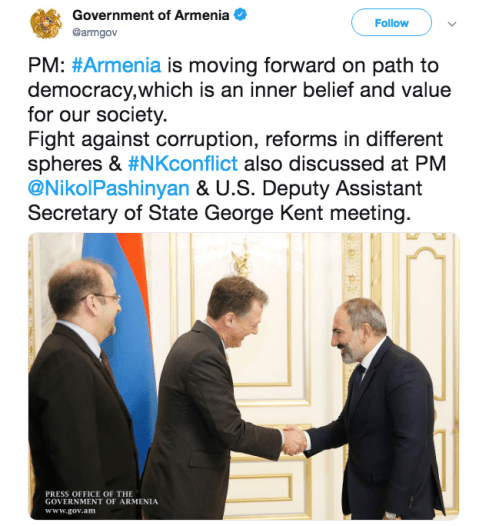
Bolton’s visit to the Caucasus comes on the heels of Armenian Prime Minister Nikol Pashinyan’s meeting with U.S. Deputy Assistant Secretary of State George Kent in Yerevan on October 15. During that meeting, Pashinyan reiterated that “Armenia is moving forward on [a] path to democracy, which is an inner belief and value for our society,” according to a tweet from the Armenian government. The “Fight against corruption, reforms in different spheres & #NKconflict” were also discussed.
While in Russia, Bolton will meet with senior Russian leaders, including Foreign Minister Sergei Lavrov and Security Council Secretary Nikolai Patrushev.
The scheduled Bolton visit to Russia comes at a time of heightened tensions between Washington and Moscow over Russian actions in Ukraine and Syria as well as alleged Kremlin interference in U.S. elections.
In August, Bolton told Patrushev that the United States “wouldn’t tolerate meddling” in the upcoming U.S. midterm elections. Bolton also said U.S. sanctions against Russia would remain in place until Moscow changes its behavior.
Therefore, it was no surprise that on October 19, the day before Bolton was scheduled to depart on his trip, the Justice Department brought its first criminal case over alleged Russian interference in the 2018 midterm elections.
According to POLITICO, “Elena Khusyaynova, 44, a St. Petersburg, Russia-based accountant, was charged in a criminal complaint with conspiracy to defraud the United States for taking part in a scheme to spend in excess of $10 million since the beginning of the year on targeted social media ads and web postings intended ‘to sow division and discord in the U.S. political system.’”
In a tweet on October 12, Georgian Foreign Minister Mamuka Bakhtadze said the upcoming visit of Bolton to Georgia would “further strengthen the deep friendship and strategic partnership between” the United States and Georgia.
It is interesting to observers that in September President Trump announced his nomination of a new U.S. Ambassador to Armenia, Lynne Tracy, as current U.S. Ambassador Richard Mills wraps up his three year tour. Meanwhile, there has been no U.S. ambassador in Azerbaijan, or Turkey, since Trump took office two years ago. The fact that there is no gap in the high-level U.S. presence in Armenia, and that President Trump only last month nominated a representative to the the one of the two hostile muslim countries, indicates the strengthening U.S.-Armenia partnership, and symbolizes the decreased importance of Turkey and Azerbaijan as they continue to engage in activities that run counter to U.S. interests in the region.
Congress Must Investigate U.S. Loans To Azerbaijan’s Secretive Silk Way Airline
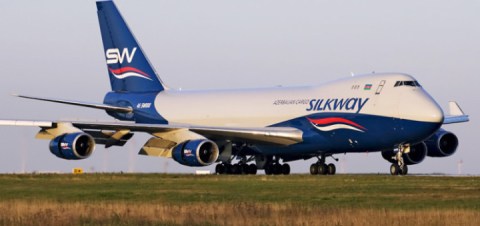
Silk Way Airlines
By Harut Sassounian
Last year, I wrote an article reporting that the Silk Way Airlines of Azerbaijan made 350 secret flights to transport hundreds of tons of weapons from Bulgaria to ISIS terrorists in Syria and other Middle Eastern countries between 2014 and 2017. We now have a new surprising revelation that Silk Way received $419.5 million of loans from the U.S. Export-Import Bank (EXIM) to buy three 747-8 cargo planes from Boeing to continue its sinister operations.
The disclosure was made by a reporter for the Organized Crime and Corruption Reporting Project (OCCRP) by filing a Freedom of Information Act (FOIA) request with the U.S. government in 2016. It is noteworthy that Silk Way, “owned by a company with past ties to Azerbaijan’s Aliyev family, won some lucrative contracts from the U.S. military,” according to FOIA documents. In fact, “Silk Way was given contracts worth more than $400 million with the U.S. Defense Department’s Transportation Command for more than decade,” according to Devansh Mehta of OCCRP. Silk Way transported “ammunition and other non-lethal materials” to Afghanistan as of 2005. “In addition to its relationship with the U.S. government, Silk Way Airlines has also worked as a subcontractor for the Canadian Department of National Defense, the German armed forces, and the French army,” Mehta revealed.
In April 2017, Silk Way increased its purchases from Boeing, signing a $1 billion deal for 10 new 737 MAX passenger planes, according to reporter Mehta. However, it is not known how the new acquisition was financed. Last October, Silk Way announced plans to buy two more 747-8 cargo planes.
Mehta disclosed that “the airline is owned by Silk Way Group, which, at least at one point, was closely associated with Azerbaijan’s ruling Aliyev family (which has used its planes for private trips) and has benefited from benevolent state deals. Information obtained through FOIA shows that Silk Way Airlines took steps to conceal its owners’ identity, perhaps to improve its chances of winning the valuable U.S. loan guarantees and military contracts.”
Mehta added that “Azerbaijan ranks 122nd out of 180 countries in Transparency International’s corruption perception index, while President Ilham Aliyev’s family owns luxury properties around the world worth over $140 million. The Panama Papers and other leaks have implicated the country’s first family as being involved in nearly all sectors of the Azerbaijani economy, from luxury hotels to mining to banking.”
According to the terms of the Export-Import Bank’s $419.5 million loan to Silk Way, in case of default the loss would be repaid by the state-owned International Bank of Azerbaijan (IBA). The problem is that IBA has been “implicated in the Azerbaijani Laundromat, a massive scheme that pumped nearly $3 billion out of the country through various shell companies,” Mehta wrote. Furthermore, IBA is not in a position to guarantee the Silk Way loan, as the IBA itself declared bankruptcy in 2015, unable to pay its $3.3 billion debt!
Nate Schenkkan, project director of the Nations in Transit report at Freedom House, a US-based nonprofit that monitors democracy and human rights around the world, questioned the wisdom of EXIM Bank’s loan to Silk Way: “In Azerbaijan, where one family dominates economically and politically, and is then using state institutions to back its economic projects, there’s an obvious conflict of interest.”
Arzu Aliyeva, Pres. Aliyev’s 21-year-old daughter in 2010, was one of the three owners of Silk Way Bank, the financial arm of Silk Way Holding. Since 2017, her name is no longer mentioned as an owner. “Silk Way Holding, also referred to as Silk Way Group (SW Group) on its website, is a conglomerate that has currently listed 11 companies in its portfolio, including the airline,” according to Mehta. Silk Way Holding dominated Azerbaijan’s aviation sector after the state carrier AZAL airlines was privatized in a highly secretive manner without any bids and tenders. Mehta wrote that “a similar privatization of the telecom sector ended up with the [Aliyev] family earning about $1 billion in bribes in cash and share value, according to an earlier OCCRP story. The investigation also found that the money was funneled to the first family through various secret offshore companies. These companies have enabled the Aliyevs to control stakes in gold mines, telecommunications and construction businesses in Azerbaijan.”
According to a filing in 2006, Silk Way Airlines was owned by IHC (International Handling Company), an offshore entity based in the British Virgin Islands. In a 2017 filing, Silk Way Airlines stated that 40% of the company was owned by IHC, while 60% was owned by SW Holding, “effectively controlled” by Zaur Akhundov, an Azerbaijani citizen. Mehta stated that “IHC is linked to the Aliyev family through its director Jaouad Dbila who reportedly served as a proxy for the first family’s business interests in the past.”
In 2011, a Russian-born manager, Grigory Yurkov, was given power of attorney for both Silk Way Holding and IHC, according to Luxembourg’s official gazette. This appointment was used as a means to conceal the true owners of IHC.
Meanwhile, Zaur Akhundov had mysteriously become the 100% owner of the entire Silk Way Group in 2014. By that time, the firm and its many holdings were already worth billions of dollars, Mehta declared, based on the company’s loan guarantee application. Akhundov, 50, had held several official positions in Azerbaijan. “It is unclear how Akhundov became the owner of a billion-dollar conglomerate with more than 10 aircrafts, an insurance company, a construction company and an aircraft maintenance company, to name a few of the enterprises in the Silk Way Group,” Mehta wondered.
According Schenkkan of Freedom House, “Azerbaijan can be described as a centralized, vertical pyramid where the benefits go to one family that collects rents throughout the economy. This includes all sorts of transactions, not only official state transactions that might involve taxes and public funds, but also things that involve what we normally consider the private sector: import-export, consumer goods, transport—any area of the economy, the family has a stake in it and receives a cut on what takes place.”
The U.S. Congress should hold a hearing to investigate the appropriateness of EXIM Bank’s $419.5 million loan guarantee to Silk Way Airlines, its arms shipments to terrorist groups in the Middle East, and its hidden ownership by the ruling Aliyev family. After all, why should Azerbaijan, a country with billions of petrodollars, be given a U.S. loan?
Azerbaijan’s U.S. Lobbying Firm’s List of Impressive Accomplishments

By Harout Sassounian
FLArmenians Commentator
Several weeks ago, I wrote about the four lobbying and PR firms hired by Azerbaijan in the United States. One of these companies is the Tool Shed Group.
This week, I would like to present a sample of the impressive activities organized by the Tool Shed Group on behalf of the Consulate General of Azerbaijan which is getting a great bargain by paying only $9,000 a month for all of these pro-Azeri efforts, almost none of which could have happened without the Tool Shed Group.
Most readers are unaware that American lobbying and PR firms hired by foreign entities are legally required not only to register their clients with the Justice Department under the Foreign Agent Registration Act (FARA), but also file the detailed list of activities on their behalf.
In order to know what efforts have been made by the Tool Shed Group on behalf of the Consulate of Azerbaijan, I have checked the website of the Justice Department where the Tool Shed Group has listed by date all of their activities for Azerbaijan’s Consulate in Los Angeles.
Tool Shed’s list of activities starts on April 1, 2009, but mysteriously ends on March 31, 2011. This must surely be a violation of the Justice Department’s requirement which has to be brought into the attention of the U.S. government. Nevertheless, the two-year report provides a detailed glimpse which I have summarized below as it is a dozen pages long:
1. Outreach to Universities:
Arranged meetings for Consul General Elman Abdullayev with the following University officials: Jolene Kester, California State University, Northridge, CA; the University of New Mexico; Geoff Cowan and Adam Clayton, USC; Chapman University, Orange, CA; Pepperdine University, Malibu, CA; Larry Greenfield, Vice President of the Claremont Institute, Los Angeles, CA; Jack Lewis, Associate Dean, USC Marshall School of Business, Los Angeles, CA; Gail Lapidus, Stanford University, Stanford, CA; David Lundberg, UCLA NanoSystems Institute; University of California, Irvine; and University of Las Vegas, Nevada; Lectures by the Consul General at UCLA; San Francisco State University; San Jose State University, San Jose, CA; USC; Scripps College, Claremont, CA; University of California, Santa Barbara, CA; California State University, Fullerton, CA; Arizona State University, Phoenix, AZ; University of Arizona, Tucson, AZ; and Stanford University, Stanford, CA; spoke at a conference on religious pluralism at USC; and conference call with USC Center for Public Diplomacy to discuss a lecture by the Consul General.
2. U.S. Politicians:
Consul General met with Darrell Steinberg, President Pro Tem, California State Senate, Sacramento, CA; Karen Bass, Speaker, California State Assembly, Sacramento, CA; Annette Porini, Chief of Staff, State Senator Joe Simitian, Sacramento, CA; Felipe Fuentes, Assemblyman, California State Assembly, Sacramento, CA; Councilor Chris Calvert, City of Santa Fe, New Mexico; Gov. Bill Richardson of New Mexico, Santa Fe, New Mexico; Speaker Ben Lujan, New Mexico State Legislature, Santa Fe, New Mexico; Mayor Bob Foster, Long Beach, CA; Cong. Adam Schiff, Glendale, CA; Congresswoman Diane Watson; Orange County Sheriff Sandra Hutchins, Santa Ana, CA; Orange County Board of Supervisors; Mike Schneider, President Pro Tem, Nevada State Senate, Las Vegas, Nevada; Mayor Oscar Goodman, City of Las Vegas, Nevada; Asked Cong. Michael McMahon (NY) to join the Azerbaijani Caucus, Los Angeles, CA; Mayor Chuck Reed, City of San Jose, CA; Meeting with California Governor Arnold Schwarzenegger to present a gift from Azerbaijan to the Governor, Los Angeles, CA; Mayor Coss, City of Santa Fe, New Mexico; Cong. Dana Rohrabacher, Huntington Beach, CA; and City Council Member Jan Perry, Los Angeles, CA.
3. Jewish and Israeli Representatives:
Consul General of Azerbaijan met with Consul General Jacob Dayan of Israel, Los Angeles, CA; John Fishel, Jewish Federation of Greater Los Angeles; Rabbi Abraham Cooper, Museum of Tolerance, Los Angeles, CA; Lecture at Temple Judea, Tarzana, CA; American Jewish Committee, San Francisco, CA; and met with Rabbi Leider and Prof. Reuven Firestone regarding a lecture by the Consul General at Temple Beth Am, Los Angeles, CA.
There are dozens of other meetings that Jason Katz, the owner of Tool Shed Group, had arranged for the Consul General of Azerbaijan. I must admit that for a paltry $9,000 a month Mr. Katz is underpaid for arranging such a wide array of access for Azerbaijan in several US States, something the Consul General of Azerbaijan could have never accomplished on his own.
The Armenian-American community makes up for its lack of lobbying and PR firms by the activism of its organizations and their members. However, a professional lobbying and PR firm can add a lot to the existing successes. Unfortunately, most Armenians do not have a proper appreciation for the work of lobbying and PR firms and therefore do not believe in funding such a valuable and much-needed effort!




 Florida Armenians