Blog Archives
Southwest Florida’s Greg Asbed Awarded MacArthur ‘Genius’ Grant
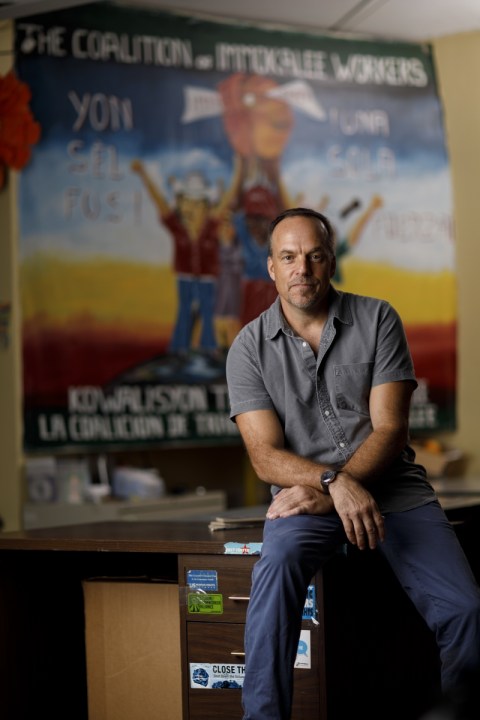
Greg Asbed. Photo Credit John D. & Catherine T. MacArthur Foundation.
Asbed is a co-founder of the Coalition of Immokalee Workers
By Jennifer Reed
Gulfshore Life
This year’s class of MacArthur Foundation fellows, announced today, includes a name familiar in Southwest Florida: Greg Asbed, a co-founder of the Coalition of Immokalee Workers.
He’s among 24 people to earn the so-called “genius grant” this year, which comes with a $625,000 award for fellows to advance their causes.
“In so many ways this is going to help us expand reach of the Fair Food Program and worker-driven social responsibility model that grew out of it,” Asbed said Wednesday afternoon after the award was made public.
Asbed, along with Lucas Benitez and Laura Germino, founded the coalition in 1993 to fight for fair wages for farmworkers and end the rampant abuses they faced, from sexual assault to forced labor to withheld wages and other forms of exploitation. In its 24 years, the coalition has led anti-slavery campaigns, liberating more than 1,200 workers; spearheaded an industry-rattling boycott of Taco Bell; led a six-month hunger strike and a 234-mile march from Fort Myers to Orlando to protest declining wages in the tomato industry; and won industry-wide raises of 13 to 25 percent for laborers.
But it’s the synthesis of these efforts, the Fair Food Program, that perhaps has had the greatest impact. The program is inspiring change not just in Florida’s fields but also in agricultural communities throughout the United States and in traditionally low-paying, highly exploitative industries around the world.
The program created a partnership among farmworkers, tomato growers and participating retail buyers. It established new labor standards, protected wages and set up a Fair Food Standards Council, a third-party monitor to ensure compliance. (The audits are tough, requiring, among other things, monitors to interview 50 percent of the workforce to verify compliance.) In the legally binding Fair Food Agreements, participating buyers pledge to buy Florida tomatoes only from growers who adhere to the Fair Food Program standards and cease to buy from growers who do not follow its code of conduct.
Critically, it’s workers who drive the changes—insisting on standards and regulations that only someone on the frontlines would consider. As one example, the Fair Food Program includes a provision stipulating that workers, paid by the bucket, cannot be required to overfill their containers, Asbed explained. It’s the workers, too, who educate their fellow laborers about the agreed-upon rules and their rights.
“The whole model from beginning to end is about worker participation,” Asbed said.
The Fair Food Program evolved into a new model for worker protection known as “worker-driven social responsibility,” or WSR. The approach ensures that human rights are respected in the workplace, that workers help determine standards and codes of conduct, and that monitoring and enforcement standards are established. Asbed is a founder of the new Worker-Driven Social Responsibility Network, headquartered in New York.
The fight in Florida is not over—big corporations including Wendy’s and Publix have yet to sign on to the Fair Food Program—and Asbed and the coalition continue to push for change here. At the same time, they are helping other companies and other industries craft agreements based on WSR principles. In just the past month, the coalition has celebrated a new Milk with Dignity agreement between the Vermont dairy industry and Ben & Jerry’s ice cream. CIW representative Lupe Gonzalo appeared with soccer star Abby Wambach and her partner, Naples author Glennon Doyle, on at a multi-city women’s conference. Gonzalo spoke of ending sexual violence against female farmworkers.
“There’s a world of problems today,” Asbed says. “Most of them don’t have proven solutions that you can just plug and fix, but this one does. We can stop violence against women in the field with this (WSR) program. We’ve done it.”
Incidentally, he’s a first-generation Armenian-American. His grandmother survived the Armenian Genocide by being taken into captivity and sold—twice—starting at age 13. The fight for human rights intertwined in his family’s story.
According to the MacArthur Foundation: “Workforces engaged with other crops in Florida, the garment industry in Bangladesh, and the dairy industry in Vermont have already or are in the process of adopting the WSR approach, and Asbed’s expertise is being sought by international organizations for the development of customized variants of the WSR model to address such issues as child labor in Africa and gender-based violence in domestic work settings in Mexico. Asbed’s visionary strategy for WSR has the potential to transform workplace environments across the global supply chain.”
Click here to learn more about Asbed and the MacArthur award. To learn more about the Coalition of Immokalee Workers, visit its website.
This story originally appeared in Gulfshore Life, and is reproduced with the expressed written consent of the author.
Couple Shares Their Armenian Culture with Clay County
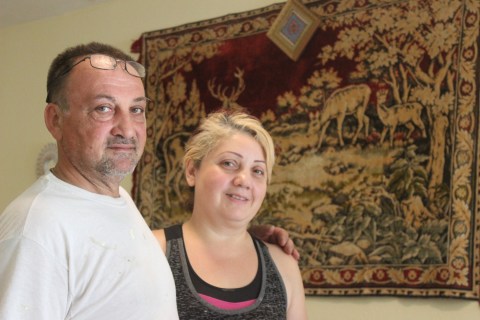
Shahen Musinian and Izabelle Kardian stand in the seating area of their new restaurant, Mush Armenian Kitchen, in Green Cove Springs. (Photo Credit Clay Today Online)
By Jesse Hollett
Clay Today Online
GREEN COVE SPRINGS, FL – Shahen Musinian and Izabelle Kardian believe the best way to share the history of their motherland Armenia is through their food.
The couple, having been married 28 years, lugged their culture through three separate countries – each more different than the last – and ended up in Green Cove Springs (just south of Jacksonville), the location of their new restaurant, Mush Armenian Kitchen.
Having opened for business Tuesday at 1600 Idlewild Ave., in a storefront just under 1,000 square feet, the menu contains Mediterranean staples absent from Green Cove Springs such as kebabs and gyros and house made hummus with some lesser known menu items such as baklava and baba ghanoush.
While not all items originated in Armenia, Armenian Mediterranean cuisine developed simultaneously and what they don’t share in geography, they make up for in the similar ingredients and spices used. Musinian said the menu items come from recipes he grew up eating and cooked for his family.
“I think it’s very important to keep our traditions, educate other people and kind of get them familiarized with other cultures and what they’re all about,” Kardian said. “We’re very family oriented, we’re very close, we like to get together and we wanted to bring that and this kind of family atmosphere to this place so that people can be comfortable.”
Many of the tapestries on the walls are works done by their parents. Below them sit framed printouts detailing historic sites, ruins and churches native to Armenia that Musinian and Kardian hope customers will enjoy while they eat.
The impetus behind the tableside printouts, Musinian said, is to help people better understand Armenia, a country he said most people know little about. “If I say I’m from Britain, I’m from England, everyone knows where England is,” Musinian said. “England is no older than Armenia…Armenia has somehow been forgotten in the world, but Armenia has given the world lots and lots of actors and war heroes – it’s got a rich, rich history.”

Their menu includes Mediterranean favorites and other dishes that will be new to some guests. The restaurant held a soft opening for friends and family on Oct. 13. (Photo Credit Clay Today Online)
Aside from sharing his culture with the community, owning a restaurant has always been one of Musinian’s dreams.
The family invested roughly $65,000 of savings and loans into the restaurant, storefront and equipment. Despite the cost, Musinian appeared delighted on his progress and business endeavor as they put the finishing touches on their storefront Monday.
“This really is as they say dreams come true, it’s a dream come true,” he said. It was a long trek to get where they are now, the two admitted.
Musinian and Kardian, along with their two children, immigrated from Armenia to Israel with their parents in 1993. Kardian’s parents sold their home in Armenia to pay for plane tickets to Israel.
Musinian said after the fall of the Soviet Union in in 1991, that Armenia’s infrastructure largely fell apart. The family rationed food and struggled to find water. Kardian said she was pregnant at the time the rationing began.
“The electricity was on 45 minutes a day – but you never knew when those 45 minutes were coming,” Kardian said.
They stayed in Israel for 10 years before the United States accepted the family as immigrants through its lottery system.
Kardian said owning the restaurant still feels like a dream. “He cooks really good, and we were joking at first, ‘oh, you need a restaurant,’” she said. “The kids were little and we were just trying to” get by.
“We came here without nothing,” she said. Mush kitchen is open for breakfast and lunch Tuesday through Sunday.
This story originally appeared in Clay Today Online, and is republished with the expressed written consent of the author.






 Florida Armenians