Blog Archives
Nova Southeastern University Actively Fundraising for Armenian Genocide Studies
By Aram Arkun
Armenian Mirror-Spectator Staff
FORT LAUDERDALE, FL — Armenian Studies is a small field, with a small number of academic specialists. The number of academic specialists on the Armenian Genocide is even smaller, and there are very few positions for them at universities in the United States. While this situation is unlikely to change drastically, occasionally efforts are made to initiate new academic programs and positions. Nova Southeastern University appears on the verge of making such an effort, if sufficient support and funding are found.
 Nova Southeastern University (NSU) is a relatively young university, founded in 1964, but it already is fairly large, with more than 28,000 students. Dr. Susanne Marshall, senior associate dean of operations and student services at NSU, explained that the university has had graduate programs in conflict resolution for many years. There are more than 800 students enrolled in them now. The focus of these programs has been on the international and governmental level. A few years ago, NSU hired a young faculty member, Jason J. Campbell, as a professor in these programs. Campbell had already founded a non-profit activist organization, the Institute for Genocide Awareness and Applied Research, in 2009. His research happened to focus on genocide and he suggested that it needed to be a more defined curricular focus. NSU agreed. (Despite repeated efforts to contact him, Campbell was unavailable to be interviewed for this article.)
It was already necessary to provide historical and sociopolitical backgrounds for analysis in the multidisciplinary field of conflict analysis, so genocide studies fit in well here, but the university wishes to expand its offerings further. Marshall said, “We would like to have a more independent framework for genocide studies and genocide prevention, and establish a separate degree program, or at least a concentration in master’s and doctoral programs. We are not quite there yet.”
The interest in Armenia came about through research into modern genocide. Marshall points out that “as Dr. Campbell demonstrates in his research, the Armenian Genocide is a blueprint for the genocides of the 20th and 21st centuries. You see all the factors here mirrored in later genocides, so you can learn a lot about prediction and prevention by studying this genocide.” In this sense, Marshall said, in-depth studies of the factors leading up to the Armenian Genocide can be quite useful. The approach at NSU is an activist one, so graduate students want to learn what can be done for prevention.
At the moment, the Armenian Genocide is a component of the courses on genocide being offered. It does not have a faculty member whose research specifically has been on the Armenian Genocide and does not offer Armenian language classes, but it has hosted relevant guest speakers and lectures. For example, Florida resident Margaret Ajemian Ahnert, author of the memoir A Knock at the Door, spoke there in 2008.
Not only does NSU want to expand its genocide studies programs, but it also wants to expand their Armenian component. At the moment, Marshall said, “A lecture series on issues connected to the Armenian Genocide or the early modern genocides is something we are considering. We could bring in people without making a faculty line available. We would like to make more resources specific to the Armenian Genocide available to our students.” However, due to financial difficulties, she stated that “whether we could get a full faculty position without additional funding available is unclear.”
Marshall added, “We are actively seeking funding. It would be a dream to be able to hire someone whose specific academic background is in Armenian Studies.”
Armenian language courses would be possible too, if funding was sufficient to hire an independent faculty member for this.
Marshall is not worried about any potential interference from the Turkish government. She said, “It is hard to envision resistance from a foreign government reaching what we are doing here at Nova SU in the curricular area, though I know it can happen. In any case, we are poised to move ahead at this point.”
NSU has a grant proposal pending with one Armenian foundation, and is looking at other grant sources as well as private donor funding. The university has a definite time frame in mind. Marshall explained that “the firm curricular framework that I would like to establish should really be announced at the one hundredth anniversary of the Genocide. That would be the most appropriate time for a new outreach program or a firm faculty member.”
There is at least one prominent Armenian-American already involved with NSU who would be supportive of such programs. Marta T. Batmasian is a member of the Board of Governors of the H. Wayne Huizenga School of Business and Entrepreneurship at Nova Southeastern. Furthermore, she and her husband in the past donated a large memorial to the Armenian Genocide, which stands at the entrance of the school.
Marshall concluded, “We are an attractive host for this sort of thing. We have a working program already. Our program in conflict resolution is available fully on line. The university is young and is able to move in the direction of where there is a need for learning. We have identified the Armenian Genocide and genocide in general as an area of critical importance to learn about.”
This article originally appeared in the Armenian Mirror-Spectator and is reprinted with the permission of the author.
Dr. Richard Hovannisian to Present ‘The Smyrna Catastrophe, 1922-2013’ at Boca Raton’s St. David Armenian Church
The Smyrna Catastrophe, 1922-2013
An Illustrated Lecture by
Dr. Richard Hovannisian
Co-sponsorsed by St. David Armenian Church
&
The National Association for Armenian Studies and Research (NAASR)

September, 2012 marked the 90th anniversary of the Smyrna catastrophe when much of the city, the second largest in the Ottoman Empire, was destroyed by fire four days after the Turkish army had occupied the city. The calamity, a part of the final phase of the Armenian Genocide, marked the end of a strong Christian presence in the historic Aegean coastal regions and turned hundreds of thousands of Greeks and Armenians into refugees.
In this illustrated lecture, Prof. Richard Hovannisian will discuss the important role of Smyrna (Izmir) in modern Armenian history and the inferno that engulfed the city in September, 1922. Hovannisian is the editor of the recently published Armenian Smyrna/Izmir, the eleventh volume of proceedings from the University of California Los Angeles (UCLA) conference series “Historic Armenian Cities and Provinces.” He also traveled to Izmir and environs in June, 2012 as the historian-guide for a NAASR Armenian Heritage Tour led by Armen Aroyan.
Professor Hovannisian was the first holder of the Armenian Educational Foundation Chair in Modern Armenian History at UCLA. He currently serves as Distinguished Chancellor’s Fellow at Chapman University in Orange County, CA and Distinguished Visiting Lecturer at the University of California, Irvine. He is the author of Armenia on the Road to Independence, the four-volume history The Republic of Armenia, and has edited and contributed to more than twenty-five books including The Armenian Genocide in Perspective; The Armenian People from Ancient to Modern Times; Remembrance and Denial; Looking Backward, Moving Forward; and The Armenian Genocide: Cultural and Ethical Legacies.

TIME & LOCATION
WHEN: Sunday, March 3, 2013 at 1:00 PM
WHERE: St. David Armenian Church, 2300 Yamato Rd., Boca Raton, FL 33431
The event is free and open to the public. A book signing of Armenian Smyrna/Izmir will immediately follow the lecture. For more information please contact St. David Armenian Church at (561) 994-2335 or stdavidarmchurch@bellsouth.net, or NAASR at 617-489-1610 or hq@naasr.org.
Armenian-Americans at RNC 2012: Support Mitt Romney for President
By Taniel Koushakjian
FLArmenians Political Contributor

The Tampa Bay Times Forum, Home of RNC 2012
Every four years, the campaign for the highest office of the land takes place. As candidates from the Republican Party navigated the choppy waters of the primary storm this election season, one man sailed to victory: former Massachusetts Governor Mitt Romney. Winning the party’s nomination was no easy feat and on several occasions, the media and members of his own party, were quick to write him off. However, Mitt Romney and his campaign rose to the challenge, and secured the 1,190 Republican Party Delegates necessary to clinch the nomination. No doubt, the battles he faced in the primary contest will come in handy when he goes head-to-head with President Obama.
Among these Republican Party Delegates, who are elected within their respective state party systems, were six Armenian-Americans. The States of Connecticut, Florida, Kentucky, Massachusetts, Michigan and Rhode Island were each represented by an official GOP Delegate of Armenian descent.
Harout Samra, an attorney in Miami said, “it was a privilege to attend the Republican National Convention as a delegate for Florida. Coming to the floor of the Convention hall for the first time was very exciting. Frankly, I did not expect to be as moved as I was. It was a great honor to have been selected to represent my fellow Floridians. That came home to me as I reached the floor. I genuinely enjoy interacting with people from different backgrounds. The United States is a remarkably diverse place, and I believe this diversity was represented not only in our delegation, but also in those of the other states. Florida’s delegation included first-generation Americans, such as myself, and longtime natives. It included Indian-Americans, Cuban-Americans, and even one Armenian-American.
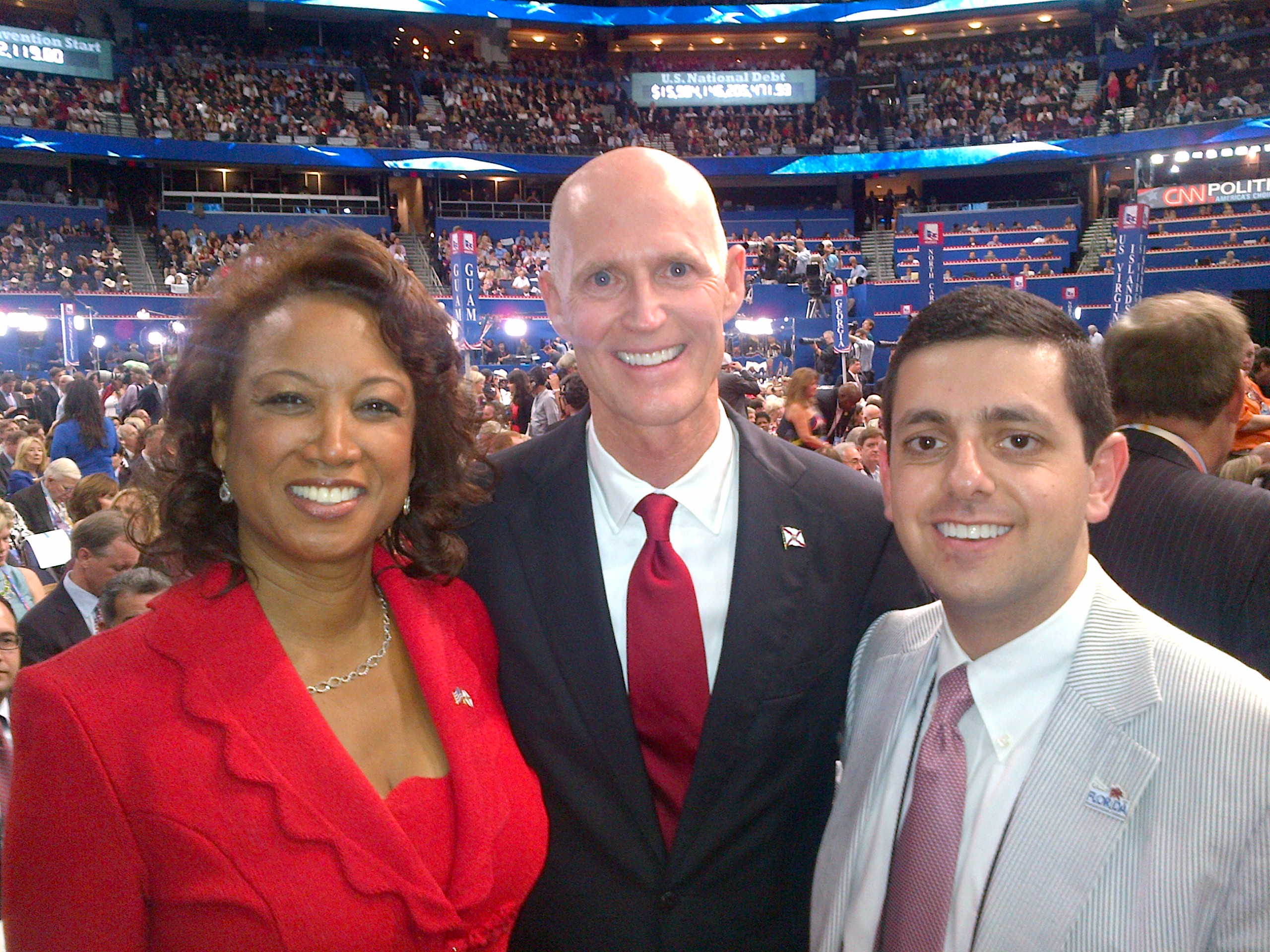
Florida Lt. Gov. Jennifer Carroll, Florida Gov. Rick Scott, Harout Samra
“Governor Romney knows and understands the issues that are important to Armenian-Americans. Living in Belmont and serving as the Governor of Massachusetts, he’s had more important contacts and relationships with the Armenian-American community than any President since Ronald Reagan. He will not mislead us and pander to us to get Armenian-American votes like President Obama.
“Governor Romney is the right man for the moment. He understands how to turn around the economy at home and to ensure that America is respected abroad. Unlike President Obama, Governor Romney’s top priority will be to create an environment that leads to more jobs and spurs economic growth,” stated Samra.
Another Republican Party Delegate, Bob Semonian, State Chairman of Massachusetts Republican Party-Ethnic Outreach expressed that he was “thrilled to attend the Republican National Convention in Tampa this year. Americans want honesty in the White House and Mitt Romney is an honest man who will best represent all of America,” stated Semonian, who also serves as the Armenian-Americans for Mitt Romney Coalition Massachusetts State Chair.

Bob Semonian with Josh Romney
From the Great Lakes State was Krista Haroutunian, who serves as the Republican Party Chair for the 13th Congressional District. She stated, “My time at the 2012 RNC was extremely important and made me proud to be American, an Armenian, and from Detroit, Michigan.” Haroutunian continued, “The first concern of an American, of whatever cultural or ethnic background, is the independence, freedom, and well-being of Americans. This allows us to be able to express concerns for Armenian issues and to assist appropriately.
“Mr. Romney knows that the founding fathers of America had great concerns about dictatorial attitudes and insisted upon a separation of powers – something Mr. Obama has side-stepped for the better part of four years. Mr. Romney wants to return to a Constitutional government through our elected Representatives. Mr. Obama wants all-pervasive government with the decision makers being unelected bureaucrats.
“The choice is clear – constitutional guarantees and responsibilities to preserve the rule of law versus arbitrary actions from a few with no guarantees of the rule of law. For all Armenians and all Americans, Mitt Romney is the best choice.”
Over the course of this year, several Armenian-Americans across the country, including the author, have been challenged on our position of supporting Governor Romney over President Obama. “What do you expect from Romney that will be different from Obama,” is the common intrigue. To put it plainly, like all Americans, we expect leadership, honesty and values from our elected officials. When it comes to Armenian issues, President Obama failed to fulfill his campaign pledge to acknowledge the Armenian Genocide as President. That calls into question his honesty. President Obama’s nomination and subsequent recess appointment of Matthew Bryza to serve as Ambassador to Azerbaijan was opposed by Senators of his own party, not to mention many Armenian-Americans. That calls into question his ability to lead. And the silence of the Obama administration on the destruction, confiscation and profiteering of Christian Armenian religious properties by the Turkish Government, as well as Azerbaijan’s completed destruction of centuries-old Armenian Khachkars at Julfa, call into question his values.
From Fresno to Philadelphia, from Manchester to Miami, from Detroit to Denver, from Waukesha to Washington, DC, Armenian-Americans have expressed their frustration with President Obama, and many former Armenian supporters of his are now backing Mitt Romney for President. In fact, one prominent Armenian-American who supported President Obama in 2008, and is now backing Governor Romney, expressed as much to the author. Speaking on the condition of anonymity, she shared her frustration: “Senator Obama chose to promise, in campaign speeches and written outreach, recognition of the 1915 genocide of Armenians at the hands of Ottoman Turks. He fully understood the importance of that issue to the Armenian American community and indeed to all right thinking Americans. Americans deserve a President who knows his principles and makes his decisions in accordance with those principles. Americans deserve a President who has integrity. So why come November would I vote for a President who over the course of four years has delivered precious little and lied to us and other communities?”
Indeed, why would we? She then confessed, “I’ll take a chance on Romney.”
This article originally appeared in the October 13, Volume 13 Print Edition of the Armenian Mirror-Spectator.




 Florida Armenians