Armenian Assembly Action Alert: Tell Congress to Push for Trump-Pashinyan Meeting

WASHINGTON, DC – This week, the Armenian Assembly of America issued an Action Alert calling on Armenian Americans across the U.S. to “contact your representative and ask them to urge President Trump to meet with Armenia’s Prime Minister, Nikol Pashinyan.”
The Congressional Caucus on Armenian Issues, led by Reps. Frank Pallone, Jr. (D-NJ), David Valadao (R-CA), Jackie Speier (D-CA), Dave Trott (R-MI), Adam Schiff (D-CA), and Gus Bilirakis (R-FL), is currently asking Members of Congress to sign a bipartisan letter “encouraging President Trump to meet with Armenia’s newly elected Prime Minister, Nikol Pashinyan, while he is in the United States for the 73rd Session of the United Nations General Assembly in September.”
The Assembly’s alert highlight’s Armenia’s “remarkable change in its government through peaceful and democratic means” following the April 2018 “Velvet Revolution.”
“This grassroots movement, led by Mr. Pashinyan, resulted in a transition to a more genuinely democratic system. In a small, post-Soviet and landlocked country like Armenia, this non-violent transfer of power between governments is unprecedented and incredible, especially compared to its authoritarian neighboring nations,” the Assembly alert states.
The Assembly’s alert further states that “a conversation between President Trump and Prime Minister Pashinyan emphasizing economic development, security, and democracy is critical for a strong pivot towards a strategic partnership between our countries.”
The Armenian Assembly of America’s Action Alert is available here.
Henry Morgenthau III, Grandson of Ambassador Morgenthau and Lifelong Supporter of US Affirmation of Armenian Genocide, Passes Away at 101
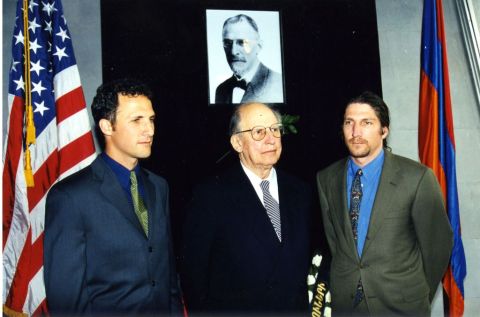
(L-R) Kramer Morgenthau, Henry Morgenthau III, and Dr. Henry Ben Morgenthau standing underneath a photo of Ambassador Henry Morgenthau at the Armenian Genocide Museum in Yerevan.
WASHINGTON, DC – The Armenian Assembly of America and Armenian National Institute mourn the loss of a longtime friend of the Armenian people, Henry Morgenthau III, who dedicated himself to honoring the memory of his grandfather, Ambassador Henry Morgenthau. He passed away on July 11.
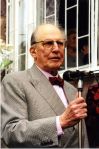
Henry Morgenthau III in Yerevan.
In countless public presentations, in television appearances, and in numerous publications, Henry Morgenthau III recounted his recollections of his grandfather with whom he lived in New York City. He was honored on many occasions by Armenian organizations across the country.
The Armenian National Institute and the Armenian Assembly of America shared the distinction of organizing Mr. Morgenthau’s trip to Armenia in 1999 where he was honored by the National Academy of Sciences, the Armenian Genocide Museum, and the City of Yerevan.
Morgenthau was joined by his sons Dr. Henry Ben Morgenthau and Kramer Morgenthau, as well as Armenian Assembly President Carolyn Mugar, longtime personal friend of Henry from the time of his residence in Cambridge, Massachusetts, and Mrs. Kitty Dukakis, wife of the former governor of the state of Massachusetts and a board member of the U.S. Holocaust Memorial Museum.

Armenian National Institute Director Dr. Rouben Adalian, Armenian Assembly President Carolyn Mugar, Kramer Morgenthau, Kitty Dukakis, Henry Morgenthau III, and Dr. Henry Ben Morgenthau at Tsitsernakaberd Armenian Genocide Memorial.
The Morgenthau delegation was received by the president of Armenia, Robert Kocharian, met with several other officials including U.S. Ambassador to Armenia Michael Lemmon, and was the guest of honor at the naming of a Yerevan city school in honor of Ambassador Morgenthau.
“My grandfather frequently told me that his attempts to save Armenian lives at the time of the Genocide and the establishment of the Near East Relief effort were the achievements that meant the most to him,” Morgenthau explained on the occasion. Ambassador Morgenthau served as President Woodrow Wilson’s emissary to the Ottoman Empire during World War I.
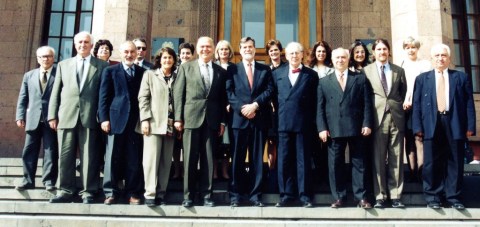
Front Row: Dr. Hrand Avetisyan, Dr. Pietro Kuciukian, Armenian Assembly President Carolyn Mugar, Dr. Richard Hovhannissian, Ambassador Michael Lemon, Henry Morgenthau III, Dr. Fadei Sargsyan, Dr. Henry Ben Morgenthau, and Dr. Lavrenti Barseghyan.
With Henry Morgenthau III’s endorsement, in 1996 the Armenian Assembly of America established the Henry Morgenthau Award for Meritorious Public Service which is given out to public officials in recognition of their contributions in defense of human rights. Recipients of the Assembly’s Morgenthau Award include the first U.S. Ambassador to the Republic of Armenia Harry Gilmore and U.S. Ambassador John Evans who publicly called for official U.S. recognition of the Armenian Genocide.

Former Armenian Assembly Chairman Hirair Hovnanian, Samantha Power, Henry Morgenthau III, Ambassador John Evans, and Armenian Assembly President Carolyn Mugar.
A friend also of the Armenian National Institute (ANI), Henry Morgenthau III encouraged the organization with symbolic gifts of $1915 and joined with supporters and Armenian Ambassador to the U.S. Tatoul Markarian in the opening of the ANI Library, to which he contributed his grandfather’s library.

Ambassador Tatoul Markarian, Henry Morgenthau III, and ANI Director Dr. Rouben Adalian at the opening of the ANI Research Library.
Henry Morgenthau III was an author and television producer. His family history, Mostly Morgenthaus, won the 1992 National Jewish Book Council prize for best memoir. He was a fellow at the Joan Shorenstein Center on the Press, Politics, and Public Policy at the Kennedy School of Government of Harvard University. Morgenthau’s shows on Boston’s public television station, WGBH, won Peabody, Emmy, UPI, EFLA and Flaherty Film Festival awards. Morgenthau also updated his grandfather’s memoir, Ambassador Morgenthau’s Story, with a lengthy postscript about the Ambassador’s life in the 2003 edition of the book published by Wayne State University Press.
Henry Morgenthau III’s brother, Robert Morgenthau, also a vocal advocate for Armenian Genocide recognition, served as District Attorney for New York County in Manhattan. Their father, Henry Morgenthau II, was Secretary of the Treasury under President Franklin D. Roosevelt.
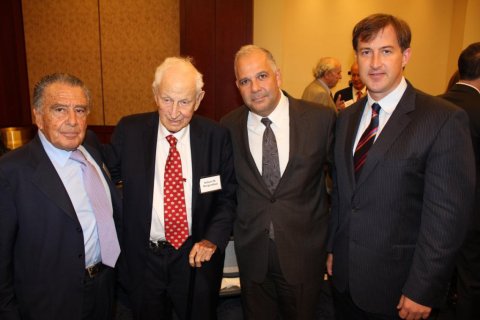
International Raoul Wallenberg Foundation Chairman Eduardo Eurnekian, Robert Morgenthau, Armenian Assembly Co-Chair Anthony Barsamian, and Assembly Executive Director Bryan Ardouny.
“The Armenian people have lost a true friend with Henry’s passing. His grandfather Ambassador Henry Morgenthau played a critical role as the first opponent of genocide on the world stage as he defended the Armenian people. With his first-hand familiarity of his grandfather’s legacy, Henry stood with the Armenian people throughout his life, always ready to step up immediately to lend his gravitas in support of all essential issues for Armenians,” stated Armenian Assembly President Carolyn Mugar.
“Despite his advancing age, Henry continued to participate in Armenian Genocide commemorative and advocacy events. He was honored at the community-wide Centennial Genocide Commemoration in Washington, D.C. in 2015, where he walked on stage surrounded by his children and grandchildren. The Morgenthaus are legendary within the Armenian community, who are grateful that this noted family validated their traumatic history as a people by informing the entire world,” she continued.
Carolyn added: “Henry was exemplary in carrying on Ambassador Morgenthau’s commitment to genocide recognition and prevention. We all honor him for his total resolve to relentlessly stand up and speak out against injustices of the past. He used his voice to deepen people’s recognition of the importance of acknowledging the truth in history and thereby using this truth to prevent the recurrence of atrocities.”

Henry Morgenthau III speaking at the Republic of Armenia Academy of Sciences Conference.
Established in 1972, the Armenian Assembly of America is the largest Washington-based nationwide organization promoting public understanding and awareness of Armenian issues. The Assembly is a non-partisan, 501(c)(3) tax-exempt membership organization.
Diaspora Must Do Better in Keeping Institutions

By Taleen Babayan
Guest Contributor
Among the maze-like streets of Bourdj Hammoud, where crossed wires hang on for dear life and the Armenian language swirls in the air exist buildings that evoke an integral part of Diasporan history. Once crown jewels, these landmarks now teeter on the edge of obsolescence — an unheard of development for the thousands who once called these corridors home.
Growing up, we all heard stories from our grandparents, who came of age during a significant make-or-break era. Genocide survivors themselves, or children of the brave who escaped the atrocities, they arguably helped save a race from succumbing to destitution. But the stories I heard from my grandfather were seldom set in his birthplace of Aintab. Instead, they took place in the port city of Beirut, in the hallways named after one of the Armenian people’s most revered poets.
While it had been three decades since his black leather laced wingtips tapped the concrete floors of the Vahan Tekeyan School, I still felt my grandfather’s presence in the classrooms and stairwells during a recent visit; the air tinged with his spirit and service. These were the very same pathways where he served as principal and taught his students, through both word and action, the pride in being Armenian and the importance of contributing to the nation and culture in a positive way. A lesson he made sure to instill in all his grandchildren.
At the height of the school’s success — in the gilded Golden Age of Lebanon in the 1960s and early 1970s — my grandfather oversaw the education of thousands of students, each a mere generation or two removed from the crippling Armenian Genocide, which could have very well expunged the remaining survivors. But it was the Vahan Tekeyan School, akin to a handful of its counterparts around the Diaspora, that rose to the occasion — and lifted those students to their rejuvenated feet, citing countless successful alumni in its wake.
But now these venerable institutions are at a crossroads. And it is not just limited to Beirut and the political upheaval of the Middle East. Each carefully constructed Diasporan community, which built up communities and neighborhoods in their adopted countries, is vulnerable.
Armenians are capable of building — there is no doubt about that — but are they capable of preserving?
Far away from the turquoise ripples of the Mediterranean, the polluted East River envelopes the St. Vartan Cathedral, home to the Eastern Diocese, which is on its way to purportedly selling its air rights for $50 million. The Diocesan Council, ostensibly a democratically-elected body, has not been forthright in its public pronouncements of this rumored deal, which according to New York real estate savvy individuals, is well below market value.
What would the founders of the cathedral — those genocide survivors who barely made it to the U.S. with only the tattered clothes on their back — have to say about this charade? And how would they feel about the fact that the new wave of donors who picked up where their forefathers left off were shut out of this ill-conceived undertaking? The cathedral elevated the Armenian Diaspora to new heights in the New World — a golden dome smack dab in the middle of midtown Manhattan. To sell its coveted air rights, for a short-term fix, is shortsighted, to say the least.
Where is the vision that was once tirelessly pursued by leaders of our beloved institutions? It was only 50 years ago, that after decades of tireless fundraising, the doors swung open to thousands of faithful as the 12 Godfathers of St. Vartan Cathedral, their eyes brimming with tears, stood alongside His Holiness Vasken I, of blessed memory, as he consecrated the first Armenian cathedral in the Western Hemisphere.
Why is it that so few today are questioning the status quo and demanding better governance? Why are rational voices stifled as calls for a transparent conversation are neglected? Why are donors quickly called upon in times of financial need but not during times when their opinion should matter most? From top to bottom there is no accountability, discipline or leadership. Could this be a sign of national amnesia — a nation that is tired of itself?
My grandfather, though rooted in tradition, was a keen proponent of vision. In fact it was this vision early on in his tenure that expanded the Vahan Tekeyan School from an aluminum hovel to a robust, concrete building, all within the course of 10 years. What he was averse to, however, was mismanagement. With thousands of students and hundreds of faculty under his wing, he traveled around the world to fundraise — before, during and after the devastating Lebanese Civil War — inspiring donors to give to the educational institution during a time when the Diaspora wasn’t even half as prosperous as it is now. So for those in decision-making positions to claim that these institutions can’t be supported anymore, financially, is therefore, a complacent response. It should be the priority of leadership to be fiscally responsible. In this case, the Diocesan Council needs to shore up continued support and interest to sustain the Diocesan Center and St. Vartan Cathedral instead of throwing in the towel — and that can only be achieved by regaining trust in donors and ruling, not with an iron fist, but through transparency and consensus. Prudence and foresight — not egos and backroom deals — should lead commercial deals of this magnitude.
These historic institutions don’t just support local communities; they support the Diaspora as a whole. And a strong Diaspora is a prerequisite for a strong Armenia. I vividly recall all of my grandfather’s students who would visit him, years after he retired from a 60-year career in education and public service. He remembered each one by face, by name, by voice. Tekeyan wasn’t just a school or a job to him. It was his life. His family. Each of those students were his children. So much so that 30, 40, even 50 years later, they still referred to him as their “Harkeli Baron Dnoren Yervant Babayan.” My grandfather, who studied in Paris, spoke five languages and could have easily remained in Europe and entered a fruitful life in the private sector, gave his heart to the Vahan Tekeyan School and that is an integral reason for its bone-deep impact. In the case of the Eastern Diocese, there seems to be no business sense, but more dangerously, there seems to be no heart. And with no heart, there can be no pulse.
Lack of funds is not the real problem. Apathy is the evil. St. Vartan Cathedral and the Diocesan Complex were built by thousands of donors, large and small, and there are thousands of donors who still give, large or small, myself included. Yet it’s being torn down by a few in front of our own eyes. I’m sure I’m not the only one who remembers the heyday of the dynamic activities of the cathedral and the Diocese: the headline-making all-inclusive One World Festival, the vibrant Armenian school programs, or the talented theater ensemble.
Based on contemporary history, the culturally rich Diasporan communities in the Middle East have faced political turmoil and conflict in addition to financial burdens. It is, to an extent, understandable that the most influential Diasporan communities — Beirut, Aleppo, Tehran, Baghdad, Cairo — don’t have the sizable presence they once did, though they continue to possess innate vigor to keep their communities alive. But what about the so-called stable communities in, say, Paris, London or New York? Aren’t they also on the verge of gradually dying out? Could the prospect of apathy and assimilation be even more menacing than that of political conflict?
Selling the air rights may spur a fatal domino effect, setting the precedent for New York City’s St. Vartan Cathedral and Eastern Diocese to become an “in memoriam” like many other Diasporan institutions, that too, weren’t “sustainable” anymore, vanishing into the annals of unrecorded history.
As Armenians, it is not that we can do better, it is that we must do better. Isn’t it time to override the corroding dysfunction that plagues many Armenian organizations? We must expect more from those who sought to assume leadership positions. We must read their intentions, their motives and their abilities before entrusting them to make these critical decisions. And we must examine if they are indeed upholding their duties. Above all, we must honor and respect donors — those who have built, stone by stone, the very bedrock of our most revered Diasporan institutions.
I thought fondly of those donors and their sacrifices as I made my way out of the Vahan Tekeyan School, pleased to witness the dedicated staff in action. While stepping back onto the maze-like streets of Bourdj Hammoud, a teacher stopped me. He proudly revealed a book given to him by my grandfather, who had authored the tome. Our family ties went back — his father was a student of my grandfather’s in Aleppo when he had served as principal of the Giligian School. And the teacher, himself a graduate of the Vahan Tekeyan School and a holder of a master’s degree, chose to educate the next generation at his alma mater. As he clutched the book, he told me he still read through the pages for guidance and inspiration, my grandfather’s lessons, too, ringing in his ears.
That, dear reader, is my legacy. What is yours? And more importantly – what are you doing to protect it?
This article originally appeared in the Armenian Mirror-Spectator and is reprinted with the expressed written consent of the author.




 Florida Armenians