Diaspora Must Do Better in Keeping Institutions

By Taleen Babayan
Guest Contributor
Among the maze-like streets of Bourdj Hammoud, where crossed wires hang on for dear life and the Armenian language swirls in the air exist buildings that evoke an integral part of Diasporan history. Once crown jewels, these landmarks now teeter on the edge of obsolescence — an unheard of development for the thousands who once called these corridors home.
Growing up, we all heard stories from our grandparents, who came of age during a significant make-or-break era. Genocide survivors themselves, or children of the brave who escaped the atrocities, they arguably helped save a race from succumbing to destitution. But the stories I heard from my grandfather were seldom set in his birthplace of Aintab. Instead, they took place in the port city of Beirut, in the hallways named after one of the Armenian people’s most revered poets.
While it had been three decades since his black leather laced wingtips tapped the concrete floors of the Vahan Tekeyan School, I still felt my grandfather’s presence in the classrooms and stairwells during a recent visit; the air tinged with his spirit and service. These were the very same pathways where he served as principal and taught his students, through both word and action, the pride in being Armenian and the importance of contributing to the nation and culture in a positive way. A lesson he made sure to instill in all his grandchildren.
At the height of the school’s success — in the gilded Golden Age of Lebanon in the 1960s and early 1970s — my grandfather oversaw the education of thousands of students, each a mere generation or two removed from the crippling Armenian Genocide, which could have very well expunged the remaining survivors. But it was the Vahan Tekeyan School, akin to a handful of its counterparts around the Diaspora, that rose to the occasion — and lifted those students to their rejuvenated feet, citing countless successful alumni in its wake.
But now these venerable institutions are at a crossroads. And it is not just limited to Beirut and the political upheaval of the Middle East. Each carefully constructed Diasporan community, which built up communities and neighborhoods in their adopted countries, is vulnerable.
Armenians are capable of building — there is no doubt about that — but are they capable of preserving?
Far away from the turquoise ripples of the Mediterranean, the polluted East River envelopes the St. Vartan Cathedral, home to the Eastern Diocese, which is on its way to purportedly selling its air rights for $50 million. The Diocesan Council, ostensibly a democratically-elected body, has not been forthright in its public pronouncements of this rumored deal, which according to New York real estate savvy individuals, is well below market value.
What would the founders of the cathedral — those genocide survivors who barely made it to the U.S. with only the tattered clothes on their back — have to say about this charade? And how would they feel about the fact that the new wave of donors who picked up where their forefathers left off were shut out of this ill-conceived undertaking? The cathedral elevated the Armenian Diaspora to new heights in the New World — a golden dome smack dab in the middle of midtown Manhattan. To sell its coveted air rights, for a short-term fix, is shortsighted, to say the least.
Where is the vision that was once tirelessly pursued by leaders of our beloved institutions? It was only 50 years ago, that after decades of tireless fundraising, the doors swung open to thousands of faithful as the 12 Godfathers of St. Vartan Cathedral, their eyes brimming with tears, stood alongside His Holiness Vasken I, of blessed memory, as he consecrated the first Armenian cathedral in the Western Hemisphere.
Why is it that so few today are questioning the status quo and demanding better governance? Why are rational voices stifled as calls for a transparent conversation are neglected? Why are donors quickly called upon in times of financial need but not during times when their opinion should matter most? From top to bottom there is no accountability, discipline or leadership. Could this be a sign of national amnesia — a nation that is tired of itself?
My grandfather, though rooted in tradition, was a keen proponent of vision. In fact it was this vision early on in his tenure that expanded the Vahan Tekeyan School from an aluminum hovel to a robust, concrete building, all within the course of 10 years. What he was averse to, however, was mismanagement. With thousands of students and hundreds of faculty under his wing, he traveled around the world to fundraise — before, during and after the devastating Lebanese Civil War — inspiring donors to give to the educational institution during a time when the Diaspora wasn’t even half as prosperous as it is now. So for those in decision-making positions to claim that these institutions can’t be supported anymore, financially, is therefore, a complacent response. It should be the priority of leadership to be fiscally responsible. In this case, the Diocesan Council needs to shore up continued support and interest to sustain the Diocesan Center and St. Vartan Cathedral instead of throwing in the towel — and that can only be achieved by regaining trust in donors and ruling, not with an iron fist, but through transparency and consensus. Prudence and foresight — not egos and backroom deals — should lead commercial deals of this magnitude.
These historic institutions don’t just support local communities; they support the Diaspora as a whole. And a strong Diaspora is a prerequisite for a strong Armenia. I vividly recall all of my grandfather’s students who would visit him, years after he retired from a 60-year career in education and public service. He remembered each one by face, by name, by voice. Tekeyan wasn’t just a school or a job to him. It was his life. His family. Each of those students were his children. So much so that 30, 40, even 50 years later, they still referred to him as their “Harkeli Baron Dnoren Yervant Babayan.” My grandfather, who studied in Paris, spoke five languages and could have easily remained in Europe and entered a fruitful life in the private sector, gave his heart to the Vahan Tekeyan School and that is an integral reason for its bone-deep impact. In the case of the Eastern Diocese, there seems to be no business sense, but more dangerously, there seems to be no heart. And with no heart, there can be no pulse.
Lack of funds is not the real problem. Apathy is the evil. St. Vartan Cathedral and the Diocesan Complex were built by thousands of donors, large and small, and there are thousands of donors who still give, large or small, myself included. Yet it’s being torn down by a few in front of our own eyes. I’m sure I’m not the only one who remembers the heyday of the dynamic activities of the cathedral and the Diocese: the headline-making all-inclusive One World Festival, the vibrant Armenian school programs, or the talented theater ensemble.
Based on contemporary history, the culturally rich Diasporan communities in the Middle East have faced political turmoil and conflict in addition to financial burdens. It is, to an extent, understandable that the most influential Diasporan communities — Beirut, Aleppo, Tehran, Baghdad, Cairo — don’t have the sizable presence they once did, though they continue to possess innate vigor to keep their communities alive. But what about the so-called stable communities in, say, Paris, London or New York? Aren’t they also on the verge of gradually dying out? Could the prospect of apathy and assimilation be even more menacing than that of political conflict?
Selling the air rights may spur a fatal domino effect, setting the precedent for New York City’s St. Vartan Cathedral and Eastern Diocese to become an “in memoriam” like many other Diasporan institutions, that too, weren’t “sustainable” anymore, vanishing into the annals of unrecorded history.
As Armenians, it is not that we can do better, it is that we must do better. Isn’t it time to override the corroding dysfunction that plagues many Armenian organizations? We must expect more from those who sought to assume leadership positions. We must read their intentions, their motives and their abilities before entrusting them to make these critical decisions. And we must examine if they are indeed upholding their duties. Above all, we must honor and respect donors — those who have built, stone by stone, the very bedrock of our most revered Diasporan institutions.
I thought fondly of those donors and their sacrifices as I made my way out of the Vahan Tekeyan School, pleased to witness the dedicated staff in action. While stepping back onto the maze-like streets of Bourdj Hammoud, a teacher stopped me. He proudly revealed a book given to him by my grandfather, who had authored the tome. Our family ties went back — his father was a student of my grandfather’s in Aleppo when he had served as principal of the Giligian School. And the teacher, himself a graduate of the Vahan Tekeyan School and a holder of a master’s degree, chose to educate the next generation at his alma mater. As he clutched the book, he told me he still read through the pages for guidance and inspiration, my grandfather’s lessons, too, ringing in his ears.
That, dear reader, is my legacy. What is yours? And more importantly – what are you doing to protect it?
This article originally appeared in the Armenian Mirror-Spectator and is reprinted with the expressed written consent of the author.
Senators Introduce Bill Demanding Turkey End Unjust Detention of US Citizens

Legislation Requires U.S. to Reject International Loans to Turkey Until Campaign of Harassment and Detention Ends
WASHINGTON, DC – On Friday, U.S. Senators Bob Corker (R-TN) and Bob Menendez (D-NJ), chairman and ranking member of the Senate Foreign Relations Committee, introduced bipartisan legislation with Senators Thom Tillis (R-NC), Jeanne Shaheen (D-NH), James Lankford (R-OK), and Bill Nelson (D-FL) to restrict loans from international financial institutions to Turkey until the Turkish government ends the unjust detention of U.S. citizens. In 2016, Turkey imprisoned American Pastor Andrew Brunson and indicted him on unsubstantiated charges earlier this year. A Turkish court ruled Thursday that Brunson will remain in custody until the next hearing on his case in October. In April, the senators led a bipartisan group of 66 senators in a letter to Turkish President Recep Tayyip Erdogan demanding Brunson’s release. Other U.S. citizens, locally employed staff of the U.S. embassy, and tens of thousands of Turkish citizens still face unacceptable harassment and human rights violations by the Government of Turkey.
“Erdogan continues to undermine Turkey’s democracy, crack down on journalists and violate human rights. And he continues to hold Pastor Brunson on completely baseless charges. This thuggish behavior must not go unchecked,” said Senator Nelson.
The Turkey International Financial Institutions Act directs the U.S. executive of the World Bank and the European Bank for Reconstruction and Development (EBRD) to oppose future loans, except for humanitarian purposes, to Turkey by the International Finance Corporation (IFC) and EBRD until the administration can certify to Congress that Turkey is “no longer arbitrarily detaining or denying freedom of movement to United States citizens (including dual citizens) or locally employed staff members of the United States mission to Turkey.”
Turkey relies heavily on loans from both the IFC and EBRD. In 2017, Turkey ranked second among all IFC recipients with $927 million in new long-term commitments. Turkey was the largest EBRD borrower in 2017, securing about $1.8 billion in new commitments.
Text of the legislation is available here.
An Unforgettable Summer
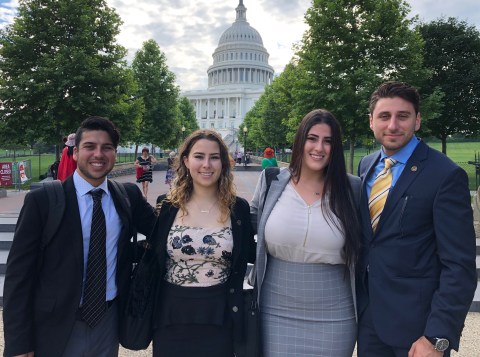
Mireille Samra (center right) with Armenian American interns on Capitol Hill
By Mireille Samra
Special Guest Contributor
After packing my five very heavy suit cases, I felt prepared to enter my direct flight to Washington D.C. Why might a South Florida native fly to Washington D.C. other then touring all the national monuments and museums? The simplest answer is to learn. My name is Mireille Samra and I am currently enrolled in the Armenian Assembly of America’s Terjenian-Thomas Summer Internship Program in Washington, D.C. Through the internship with the Assembly, I was placed on Capitol Hill, in the Office of Congressman Gus Bilirakis (R-FL), Vice Chairman of the Armenian Caucus in Congress.

President of Armenia, Armen Sargsyan with Mireille Samra at the Embassy of Armenia in Washington, D.C.
As an intern with the Armenian Assembly this summer, I have gained several new professional and personal connections. I was able to meet the President of Armenia twice in one day, along with the honorable First Lady of Armenia, on their first official visit to the U.S. So far, the 2018 class of Assembly interns have met with several community, political, and industry leaders. Early on, we met with the Director of the Armenian National Institute (ANI), Dr. Ruben Adalian. ANI provides historical information concerning the Armenian Genocide. In addition, the Assembly program provides us with direct meetings with elected officials, such as Congresswoman Jackie Speier (D-CA), Congressman Bilirakis, and Senator Ed Markey (D-MA), to name a few.

Armenian Assembly interns talking with Rep. Gus Bilirakis (R-FL) in his Capitol Hill office.
Currently, I have only been in D.C. for about one month. In that short amount of time, I have been learning things I could have never expected to learn, from how the metro (subway) system works, and the fact that finding parking in Washington, D.C. is like winning the lottery! Growing up, I’ve been known for always taking opportunities and not thinking much about them. Truthfully, this internship has taught me a lot. A typical workweek is Monday through Friday, 9:00am to 6:00pm, most days. Working on Capitol Hill, the people you meet are endless. Just last week I was giving a tour of the Capitol when the Queen of Jordan Rania Al-Abdullah walked by a few feet away from me! Something that keeps the internship on the Hill very interesting is that no two days are ever the same. For any Armenian American that is passionate about working hard in a big city and learning, the summer internship with the Armenian Assembly of America is a must before graduating.
Mireille Samra is a resident of Boca Raton, Florida and an active member of the South Florida Armenian American community. She graduated from Spanish River High School and currently studies Criminal Justice at Lynn University in Boca Raton.




 Florida Armenians