St. David Armenian Church Youth Reorganize, Community Lay Leaders Participate in Religious Education Program
ST. DAVID ARMENIAN CHURCH YOUTH REORGANIZE, COMMUNITY LAY LEADERS PARTICIPATE IN RELIGIOUS EDUCATION PROGRAM
Boca Raton, FL – On Sunday, September 11, 2011, the Armenian Church Youth Organization of America (ACYOA) Jrs. and Srs. gathered at St. David Armenian Church to reorganize the chapter and elect new officers. The meeting was presided by the Very Rev. Dr. Nareg Berberian, Pastor.
Fr. Nareg introduced FLArmenians Contributor George Macarian as the new Youth Advisor of the ACYOA Chapter at St. David Armenian Church.
Currently, there are over 20 ACYOA members. George Macarian explained that through his leadership, many programs and activities will be organized for them with the assistance of a new ACYOA Executive Board. There will be religious, educational, and social activities for them. During the meeting, five new officers were elected in the executive board.

St. David ACYOA Jrs. & Srs.
Florida Armenians would like to congratulate the newly elected officers and wish all the members a very successful year. We also congratulate George Macarian who recently graduated from the University of Florida, and has moved back to Boca Raton. He will be a great asset to the St. David chapter as a Youth Advisor and a liaison to the ACYOA Central Council.
In addition, the Diocesan Assembly has declared the upcoming year as “The Year of Lay Ministry.” Very Rev. Dr. Nareg Berberian has initiated a Religious Education Program for the lay leadership of our Church, so that the participants will closely study the faith, history and theology of the Armenian Church.
This seven week course is designed to enhance the knowledge of our lay leaders in the faith and theology of the Armenian Apostolic Church, while fulfilling their role as “Lay Ministers” of St. David Armenian Church. Participants will meet regularly every Thursday through October and further attendance from the community is highly encouraged.
The Religious Education Program will offer the following themes: The Sacraments of the Armenian Church, the Apostolicity of the Armenian Church, the Divine Liturgy, the Understanding of the Holy Trinity, the Theology of Death and Dying, the Holy Bible, and Contemporary issues the Armenian Church faces today.

St. David Armenian Church Lay Leaders
On Thursday, September 15, 2011, from 7:00 – 9:00p.m., more than 25 Lay Leaders participated in the first lecture series. Fr. Nareg spoke eloquently about the sacraments of the Armenian Church and its impact in our lives. He emphasized that the sacraments of the Church are the means to enter into the vineyard of the Lord and enhance our faith by maintaining its divine mystery in our lives. “Since we are offered to the altar of God during our baptism, we are called for the first time to become lay ministers of the Church and live through faith, hope and love,” stated Fr. Nareg.
In his remarks to the participants, Fr. Nareg noted, “To be a successful and effective lay minister, it is prerequisite to gain knowledge of the basic teachings of our Church so you may be able to identify yourself with the history and faith that you are called upon to serve as a representative of your church community. Without that basic knowledge, a lay minister will fail in his/her ministry.”
The participants were captured by the theme and fully engaged in a theological discussion. Carol Norigian, Diocesan Delegate and Chair of the Women’s Guild reflected, “As I continue to study about our Church, my faith and my service in the Armenian Church will strengthen, and I will appreciate the theology and the ancient tradition passed onto us through the generations.”

St. David Armenian Church Religious Education Program
On Sunday, September 18, 2011, the Diocesan theme was introduced to the parishioners of our Church. Fr. Nareg delivered a sermon based on Jesus’ word, “Follow me.” He focused on three points: 1) The Call comes from Christ; 2) The Call is simple; and 3) The Call is transformative. Being an active parish in our Diocese, St. David Armenian Church will continue to follow the directives sent by the Diocese to strengthen the lay leadership of the Church through educational and outreach programs.
The next course in the Religious Education Program will discuss the Divine Liturgy (Holy Badarak) of the Armenian Church, on Thursday, September 29, 2011.
Recently, our Pastor published his first handbook entitled, “Walking Through the Armenian Faith and History: An Instructional Handbook,” which will be unveiled in February 2012.
Chef John Minas adds Armenian Flair to Florida Fare as New Executive Chef at the Governor’s Mansion
Chef John Minas adds Armenian Flair to Florida Fare as New Executive Chef at the Governor’s Mansion
By Doug Kalajian
FLArmenians Cuisine Contributor
Ask anyone with a glimmer of culinary consciousness about Florida cuisine and you’ll most likely hear a tale of Caribbean-Latin fusion that sizzles like the sands of South Beach.
Then ask Chef John Minas.
For one of his first dinners as Executive Chef at the Florida governor’s mansion, Minas served notice that there’s a new culinary accent in the Sunshine State: Armenian.
“I made grape leaves,” he said proudly.
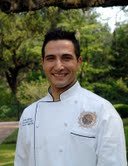
Executive Chef John Minas
Minas, who grew up in the deep-rooted Armenian community of Watertown, Mass., inherited a love of food from his Armenian and Assyrian family. He credits his paternal grandfather, Bashir Minas, with inspiring him.
“Every Sunday, we’d go to my grandfather’s house,” he said. “He cooked the best Armenian and Middle Eastern food I ever tasted. Dolmas, sarmas. And his fasoulia — oh my gosh! He made it all and he made it amazing. He wasn’t a trained chef, but he was a great cook.”
On weekdays, young Minas rushed home from high school to watch the back-to-back shows of Food Network pioneers Emeril Lagasse and Mario Batali. “Those guys were all about the food and the technique,” he said.
The idea took hold that he could meld the elegance and discipline of Western fine dining with the flavors and ingredients he grew up with.
After training at the prestigious Culinary Institute of America in Hyde Park, New York, Minas worked at several restaurants in the Northeast and was planning to open his own when he heard about the unique opportunity in far-off Tallahassee, Florida. He sent a resume and got a quick invitation for an interview on April 11, his 26th birthday.
The interview turned out to be an audition.
“All of a sudden I was cooking breakfast at the mansion,” he said. “That was followed by lunch and then dinner.” While he was at it, Minas volunteered an afternoon snack, “a real mezze platter” including feta cheese and pita bread.
Nearly every dish in his day-long cooking marathon reflected Minas’ cultural connection.
“My dinner entree was a watercress tabbouleh with Chilean sea bass and grilled asparagus,” he said. “It was a French take on Middle Eastern. I’m very big on that.”
The fourth of six candidates to try out, Minas was barely back in Boston when he received news that he’d been hired. He started his new job in May and launched straight into an exciting yet demanding routine. Minas supervises all planning and preparation for a whirlwind of state dinners and charity events as well as daily meals for Gov. Rick Scott and First Lady Ann Scott.
Minas said he’s excited about Florida’s rich variety of fresh seafood and produce, but the job has kept him so busy that he’s had limited opportunity to travel around the state. “I’m really looking forward not only to getting to know the state, but to meet the Armenians here,” he said. “I want to get to Boca Raton and all the other Armenian communities.”
So far, Minas has brought not only Armenian touches to the mansion menu but other Middle Eastern favorites.
“I take our cuisine and try to make it relevant for a new generation,” he said. “I make a very refined hummus, with several variations on a plate. For example, a kalamata hummus served with traditional pita chips and a basil-pesto hummus with tomato pita chips. It’s no better than my mother’s hummus, but it’s my version.”
Gov. Scott has become such a fan that he appointed Minas and his sous chef, Carin Butler, to represent the state in the 2011 Great American Seafood Cook-Off in New Orleans. “John is a talented chef and cooks up some of the best food I’ve ever tasted,” the governor announced. “He’s going to give those other chefs a run for their money.”
Minas presented a Florida black grouper with avocado crème fraiche and spicy shrimp toast that he said “tastes like the state of Florida on a plate.” He didn’t win, but he wasn’t discouraged.
“I’m just getting started,” he said. “The job and the people here are wonderful. I plan to be in Tallahassee for a long time. Then, who knows?”
Doug Kalajian is a retired journalist in Palm Beach County and Sous Chef at http://www.TheArmenianKitchen.com.
American, Turkish and Armenian Universities Participate in Joint Tourism Project
By Taniel Koushakjian
FLArmenians Political Contributor
A joint tourism project between the United States, Turkey and Armenia has been actively working to foster greater cooperation and integration between the three countries and between Armenia and Turkey in particular. The project, entitled “A Multilateral University Consortium to Strengthen Tourism Education, Research, and Industry Outreach,” is led by the University of Florida (UF) along with Dokuz Eylul University (DEU) in Turkey, and the Armenian State University of Economics (ASUE).
ATA Fellows
The consortium or American-Turkish-Armenian (ATA) Fellows, is a 21-member team of expert academics and practitioners with diverse experiences and backgrounds. The ATA Fellows work to promote collaboration between American, Turkish and Armenian academic institutions in the travel and tourism industry and will bring together private sector actors to research, train, educate, build and strengthen capacity within the context of sustainable regional tourism development. According to the Eric Friedheim Tourism Institute at the University of Florida, “The prospect to promote cultural understanding, mutual respect and peace via travel and tourism is a monumental opportunity to strengthen dialogue between Turkey and Armenia whose relations have been strained by a number of historical and political issues. Travel and tourism, education and research partnerships between Turkey and Armenia can facilitate the normalization of relations between the two nations.” The project was initiated in September 2010 through a grant by the U.S. Department of State-Embassy in Ankara.
The stated goals of the ATA Fellows are to: promote more sustainable tourism development; enhance cultural and environmental awareness; diminish the negative impacts of tourism; diversify tourism products; brand the region as a sustainable, safe and quality tourism brand; improve human capital with a focus on non-elite groups; promote mutual trade and investment, investment in tourism infrastructure (i.e. hotels, attractions, etc.); enhance cross-cultural interaction, exchange and understanding; facilitate the normalization of relations between the two nations; stimulate economic development in the region; and ultimately promote regional peace.
“This project is one of those rare opportunities of life accomplishment, a cause for the greater good of the world community,” stated Dr. Asli Tasci, ATA Fellows Project Director at the University of Florida. “With the initiation and leadership of the University of Florida, two educational institutions from Turkey and Armenia were stimulated to pull their resources together and put tourism at work for peace,” Dr. Tasci told FLArmenians.
Track II Diplomacy
Secretary of State Hillary Clinton visited Turkey last month and met with Turkish officials to discuss a broad range of issues, including Armenian-Turkish normalizations of relations. According to an RFE/RL report, “She encouraged Turkey to support and move the [Turkish-Armenian] protocols, which have been stuck in the Turkish parliament, but more generally to reach out to Armenia with confidence-building measures and do whatever possible to strengthen that relationship, leading ultimately to restored diplomatic ties.”
The Foreign Ministers of Armenia and Turkey signed two historic protocols, on the normalization of relations and the establishment of diplomatic relations, in Zurich, Switzerland on October 10, 2009, in the presence of the U.S. Secretary of State Hillary Clinton, Russian Foreign Minister Sergei Lavrov, French Foreign Minister Bernard Kouchner, and Swiss Foreign Minister Michele Calmy-Rey. However, despite the stalling of Armenian-Turkish rapprochement, civil society institutions, non-governmental organizations (NGOs), academics, journalists and human rights activists from Armenia and Turkey have continued to work to promote cross-cultural understanding and awareness. As Track I diplomacy seems to be grinding to a halt, Track II diplomacy is rapidly picking up the pace.
A recent headline in the Turkish Hurriyet Daily News read, “Confidence-building steps planned toward Armenia.” In the absence of Turkish political will to ratify the protocols, the author sites several steps that the Turkish side aims to take in the next few years to keep the rapprochement process moving forward. Although nothing official has been announced, some ideas cited by the author include opening a Turkish Airlines office in Armenia, visits to Armenia and Georgia by Turkish Education Ministry officials, and the opening of certain border crossings.
In addition, it was reported that Turkish companies have now begun organizing package tours to Armenia. According to the Hurriyet Daily News, “A joint enterprise between two Turkish-based tourism companies is planning to organize special package tours from Turkey to Armenia in August, even though the two countries’ borders have remained closed since 1993.” Dikran Altun, owner of Tower Turizm told Hurriyet: “Unfortunately, our people do not know each other – hence their hesitation to travel,” adding that Turkish and Armenian tourists who are interested in visiting each other’s countries for the first time always ask if it is safe to travel.
Also, just a few weeks ago, an association of Armenian and Turkish travel agencies was established in Yerevan, Armenia. According to News.am, 27 businessmen and NGO representatives from Turkey were invited to Armenia to participate in the forum. During the forum a memorandum was signed to promote mutual and international tourism aimed at developing economic relations between the two countries.
Furthermore, in a separate project through the International Center for Journalists, several reporters from Armenia and Turkey recently visited media outlets throughout the United States, including the Tallahassee Democrat.
Current U.S. Ambassador to Turkey, Francis Ricciardone, who is serving a 1-year recess appointment set to expire at the end of this year, testified before Congress earlier this month. His testimony states: “Facilitating regional integration is a high priority for the United States. Rapprochement between Turkey and Armenia will foster increased stability and prosperity in the Caucasus region. We commend the governments of Turkey and Armenia in signing the historic protocols on normalization of relations on October 10, 2009 in Zurich. During her visit last month, Secretary of State Clinton again urged Turkey to ratify the protocols, and we will continue to support programs that build understanding between Turks and Armenians.”
While the international community would like to see the two protocols ratified, and thus the opening of the Armenian-Turkish border and the establishment of diplomatic relations, it is apparent that efforts on the grassroots level will continue to build the confidence and good will necessary for both populations to live in peace.
“I am pleased to be a part of the ATA Fellows initiative and to have the opportunity to work in an environment that promotes a peaceful exchange and builds a cross-cultural understanding between Turks and Armenians through tourism,” stated Dr. Artak Manukyan, Armenian Project Director at ASUE. “We are looking forward to the upcoming field trips and to hosting our American and Turkish colleagues in Armenia,” Dr. Manukyan told FLArmenians.
ATA Fellows Project Activities
Since its inception, the ATA Fellows have initiated a number of assignments and activities to fulfill four main goals: Curriculum Development; Research; Industry Outreach; and Capacity Building. These goals will be realized through a serious of meetings in each country, collaborative research assignments and scientific studies, as well as student exchange field trips and an international symposium.
The ATA Fellows will conduct three vision meetings, one in each country. The first meeting was held in November 2010 at the University of Florida, in Gainesville. This initial meeting sparked the relationships and creative processes necessary for achieving the project goals. The second meeting was held in March 2011 in Istanbul and Izmir, Turkey. During this trip, several meetings and presentations were conducted covering a wide range of tourism industry specific issues, as well as cross-cultural activities and visits to various historical attractions. In addition to the ATA Fellows, local entrepreneurs, students, practitioners and diverse stakeholders participated in the activities, which greatly developed a working fellowship among the project team members. In September 2011 the ATA Fellows will travel to Yerevan and Gyumri, Armenia for their final vision meeting.
Next year, in August 2012, the ATA Fellows will hold their first student field trip to Ani, Turkey. Dokuz Eylul University, in collaboration with industry stakeholders, will welcome the ATA Fellows and 10 students from each country for a 10-day field trip to the ancient city. Ani is a very important Armenian city, once the capital of the medieval Armenian Bagratuni Kingdom (895 – 1046 AD). The following month, the UF team, in collaboration with the Alachua County Visitors and Convention Bureau, will host students from the U.S., Turkey and Armenia for a 14-day tourism service learning project in North and Central Florida. Tourism is the major industry for the Sunshine State, famously known for its beautiful beaches, Disney World and Universal Studios in Orlando, as well as historic cities such as St. Augustine. The cross-cultural exchange of academics, students, and practitioners in the field of travel and tourism is a promising opportunity, not just for Turks and Armenians, but for all of the institutions and stakeholders involved.
Like all major projects of its kind, the research and development component is vital to achieving project goals and is an ongoing endeavor. For instance, a focus group study was conducted on students at DEU and ASUE to gain a greater understanding of the issues surrounding image, cultural distance and tourism potential between Turkey and Armenia. As reflected in Mr. Altun’s statement, the results indicated that the majority of the students’ perception fell into the categories of lack of any perception to somewhat biased perception. Naturally, these types of studies and exchanges are a first step at addressing the perception issue. Once that barrier is broken down, dialogue has been established and economic benefits are introduced, the potential for normalization of relations between Turkey and Armenia becomes that much greater.
To conclude the project a major symposium will be held and is currently scheduled for the summer of 2013. This workshop-style symposium will focus on the issues concerned with achieving environmental, social and economic sustainability of tourism for regional development. ATA Fellows will present their findings and discuss ways to foster greater collaboration between tourism scholars, experts, academics, practitioners, government officials, students, NGOs and other stakeholders from the United States, Turkey and Armenia.
“The ATA Fellows project is a wonderful initiative and we commend the participating universities and individuals for working towards an honest and just peace with the people of Armenia and Turkey through the travel and tourism industry,” stated FLArmenians Communications Director Arsine Kaloustian-Rosenthal, an alumnus of UF. “I would also like to thank Dr. Tasci and the University of Florida for their leadership and positive approach in making this project a reality,” concluded Kaloustian-Rosenthal.




 Florida Armenians