
Category Archives: Arts & Culture
Couple Shares Their Armenian Culture with Clay County
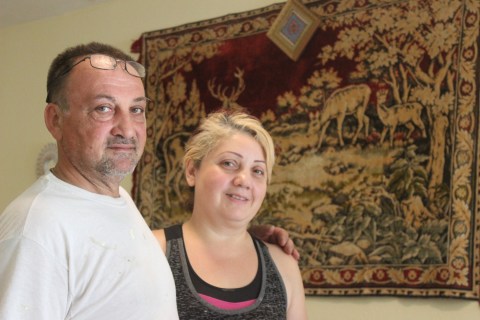
Shahen Musinian and Izabelle Kardian stand in the seating area of their new restaurant, Mush Armenian Kitchen, in Green Cove Springs. (Photo Credit Clay Today Online)
By Jesse Hollett
Clay Today Online
GREEN COVE SPRINGS, FL – Shahen Musinian and Izabelle Kardian believe the best way to share the history of their motherland Armenia is through their food.
The couple, having been married 28 years, lugged their culture through three separate countries – each more different than the last – and ended up in Green Cove Springs (just south of Jacksonville), the location of their new restaurant, Mush Armenian Kitchen.
Having opened for business Tuesday at 1600 Idlewild Ave., in a storefront just under 1,000 square feet, the menu contains Mediterranean staples absent from Green Cove Springs such as kebabs and gyros and house made hummus with some lesser known menu items such as baklava and baba ghanoush.
While not all items originated in Armenia, Armenian Mediterranean cuisine developed simultaneously and what they don’t share in geography, they make up for in the similar ingredients and spices used. Musinian said the menu items come from recipes he grew up eating and cooked for his family.
“I think it’s very important to keep our traditions, educate other people and kind of get them familiarized with other cultures and what they’re all about,” Kardian said. “We’re very family oriented, we’re very close, we like to get together and we wanted to bring that and this kind of family atmosphere to this place so that people can be comfortable.”
Many of the tapestries on the walls are works done by their parents. Below them sit framed printouts detailing historic sites, ruins and churches native to Armenia that Musinian and Kardian hope customers will enjoy while they eat.
The impetus behind the tableside printouts, Musinian said, is to help people better understand Armenia, a country he said most people know little about. “If I say I’m from Britain, I’m from England, everyone knows where England is,” Musinian said. “England is no older than Armenia…Armenia has somehow been forgotten in the world, but Armenia has given the world lots and lots of actors and war heroes – it’s got a rich, rich history.”

Their menu includes Mediterranean favorites and other dishes that will be new to some guests. The restaurant held a soft opening for friends and family on Oct. 13. (Photo Credit Clay Today Online)
Aside from sharing his culture with the community, owning a restaurant has always been one of Musinian’s dreams.
The family invested roughly $65,000 of savings and loans into the restaurant, storefront and equipment. Despite the cost, Musinian appeared delighted on his progress and business endeavor as they put the finishing touches on their storefront Monday.
“This really is as they say dreams come true, it’s a dream come true,” he said. It was a long trek to get where they are now, the two admitted.
Musinian and Kardian, along with their two children, immigrated from Armenia to Israel with their parents in 1993. Kardian’s parents sold their home in Armenia to pay for plane tickets to Israel.
Musinian said after the fall of the Soviet Union in in 1991, that Armenia’s infrastructure largely fell apart. The family rationed food and struggled to find water. Kardian said she was pregnant at the time the rationing began.
“The electricity was on 45 minutes a day – but you never knew when those 45 minutes were coming,” Kardian said.
They stayed in Israel for 10 years before the United States accepted the family as immigrants through its lottery system.
Kardian said owning the restaurant still feels like a dream. “He cooks really good, and we were joking at first, ‘oh, you need a restaurant,’” she said. “The kids were little and we were just trying to” get by.
“We came here without nothing,” she said. Mush kitchen is open for breakfast and lunch Tuesday through Sunday.
This story originally appeared in Clay Today Online, and is republished with the expressed written consent of the author.
Why is October “Armenian Cultural Month”?
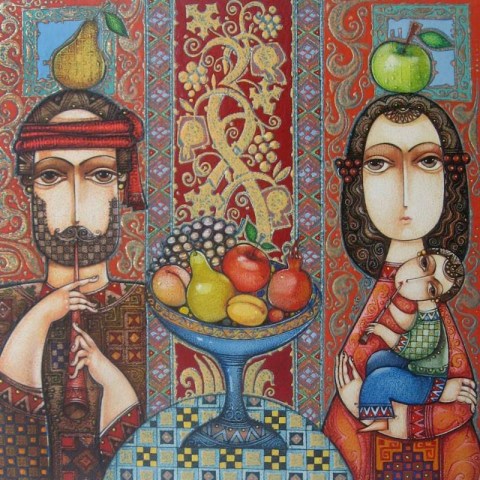
“Wistfulness” (2013) by Sevada Grigoryan
(Eastern Diocese) – To Armenians in the United States, “Armenian Cultural Month” has been a feature of community life for as long as they can remember. It arrives each October—and with it a flurry of lectures, readings, exhibits, sacred celebrations, and events intended to remind Armenians of the richness of their cultural heritage.
But how and when did it begin? And why was October chosen as the annual showcase for Armenian culture?
Surprisingly, Armenian Cultural Month originated in the Eastern Diocese, and this month marks its 75th anniversary.
Credit for launching the observance goes to Archbishop Karekin Hovsepian: the late Primate of the Diocese (1939-1944), who went on to become the Catholicos of Cilicia (1945-1952).
An Armenian intellectual figure of international reputation, a stirring orator, and one of the great churchmen of the 20th century, Hovsepian was responsible for many of the enduring developments of the Armenian Church in America. It was Archbishop Hovsepian who conceived of building a “national home” for the Armenians of America—an idea which would eventually evolve into the St. Vartan Cathedral project. Among his innovations was the official Diocesan publication, Hayastanyaitz Yegeghetzi, which later prospered under the English title, The Armenian Church.
An old edition of that publication reveals that Archbishop Hovsepian named October as a month for celebrating Armenian culture in an encyclical dated August 14, 1942.
The Primate’s encyclical (yes—diocesan primates, and not just the catholicos, could issue encyclicals in those days), written in Armenian, was titled “To Our Faithful People and Diocesan Parish Organizations.” It explained that on August 6, Archbishop Hovsepian had presided over a gathering of Diocesan leaders—among them the executive council (precursor to the Diocesan Council), officials of the Diocesan educational and organizational bodies, and the editors of Hayastanyaitz Yegeghetzi.
In the course of the meeting the basic idea of Armenian Cultural Month was born. A series of what we today would call “action items” describe how the observance would be realized:
- All parishes would celebrate the Divine Liturgy on Tarkamantchats—the Feast of the Holy Translators—and pastors would sermonize on the saints who devised the Armenian alphabet, translated the Scriptures, and laid the foundation for the flowering of Armenian literature.
- A special collection would be done in every parish, with proceeds used to help needy Armenian schools, or for the promotion of cultural events.
- Cultural activities like plays, readings, and art exhibits would be organized at the parish and Diocesan levels.
- The observance would begin in October of 1942, and would thereafter become an annual event, celebrated every October.
- The Diocesan center would publish a special issue of Hayastanyaitz Yegeghetzi dedicated to Armenian culture; Armenian newspapers would be asked to publish articles on cultural month, and to help promote the observance.
In introducing the idea to the public, Archbishop Hovsepian emphasized that “culture” broadly understood—literature, language, music and art—had always found a welcoming home in the Armenian Church, alongside the church’s mission to preach the Gospel of Christ to its people. Hovsepian noted that the church had been a “school” to the nation, encouraging literacy among the people and broadening their awareness of history and the larger world.
In the greatest expression of this “cultural” role, the written Armenian language had begun as a sacred undertaking of the church, to translate the Bible into Armenian. Indeed, October was chosen as the candidate for Armenian Cultural Month because it includes that most distinctive of Armenian holy days, the Feast of the Holy Translators, celebrated every year on the Saturday before the 5th Sunday after Khatchveratz (the Feast of the Exaltation of the Holy Cross).
With characteristically poetic words, Archbishop Hovsepian concluded his encyclical by taking a larger view of the importance of culture to the enduring story of the Armenian people. (The extract below is translated from Armenian):
“We have to enlighten our people so they can understand and appreciate the value of our Armenian language, literature, and culture. These are the treasures of the Armenian Church and nation—our foundation, and the things that will ensure our continuance.”
These points, presented in the encyclical and reproduced in the September 1942 issue of Hayastanyaitz Yegeghetzi, remain the essential outlines of Armenian Cultural Month, 75 years later.
—Fr. Krikor Maksoudian (adapted from his original Armenian essay by C. H. Zakian)




 Florida Armenians