Category Archives: Armenian Genocide
Nova Southeastern University Actively Fundraising for Armenian Genocide Studies
By Aram Arkun
Armenian Mirror-Spectator Staff
FORT LAUDERDALE, FL — Armenian Studies is a small field, with a small number of academic specialists. The number of academic specialists on the Armenian Genocide is even smaller, and there are very few positions for them at universities in the United States. While this situation is unlikely to change drastically, occasionally efforts are made to initiate new academic programs and positions. Nova Southeastern University appears on the verge of making such an effort, if sufficient support and funding are found.
 Nova Southeastern University (NSU) is a relatively young university, founded in 1964, but it already is fairly large, with more than 28,000 students. Dr. Susanne Marshall, senior associate dean of operations and student services at NSU, explained that the university has had graduate programs in conflict resolution for many years. There are more than 800 students enrolled in them now. The focus of these programs has been on the international and governmental level. A few years ago, NSU hired a young faculty member, Jason J. Campbell, as a professor in these programs. Campbell had already founded a non-profit activist organization, the Institute for Genocide Awareness and Applied Research, in 2009. His research happened to focus on genocide and he suggested that it needed to be a more defined curricular focus. NSU agreed. (Despite repeated efforts to contact him, Campbell was unavailable to be interviewed for this article.)
It was already necessary to provide historical and sociopolitical backgrounds for analysis in the multidisciplinary field of conflict analysis, so genocide studies fit in well here, but the university wishes to expand its offerings further. Marshall said, “We would like to have a more independent framework for genocide studies and genocide prevention, and establish a separate degree program, or at least a concentration in master’s and doctoral programs. We are not quite there yet.”
The interest in Armenia came about through research into modern genocide. Marshall points out that “as Dr. Campbell demonstrates in his research, the Armenian Genocide is a blueprint for the genocides of the 20th and 21st centuries. You see all the factors here mirrored in later genocides, so you can learn a lot about prediction and prevention by studying this genocide.” In this sense, Marshall said, in-depth studies of the factors leading up to the Armenian Genocide can be quite useful. The approach at NSU is an activist one, so graduate students want to learn what can be done for prevention.
At the moment, the Armenian Genocide is a component of the courses on genocide being offered. It does not have a faculty member whose research specifically has been on the Armenian Genocide and does not offer Armenian language classes, but it has hosted relevant guest speakers and lectures. For example, Florida resident Margaret Ajemian Ahnert, author of the memoir A Knock at the Door, spoke there in 2008.
Not only does NSU want to expand its genocide studies programs, but it also wants to expand their Armenian component. At the moment, Marshall said, “A lecture series on issues connected to the Armenian Genocide or the early modern genocides is something we are considering. We could bring in people without making a faculty line available. We would like to make more resources specific to the Armenian Genocide available to our students.” However, due to financial difficulties, she stated that “whether we could get a full faculty position without additional funding available is unclear.”
Marshall added, “We are actively seeking funding. It would be a dream to be able to hire someone whose specific academic background is in Armenian Studies.”
Armenian language courses would be possible too, if funding was sufficient to hire an independent faculty member for this.
Marshall is not worried about any potential interference from the Turkish government. She said, “It is hard to envision resistance from a foreign government reaching what we are doing here at Nova SU in the curricular area, though I know it can happen. In any case, we are poised to move ahead at this point.”
NSU has a grant proposal pending with one Armenian foundation, and is looking at other grant sources as well as private donor funding. The university has a definite time frame in mind. Marshall explained that “the firm curricular framework that I would like to establish should really be announced at the one hundredth anniversary of the Genocide. That would be the most appropriate time for a new outreach program or a firm faculty member.”
There is at least one prominent Armenian-American already involved with NSU who would be supportive of such programs. Marta T. Batmasian is a member of the Board of Governors of the H. Wayne Huizenga School of Business and Entrepreneurship at Nova Southeastern. Furthermore, she and her husband in the past donated a large memorial to the Armenian Genocide, which stands at the entrance of the school.
Marshall concluded, “We are an attractive host for this sort of thing. We have a working program already. Our program in conflict resolution is available fully on line. The university is young and is able to move in the direction of where there is a need for learning. We have identified the Armenian Genocide and genocide in general as an area of critical importance to learn about.”
This article originally appeared in the Armenian Mirror-Spectator and is reprinted with the permission of the author.
Dr. Richard Hovannisian to Present ‘The Smyrna Catastrophe, 1922-2013’ at Boca Raton’s St. David Armenian Church
The Smyrna Catastrophe, 1922-2013
An Illustrated Lecture by
Dr. Richard Hovannisian
Co-sponsorsed by St. David Armenian Church
&
The National Association for Armenian Studies and Research (NAASR)

September, 2012 marked the 90th anniversary of the Smyrna catastrophe when much of the city, the second largest in the Ottoman Empire, was destroyed by fire four days after the Turkish army had occupied the city. The calamity, a part of the final phase of the Armenian Genocide, marked the end of a strong Christian presence in the historic Aegean coastal regions and turned hundreds of thousands of Greeks and Armenians into refugees.
In this illustrated lecture, Prof. Richard Hovannisian will discuss the important role of Smyrna (Izmir) in modern Armenian history and the inferno that engulfed the city in September, 1922. Hovannisian is the editor of the recently published Armenian Smyrna/Izmir, the eleventh volume of proceedings from the University of California Los Angeles (UCLA) conference series “Historic Armenian Cities and Provinces.” He also traveled to Izmir and environs in June, 2012 as the historian-guide for a NAASR Armenian Heritage Tour led by Armen Aroyan.
Professor Hovannisian was the first holder of the Armenian Educational Foundation Chair in Modern Armenian History at UCLA. He currently serves as Distinguished Chancellor’s Fellow at Chapman University in Orange County, CA and Distinguished Visiting Lecturer at the University of California, Irvine. He is the author of Armenia on the Road to Independence, the four-volume history The Republic of Armenia, and has edited and contributed to more than twenty-five books including The Armenian Genocide in Perspective; The Armenian People from Ancient to Modern Times; Remembrance and Denial; Looking Backward, Moving Forward; and The Armenian Genocide: Cultural and Ethical Legacies.

TIME & LOCATION
WHEN: Sunday, March 3, 2013 at 1:00 PM
WHERE: St. David Armenian Church, 2300 Yamato Rd., Boca Raton, FL 33431
The event is free and open to the public. A book signing of Armenian Smyrna/Izmir will immediately follow the lecture. For more information please contact St. David Armenian Church at (561) 994-2335 or stdavidarmchurch@bellsouth.net, or NAASR at 617-489-1610 or hq@naasr.org.
Petition Launched on White House Website Calling on Government of Turkey to Open Border with Armenia for Syrian Refugees
By Taniel Koushakjian
FLArmenians Political Contributor
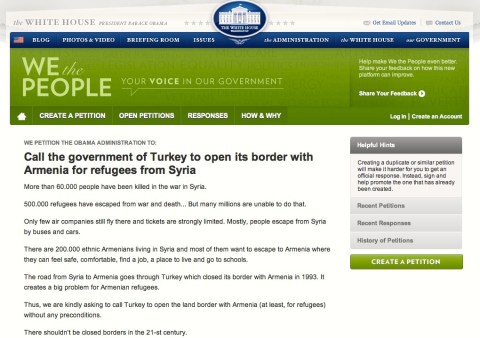
Over the course of the last week, an Internet petition launched on the White House website has stirred emotions and reignited the debate surrounding Turkey’s nearly 20-year blockade of Armenia. In September 2011, the Obama administration launched “We the People” an online platform whereby American citizens can petition their government, a right enshrined in the First Amendment of US Constitution. According to the terms, a petition must reach 25,000 signatures within 30 days of its launch in order for it to receive a response from the administration. On January 15, the White House raised the signature threshold to 100,000 signatures. However, the new requirement applies only to new petitions and does not affect this petition.
[Click here to read the petition.]
The petition says that “There are 200,000 ethnic Armenians living in Syria and most of them want to escape to Armenia where they can feel safe, comfortable, find a job, a place to live and go to schools” and that the “road from Syria to Armenia goes through Turkey which closed its border with Armenia in 1993.” It concludes, “There shouldn’t be closed borders in the 21-st century.”
The petition was launched on January 5 and, as of this writing, has garnered over 500 signatures, five of which hail from Florida. The petition was initiated by Heritage Party activist Daniel Ioannisian in Armenia, ArmeniaNow first reported. There is no stipulation that the petition organizer be a US citizen, according to the Terms of Participation of the “We the People” platform.
Last year, Florida Armenians held events in Boca Raton and Hollywood, raising thousands of dollars to assist in the Syrian-Armenian relief effort.
According to the ArmeniaNow report, Petros Gasparian, who fled to Armenia amid intense fighting in the Syrian city of Aleppo, welcomes the initiative. He says that many want to drive to Armenia, but avoid the long travel through Georgia, which is also complicated by the need to get an extra visa and other difficulties.
“The road is very long and unfamiliar, while it’s only half a day’s drive from Aleppo to Yerevan [it takes about 35 hours to reach Armenia from Aleppo by way of Georgia]. That would be easy to all of us, but I’m not sure Turkey would display such an attitude,” Gasparian told ArmeniaNow.
Syria’s largest city, Aleppo is home to 80,000 ethnic Armenians, most descendants of survivors of the 1915 Turkish genocide of Christian Armenians. Today, thousands of Armenians have fled Syria, many seeking refuge in Armenia. According to immigration officials in Yerevan over 6,000 Syrian-Armenians have applied for citizenship in Armenia.
As Turkey’s failed policy to blockade Christian Armenia enters its second decade, the remnants of the Soviet Union continue to linger in the South Caucasus as the last iron curtain hangs over this remote but volatile region. Support for Armenian-Turkish rapprochement reached an all time high in 2009 when Armenia and Turkey signed Protocols to establish diplomatic relations. However, the accords stalled in the Turkish parliament and still await ratification.
Others hope, however, that modern-day Turkey can play a leadership role in the region and in the Syrian conflict in particular. Perhaps in all of the turmoil in the Middle East the Turkish government can display such leadership and open the border with Armenia, at least for refugees. Although a relatively small step in this context, it has the potential to move the ball forward in a larger one: Armenian-Turkish relations. When US Secretary of State Hillary Clinton visited Armenia in July 2010, she was asked about the state of Armenian-Turkish relations and the next step in the process. She replied, “The ball is in the other [Turkey’s] court.”
Taniel Koushakjian is an independent political commentator for Florida Armenians. He received his bachelor’s degree in political science from Florida Atlantic University in Boca Raton, Florida, and is currently enrolled at the George Washington University Graduate School of Political Management in Washington, D.C. Follow him on Twitter @Taniel_Shant.
*This story was updated on January 16, 2013.