Blog Archives
Armenian National Institute Releases New Exhibit on YMCA & American Relief in Armenia
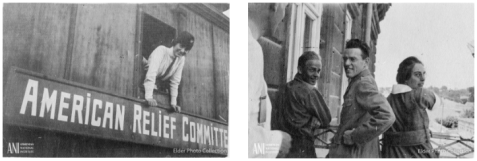
Left Image: Gertrude Pearson; Right Image: John Elder (left) with Tredwell Smith in Yerevan
ANI Releases Another Major Exhibit on the YMCA & American Relief in Armenia A Century Ago
WASHINGTON, D.C. – The Armenian National Institute (ANI) launched a new 24-panel digital exhibit displaying the role of the YMCA and American relief work during the first republic of Armenia (1918-1920). The exhibit focuses on John Elder and James O. Arroll who arrived in Yerevan, Armenia in January 1918 to open a YMCA center. As with digital exhibits previously released by ANI, American Relief in the First Republic of Armenia 1918-1920, subtitled “John Elder and James Arroll in Yerevan, Gyumri, Sevan & Etchmiadzin,” is freely downloadable from the ANI website.
Neither Elder nor Arroll had anticipated being stranded as the only Americans left in the country’s capital city with all communication to the outside world cut off when the frontline faltered. World War I was still raging at the time and Allied forces were in retreat on the Caucasian front. The November 11, 1918 Armistice that ended the global conflict was many months away, crucial months during which the very existence of the Armenian people hung in the balance.
By the time they left Yerevan in August 1919, John Elder and James O. Arroll had become responsible for the entire operation set up by U.S.-based charities that had earlier sent emergency aid and volunteer workers to Armenia. As John Elder wrote on January 16, 1919: “One year in Yerevan and what a year it has been. Had anyone told me a year ago that in addition to running a YMCA, I would be in charge of factories employing 7,500 people, orphanages with 350 children and a 120 bed hospital, I would have thought them crazy.”
ANI Chairman Van Z. Krikorian said: “The stellar example of American humanitarianism by Elder and Arroll continues to be emulated to this day. They were pathfinding pioneers who traveled all the way to Armenia during a very difficult time. All the relief workers who went to Armenia after the 1988 earthquake, and the Peace Corps volunteers who continue every year to extend their helping hand are following John Elder’s and James O. Arroll’s superb example. Armenians and Americans alike are proud to share this chapter of remarkable service to those in need.”
The exhibit reconstructs the story of the near superhuman efforts undertaken by John Elder and James O. Arroll to rescue Armenians from the many perils they faced during the 1918-1920 independent Republic of Armenia. The exhibit relies upon John Elder’s own words from his published journal, along with original records that he personally saved from the time of his service, and the photographs that he made and captioned.
Elder and Arroll arrived as two enthusiastic young men dedicated to the purpose of sustaining morale among soldiers enduring long campaigns and treacherous conditions as the Great War kept grinding on, year after year, without end. They departed as two celebrated heroes who stood by the Armenian people at the fateful hour. John Elder wrote on May 26, 1918, as Ottoman Turkish forces advanced to the outskirts of Yerevan: “You never can tell what may happen. Just as the end seems at hand the pendulum swings the other way…After a two-day battle at Sardarabad, the Turks have been completely routed.” With the decisive battle won, two days later, on May 28, 1918, Armenia declared independence.
The only Americans in Yerevan at the time, Elder and Arroll witnessed momentous events and the unfolding of a heart-wrenching humanitarian disaster as the ravages of war were revealed once the fighting stopped. A year elapsed before a new crew of relief workers reached Armenia to lighten the burden they shouldered. In the meantime, their efforts and accomplishments had become legend among admiring Armenians and fellow Americans at home.
The YMCA digital exhibit is the fifth such exhibit developed by ANI based on American documentation of the Armenian Genocide. It follows upon other educational material developed for the centennial of the Armenian Genocide, including the four large exhibits displaying hundreds of historic photographs.
These exhibits include:
- Witness to the Armenian Genocide: Photographs by the Perpetrators’ German and Austro-Hungarian Allies;
- The First Refuge and the Last Defense: The Armenian Church, Etchmiadzin, and the Armenian Genocide;
- The First Deportation: The German Railroad, The American Hospital, and the Armenian Genocide;
- Iconic Images of the Armenian Genocide (also available as a slideshow);
- Survivors of the Armenian Genocide.
The exhibit displays 95 images, 64 from John Elder’s photo collection, 8 contemporaneous records and documents, and 4 maps. With 32 quotations from Elder’s journal authenticating the photographs, along with introductory and explanatory text, the exhibit opens a window into life during the first year of the newly independent Armenian republic in 1918. The exhibit includes the entire set of photographs Elder attributed to his time in Armenia.

Children in the government orphanage
Several American relief workers are also mentioned in the exhibit, including Reverend Ernest Yarrow, Gertrude Pearson, F. Tredwell Smith, and Mabel Farrington. Mary Kifer, whose life was cut short after leaving the Caucasus, improbably found romance while conducting relief work in Armenia. Her story parallels “A Farewell to Arms” before Ernest Hemingway wrote his WWI era tragedy.
Other American personalities in the region appearing in the exhibit include F. Willoughby Smith, U.S. Consul in Tiflis, who supported the efforts of the relief workers; Robert McDowell, who was at the front when the Turkish forces broke through and invaded Alexandropol/Gyumri; Dr. John H.T. Main, president of Grinnell College in Iowa, who witnessed the horrific conditions in Armenia firsthand on behalf of the American Committee for Relief in the Near East; missionary Grace Knapp; and John Mott, longtime president of the American YMCA, who, with the encouragement of his friend President Woodrow Wilson, dispatched young Americans wherever they could lend civilian support behind the front to men in combat.
John Elder was particularly happy to welcome two Pennsylvania natives like himself, Pittsburgh businessman Howard Heinz, and president of the American Bar Association Walter George Smith, who traveled to Armenia on behalf of the American Relief Administration. Both were members of prominent families. Smith was married to Elizabeth Drexel, whose uncle, banker and philanthropist Anthony Drexel, founded Drexel University in Philadelphia. Smith became the most vocal American Catholic advocate of the Armenian people at the time.
“The Armenian National Institute thanks the Elder family for supporting the research undertaken to develop the exhibit, and for permitting our organization to continue to honor the memory of such a committed humanitarian,” stated ANI Director Dr. Rouben Adalian. “At the height of the conflict in the Caucasus when other relief workers chose to evacuate, John Elder refused to leave fearing that tens of thousands more Armenians would die of starvation if the relief programs were discontinued. He is credited in providing relief for 15,000 Armenian orphans. Such selfless heroism must be recognized.”
Adalian added: “I also want to thank Dr. Christina Maranci, Professor of Armenian Art and Architecture at Tufts University for lending her expertise. Dr. Andrew Anderson of the University of Calgary graciously extended permission to reproduce the very high quality map depicting the situation in the Caucasus in 1918. I thank as well the staff at the YMCA Archives for retrieving critical information about the protagonists of this exhibit.”
Dr. Adalian continued: “The YMCA exhibit should be viewed as a continuation of the historical reconstruction provided in a previously issued ANI exhibit and titled, The First Refuge and the Last Defense: The Armenian Church, Etchmiadzin, and the Armenian Genocide. That exhibit documented the extent of the spillover consequences in Eastern Armenia, then part of the Russian Empire, and of the atrocities committed in Western Armenia in the Ottoman Empire in 1915. The YMCA exhibit is a compelling reminder that the aftermath of the Armenian Genocide continued to unfold over the course of many years and spread across Eastern Armenia as well with every advancing step of the Turkish armies. The evidence gathered by John Elder demonstrates that Russian Armenia was not spared the genocide perpetrated by the Young Turk regime. He wrote on January 16, 1919: ‘Among the refugees it has been a holocaust.'”
The exhibit concludes with U.S. President Herbert Hoover’s tribute to the remarkable role of the YMCA pair who risked going to Armenia in the thick of World War I. The exhibit marking the centennial of the founding of the Armenian republic also extends appreciation to the Peace Corps volunteers today who are following in Elder’s and Arroll’s footsteps under the leadership of U.S. Ambassador to Armenia Richard M. Mills, Jr. who happened to be the State Department’s first Armenia desk officer when Armenia regained independence in 1991.
Margaret Ahnert has Become a Role Model for Journalism Students

(FAR Blog, Yerevan) – More than 50 students came dressed in their finest for a special meeting to say thanks to their benefactor – renowned American-Armenian writer and journalist Margaret Ajemian Ahnert of Ft. Lauderdale, FL. They were bubbling with energy and excitement to meet with the woman who believed in them and gave them a chance to delve into the world of journalism.
Margaret arrived at Yerevan State University (YSU) with her family with a goal to share updates on her award-winning book ‘The Knock at the Door: A Journey Through the Darkness of the Armenian Genocide,’ to inspire her students, and to, once again, share her mother Ester Ajemian’s story as a Genocide survivor.
The welcome speech by the YSU Journalism Faculty Dean Naghash Martirosyan, eloquently described how the Ester Ajemian Scholarship Program has influenced the students’ experience at YSU, and how important it was to make a positive difference in the lives of the graduates, reiterating the idea that the collaboration will continue.
Established in 2010, the Ester Ajemian Scholarship Program is administered by the Fund for Armenian Relief (FAR). It provides full tuition and monthly stipends to female graduate students in Armenia. So far, more than 20 young female scholars have become the proud beneficiaries of Margaret’s generosity.
During the event, Margaret Ahnert shared her commitment to supporting young female journalists through the scholarship, emphasizing with certainty that her students are her world. “I love my family, but when it comes to my students, I say, ‘Sorry Stephane [her son], but the students first,’” she smiles, adding, “I grew up in the Bronx. We didn’t have money to go to college, so after I did go, I thought about the other girls who were like me. When I came to Armenia, I noticed that in a family where a couple had a son and a daughter, the latter had less educational opportunities. So, I thought about establishing the foundation in memory of my mother that would support female students.”
Emma is among five second-year students in YSU’s graduate journalism program who are supported by the Ester Ajemian Scholarship. Along with a copy of The Knock at the Door, Emma has brought a nice bouquet of flowers to the event. “The book is mine, the flowers are for Margaret Ahnert,” she claims. “This is the second year I have received this scholarship, and I’ve never had the opportunity to meet her face to face. I wanted to let her know how much this opportunity has meant to me.”
At the close of the meeting, Margaret Ahnert was awarded with a special appreciation plaque for her continuous support to YSU’s female journalists. The students confided that they felt many emotions that day, since each of them had a unique story connected with Margaret’s generous contribution. Her support has provided huge financial relief for each of the student’s their families.
During her trip in Armenia, Margaret also paid a visit to the Armenian Genocide Museum-Institute to deliver copies of The Knock at the Door translated into six languages – Armenian, Russian, Turkish, French, Italian, and Spanish.
“I have been on a ten-year book tour, and wherever I go, I spread light on the Armenian identity as a daughter of a survivor of the Genocide. In my book, I’m talking about the dialogue of two women – mother and daughter. It resonates with the foreigners. They say, “Oh! It’s like my Irish mother,” she said during an interview with a local TV station, stressing the idea that the story should mostly be told to the odars, or non-Armenians.
A humanist by soul and media specialist by specialty, Margaret Ahnert has received the Ellis Island Medal of Honor (2011) and the Distinguished Humanitarian Award from The Little Flower Children and Family Services in New York. She has also worked as a docent at the Metropolitan Museum of Art in New York, taught art appreciation classes, and ran the Fernwood Resort and Hotel in Bushkill, Pennsylvania. Margaret Ahnert is also a member of the National League of American Pen Women.
Armenian Assembly of America Now Accepting Applications for Summer Internship Programs in Washington, Yerevan
You Can Be a Part of the Assembly’s 40th Summer Internship Class
WASHINGTON, D.C. – Applications for the Armenian Assembly of America’s (Assembly) summer internship programs are available, and the deadline for this upcoming summer is fast approaching. The 2017 Terjenian-Thomas Summer Internship Program applications in Washington, D.C. are due on December 1, 2016 and candidates for the Yerevan Internship Program in Armenia will be accepted through January 10, 2017.
This upcoming summer will mark the 40th anniversary year of the Assembly’s internship program for Armenian youth in Washington, D.C. Founded in 1977, the Armenian Assembly Summer Internship Program was the first internship program offered by an Armenian organization in America. Over 1,000 students of Armenian descent have graduated through the Assembly ranks.
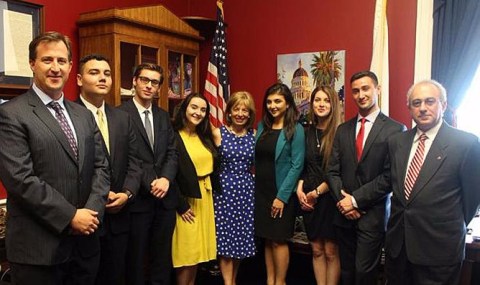
Armenian Assembly of America Executive Director Bryan Ardouny, Class of 2016 Terjenian-Thomas Assembly Interns,Armenian Caucus Co-Chair Jackie Speier (D-CA), and Armenian National Institute Director Dr. Rouben Adalian
The Terjenian-Thomas Assembly Internship Program gives college students of Armenian descent an opportunity to gain exposure to the policy-making process in our nation’s capital for eight weeks each summer. Students accepted to the Washington program are assisted in securing internships in congressional offices, government agencies, media outlets, think-tanks, and non-governmental organizations based on their educational background and interests. Placements have included the Congressional Caucus on Armenian Issues, the Senate, the House, Congressional Committees, Armenian Embassy, Library of Congress, Voice of America, and other media, federal agencies, and think tanks.
In addition, Assembly interns will have the opportunity to discuss Armenian American issues during meetings with Members of Congress, Senators, and other government officials, industry professionals, and noted academics through the Capitol Ideas and Lecture Series programs. These programs provide interns a forum to ask questions and discuss topics important to the Armenian-American community, including current events taking place throughout the world and U.S. foreign policy towards Armenia and Karabakh.
The Terjenian-Thomas Assembly Internship Program is made possible by the Memorial Fund established through the generosity of Aram Terjenian, Annie Thomas and Florence Terjenian of Belmont, Massachusetts. Additional support comes from the Richard Tufenkian Memorial Fund, the John Hanessian Scholarship Fund, the Armen Astarjian Scholarship Fund, the Ohanian Memorial Fund, the Estate of Haig J. Boyadjian, the Estate of George Judge Karabedian (George Kay), Mr. & Mrs. James and Connie Melikian, and the Knights of Vartan.

Armenian Assembly of America Regional Director Arpi Vartanian and Class of 2016 Assembly Yerevan Summer Interns with Nagorno Karabakh Republic Foreign Minister Karen Mirzoyan
The Assembly also offers a similar internship program in Yerevan, Armenia. Now entering its 17th year, the Yerevan Internship Program provides students the opportunity to live and work in one of the most historically and culturally rich countries in the world. Students can work in Armenian government agencies, non-governmental organizations, medical centers, or media outlets. Participants will meet with Armenia and Nagorno Karabakh government officials, including Assembly partner organizations of Armenia Tree Project and HALO Trust, and tour historical sites around the country. Recent placements include the United Nations, Constitutional Court, Civilitas Foundation, International Center for Human Development, and other non-governmental organizations, as well as various government ministries.
For more information on the Assembly internship programs or assistance with the application process, please contact Internship Program Director Joseph Piatt in Washington, D.C. at (202) 393-3434, ext. 336, or via email at jpiatt@aaainc.org. You can find stories, posts, and testimonials from last year’s internship class on the Assembly’s Intern Blogs (Washington, D.C. or Yerevan, Armenia). You can also check out their photo albums (Washington, D.C. or Yerevan, Armenia) on the Assembly’s Internship Alumni Facebook Page.




 Florida Armenians