
Blog Archives
Armenian Assembly of America Presents Armenian Genocide Exhibit at Holocaust Museum of Southwest Florida
Turkish Consulate in Miami Attempts to Block Discussion of Armenian Genocide
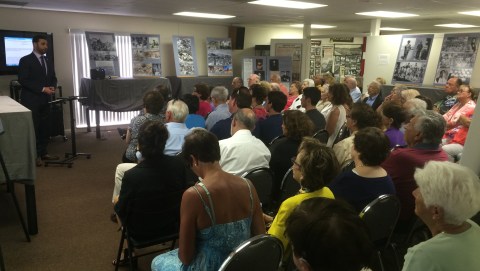
NAPLES, FL – On Sunday, April 12, Armenian Assembly of America (Assembly) Communications Director Taniel Koushakjian presented the ‘Iconic Images of the Armenian Genocide‘ exhibit at the Holocaust Museum and Education Center of Southwest Florida to mark the 100th anniversary of the Armenian Genocide which began on April 24, 1915.
With a capacity filled hall, Koushakjian discussed the systemic nature of the killings step by step, and presented the 20-panel exhibit highlighting details through the photographic evidence taken by eyewitnesses at the time, including American missionaries and German officers. The fourth in a series of digital exhibits released free of charge, ‘Iconic Images of the Armenian Genocide’ brings together as a single collection key images recording the brutal mistreatment of the Armenian population of the Ottoman Turkish Empire and the utter destruction of their historic communities.
In an outrageous move to impede a program on human rights education, the Turkish Consulate in Miami sent a letter trying to block discussion of the Armenian Genocide. “It is a disgrace that the Armenian diaspora chooses to identify itself with hatred of Turks, anti-Turkism in other words, as well as with outright dismissal of any chance of reconciliation and better relations between Turkey and Armenia,” wrote Ozgur Kivanc Altan, Consul General of the Republic of Turkey in Miami in the letter addressed to the Holocaust Museum of Southwest Florida. “This is disturbing, yet not surprising, as the [Armenian] diaspora sought in recent years to hijack the Holocaust in an attempt to garner support for a distorted presentation of the events of 1915,” read the Turkish complaint.
“We deeply appreciate the Holocaust Museum’s leadership in continuing the program as planned and are confident that Taniel’s presentation was well received,” said Assembly Executive Director Bryan Ardouny. “Despite cynical attempts to silence the truth, the truth will prevail,” added Ardouny.
In addition to Sunday’s program, Koushakjian also gave a presentation of the Armenian Genocide on Saturday, April 11 for a group of a dozen educators from surrounding Collier, Hendry, Lee, and Monroe counties as part of a public teacher workshop on Holocaust and human rights education at the Holocaust Museum and Education Center of Southwest Florida.
Additional photographs are available on the Assembly’s Facebook Page.
Established in 1972, the Armenian Assembly of America is the largest Washington-based nationwide organization promoting public understanding and awareness of Armenian issues. The Assembly is a non-partisan, 501(c)(3) tax-exempt membership organization.
###
NR: # 2015-023
Photo Caption 1: Armenian Assembly Communications Director Taniel Koushakjian speaking to the audience about the Armenian Genocide.
Miami Herald Publishes Op-Ed on the Passing of Harry Pilafian, South Florida’s Last Armenian Genocide Survivor
On Christmas Day, the Miami Herald published an op-ed by Harout Jack Samra, a Miami-based attorney of Armenian heritage. His article calls attention to the recent passing of Harry Pilafian (1921-2014), a grandfather, father, husband, veteran, and genocide survivor.

Below is an excerpt from Samra’s article and a link to the full story.
Annually, Armenians around the world gather on April 24 to commemorate the Armenian Genocide. Survivors of this national calamity stand at the front of each assembly as symbols of a people’s capacity to survive.
With each passing year in South Florida, with the commemoration reaching its centennial, survivors have grown fewer. Two weeks before Christmas, South Florida’s last known Armenian genocide survivor died.
Harry Pilafian was born in Tekirdag, in Thrace, during the final years of the Ottoman Empire. His mother and father had fled their home to Damascus in 1918. Their first son, James, was born in that ancient city.
During a period of calm, the family, like so many others, tried to return home. This is when Pilafian was born.
You can read the article in full by clicking here.




 Florida Armenians