Blog Archives
In South Florida U.S. Holocaust Museum Memorial Presents Findings on Genocide and Mass Atrocities in Iraq
By Mercedes Gechidjian
FLArmenians Miami Contributor

A displaced Iraqi Christian woman prays at the home where she is staying in Erbil. Photo courtesy of Mackenzie Knowles-Coursin for The United States Holocaust Memorial Museum.
On Tuesday, February 9th and on Wednesday, February 10th, Florida Atlantic University (FAU) in Boca Raton and the University of Miami (UM), respectively, had the honor of hosting a presentation by the United States Holocaust Memorial Museum (USHMM) entitled “Exposing the Darkness: Perspectives on Mass Atrocities.” The panel discussion featured human rights experts Naomi Kikoler, Deputy Director at the Simon-Skjodt Center for the Prevention of Genocide at the USHMM, and photographer Mackenzie Knowles-Coursin. This brilliant, powerful discussion was co-hosted by FAU’s Center for Holocaust and Human Rights Education and by the University of Miami Hillel.
In 2015, Kikoler and Knowles-Cousin travelled to northern Iraq to document evidence of mass atrocities carried out by the self-proclaimed Islamic State (IS). The USHMM report found that IS has committed crimes against humanity, war crimes, and ethnic cleansing against various minority groups and perpetrated genocide against the Yezidi people.
“The event discussed previous atrocities, such as the Holocaust and crimes in Iraq, and brought forth ideas on how these atrocities could be prevented,” stated Michael Bezjian, a University of Miami Armenian Student Association (UM-ASA) member who was present at the Miami panel.

Naomi Kikoler, Mackenzie Knowles-Coursin, and Michael Bezjian
Knowles-Coursin’s work focuses on identity within the context of migration and statelessness, so his photographs documenting the Islamic State’s brutality brought to life the plight of the displaced and persecuted.
According to USHMM’s mission statement, the “Museum strives to broaden public understanding of the history of the Holocaust through multifaceted programs: exhibitions; research and publication; collecting and preserving material evidence, art and artifacts related to the Holocaust; annual Holocaust commemorations known as Days of Remembrance; distribution of education materials and teacher resources; and a variety of public programming designed to enhance understanding of the Holocaust and related issues, including those of contemporary significance.”
Florida Armenians were encouraged to attend the USHMM discussion in the hopes of raising awareness and broadening perspectives on genocide and man’s inhumanity to man.
“Growing up as an Armenian American, I’m no stranger to the stories of genocide, as they were told to me by my grandparents, who learned from their parents. Attending high school in South Florida, we learned about Nazi Germany and the atrocities that took place in the concentration camps during WWII,” stated Florida Armenians Boca Raton Chair George Sarkisian who was present at the FAU presentation.
“’Exposing the Darkness: Perspectives on Mass Atrocities’ was truly eye-opening, and really put in context the level of violence currently taking place in Iraq and Syria. The pictures and stories shared by the panelists provided a small but powerful glimpse into the lives of the people suffering at the hands of ISIS. I was especially touched by the pictures and stories of the displaced people living in camps located in northern Iraq and it feels like the history of the Armenian people a century ago may well be repeating itself today,” Sarkisian said.
Koushakjian Talks Armenia, Christian Persecution in the Middle East with Republican Presidential Candidate Marco Rubio
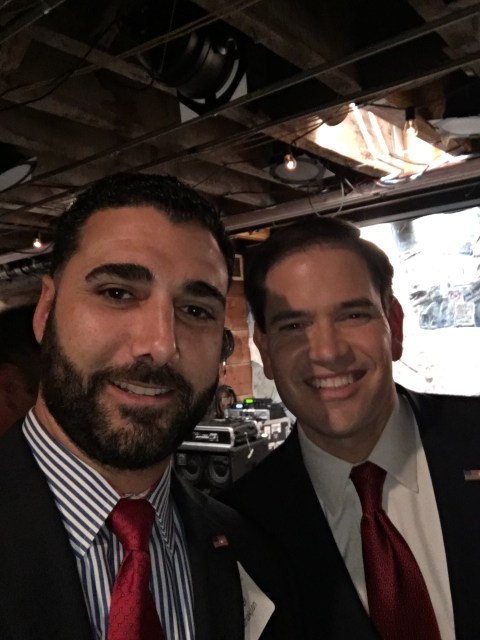
On Tuesday, January 12, Florida Armenians Editor Taniel Koushakjian spoke with Florida Senator and Republican presidential candidate Marco Rubio in Washington, D.C. Koushakjian thanked Rubio for his cosponsorship of S. Res. 140, the Armenian Genocide resolution currently pending in the Senate.
[RELATED: How Florida Representatives Voted to on the Bill to Pause the Syrian Refugee Program]
They also discussed the plight of Christians in the Middle East and the need for the U.S. to declare Islamic State (aka ISIS or ISIL) attacks on Christians as genocide. Rubio pointed out that he is also an original cosponsor of S. Res. 340, which would label ISIS attacks on Armenians, Assyrians, Yezidis, and other religious minority groups in Iraq and Syria as genocide. ISIS “is conducting genocide against Christians, Yezidis, and others in region,” Rubio said two days later at the Republican presidential debate on Thursday, January 14.
How Florida Representatives Voted on the Bill to Pause the Syrian Refugee Program
By Taniel Koushakjian
FLArmenians Managing Editor
Yesterday, the U.S. House of Representatives voted 289-137 to adopt H.R. 4038, the American Security Against Foreign Enemies (SAFE) Act of 2015, a bill that would pause the federal government’s current resettlement program for refugees from Syria and Iraq.
The bill requires the Director of the Federal Bureau of Investigations (FBI), Director of National Intelligence (DNI), and Secretary of the Department of Homeland Security (DHS) to perform background checks and sign off that each refugee “is not a threat to the security of the United States.”
The current policy only requires the DHS to perform background checks and takes 18-24 months to complete. The additional security checks would prolong the current process. All refugees seeking resettlement in the U.S. are first registered with the United Nations High Commissioner for Refugees (UNHCR) and those eligible are reported to DHS to begin the process.
The legislation comes on the heels of the November 13th terrorist attack in Paris, France that left 129 dead. At least one of the Paris attackers is known to have travelled from Syria to Europe through Greece, the route used by millions of migrants fleeing the Islamic State (also known as ISIS, ISIL, Daesh) in Syria and Iraq.
The House vote is a rebuke to President Obama, who threatened on Wednesday to veto the legislation. The additional security measures are “unnecessary and impractical,” the White House said. “Given the lives at stake and the critical importance to our partners in the Middle East and Europe of American leadership in addressing the Syrian refugee crisis, if the president were presented with H.R. 4038, he would veto the bill.”
47 Democrats joined 242 Republicans, giving House lawmakers a veto-proof majority they hope will force the President’s hand on the issue.
In Florida, 19 of the state’s 27 Representatives voted in favor of the tougher measures, with two Democrats joining Florida’s entire Republican delegation in support of the bill.
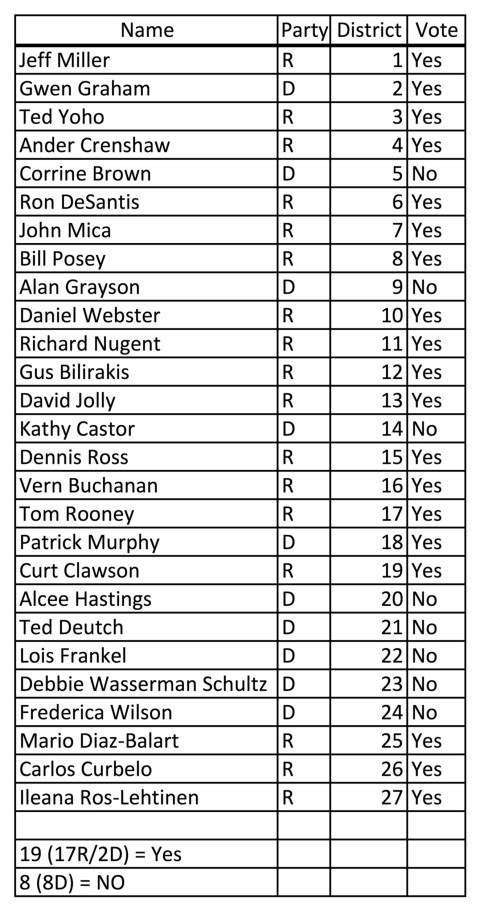
Rep. Patrick Murphy (D-FL), a candidate for U.S. Senate in 2016, voted in favor of the SAFE Act. He released the following statement after the vote: “I am deeply disappointed how divisive this debate has become. Homeland security should never be partisan and our number one priority is to always keep the American people safe. With new security considerations following the tragic and cowardly attacks in Paris last week, we must ensure that we have the strongest safeguards to certify refugees are not a threat to homeland security. This bill ensures that our entire intelligence community is on the same page without turning our backs on those fleeing violence and terror. We must put aside partisan differences to develop a comprehensive strategy that combats the threat ISIS poses to people who love freedom everywhere.”
Meanwhile, Murphy’s opponent for U.S. Senate, Rep. Alan Grayson (D-FL) voted against the bill. Murphy “chose fear over humanity when he voted against Syrian refugees,” Grayson posted on Twitter.
Rep. Gwen Graham (D-FL) is the other Florida Democrat to break ranks, stating “As the granddaughter of a Christian who came to America after fleeing religious violence, I do believe we have a role in helping peace-seeking refugees — but in light of new threats, we must strengthen our vetting process. We must be able to identify those who wish to do us harm, while continuing to offer a safe haven to those in need of refuge from war and persecution.”
Graham represents a swing district in northern Florida and narrowly won election in 2014. Her seat is expected to become safe-Republican after the Florida Supreme Court completes the redistricting process before the end of the year.
“As elected officials, we have the responsibility to do everything we can to protect our nation,” stated Armenian Caucus Vice Chair Rep. Gus Bilirakis (R-FL). “The SAFE Act puts in place a robust, extensive vetting and monitoring process to identify individuals who pose a security threat. It fulfills our promise to the American people that we are working diligently to prevent terrorists from reaching our shores.”
ARMENIAN AMERICANS REACT
For Armenian Americans, the issue tugs at the heartstrings as images and stories of those fleeing the violence emerge. Following the World War I Armenian Genocide, Christian Armenian orphans and other survivors were accepted into Syrian society and over the last century developed into a critical part of Syria’s multi-cultural mosaic. Some 180,000 Armenian Christians used to call Aleppo home up until a few years ago when they were driven out by ISIS and Jabhat al-Nusra.
“I fully support the resettlement of Syrian refugees, irrespective of their ethno-religious affiliation, in the U.S.,” stated Sarkis Balkhian, Advocacy Director for the Aleppo Compatriotic Charitable Organization, who is himself an Armenian American citizen from Aleppo. “During the 4.5 years of the Syrian conflict, the United States has resettled approximately 2,000 Syrian refugees out of a total of 4.3 million. That’s a comical number,” Balkhian said. “But yesterday’s vote confirmed that 289 Representatives are oblivious about the U.S. resettlement program and the vigorous vetting process already in place. What’s worse is that it appears they have succumbed to fear and are punishing the victims of ISIS rather than ISIS itself.”
Yet, Armenian Americans seem to be equally concerned about the potential influx of radical extremists who seek to harm us and destroy our way of life.
“I am wholeheartedly opposed to our government’s current plan to bring refugees from Syria and Iraq to the United States,” stated Ani Tramblian, an Armenian American from Annandale, Virginia. “I use the term bringing, because we are literally bringing them here, using American taxpayer dollars. Our President is putting U.S. citizens in harms way and exposing us to unnecessary risk. The House was right to pause the current process and add tougher security measures especially in light of terrorist attacks in Paris, and I hope our President takes our Congress seriously,” she said.

On Wednesday night, Florida Armenians launched an online poll, admittedly unscientific. At the time of this writing, the poll finds 51% of Armenian Americans in support of accepting 10,000 Syrian and Iraqi refugees as currently planned. 35% of Armenian Americans oppose accepting refugees from Syria and Iraq, while 13% agree with the House measure and support a pause in the current resettlement program, according to the Florida Armenians poll.
The Florida Armenians poll on Syria refugees will close on Friday at midnight.




 Florida Armenians