
Blog Archives
Exclusive Interview: Mark Samuelian, Candidate for Miami Beach Commission

By Taniel Koushakjian
Florida Armenians Editor
MIAMI BEACH, FL – Next week, Mark Samuelian could be the first Armenian American elected official in Miami-Dade County. He is a candidate for Miami Beach City Commission, Group II. It is a non-partisan race, and Election Day is Tuesday, November 7, 2017.
Originally from Dedham, Massachusetts, Samuelian bought his first home in Miami Beach in 2003. He has been active in various civic and community-based organizations. In an effort to familiarize Florida’s Armenian American community with Mr. Samuelian, FLArmenians.com reached out to him and he graciously agreed to talk to us about his Armenian American heritage, academic and business background, local community service, how he became a national chess master, and his campaign for Miami Beach City Commission.
Taniel Koushakjian (TK): Thank you, Mr. Samuelian for talking to us today.
Mark Samuelian (MS): Thank you, Taniel, I’m happy to speak with you.
TK: When I saw your first campaign video advertisement, where you asked people on the streets of Miami Beach to pronounce your name, I literally laughed out loud. Of course, practically every Armenian American has had his or her name mispronounced, but I think it’s fair to say you have it easy compared with some of us. So let’s begin there. Where is your family from and when did they arrive in the United States?
MS: I’m a a third generation Armenian American. My grandparents are from Sivas and Malatya, and they survived the Armenian Genocide before immigrating to the United States. Several family members were killed in 1915. One of my grandmothers went through Ellis Island, and my grandfather, Margos Derderian, served in the U.S. Army in World War I.
TK: You have quite an impressive resume and professional background. You graduated cum laude from Georgia Tech and received your degree in Industrial Engineering. You also earned your MBA from the Wharton School of Business, University of Pennsylvania, one of the nation’s top business schools. You’re also a seasoned executive, with three decades of engineering and business management experience. How has this education and professional career influenced you and prepared you for a life in public service?
MS: While some of the most urgent and serious issues our City faces have to do with flood risk, the City Commission currently holds no engineers. My industrial engineering degree will prove to be an invaluable tool in dealing with some of our most pressing issues. Whether it’s a more climate change resilient city, or better preparing the City to withstand the devastating effects of a Hurricane like Irma, or confronting out of control development that could weaken our city’s character, or developing meaningful traffic solutions, I am committed to the principle of making “Miami Beach Strong.”
TK: You also served as the President of Miami Beach United, a resident friendly community organization, and you have advocated aggressively on behalf of Miami Beach homeowners. Tell us about your work in this regard?
MS: Community participation is essential to sound, responsible government. I highly support and will proactively encourage greater civic engagement. I want the people to have a greater voice. Toward that end, being accessible to residents is extremely important to me. As a commissioner I intend to make my office as available and accessible as is reasonably possible. I also plan on being out in the community by attending Tuesday Morning Breakfast Club meetings, and regularly attending neighborhood meetings. I will also be available consistently and frequently to the press.
TK: This is your second campaign for Miami Beach City Commission, having lost in the 2015 election by just 77 votes. However, everyone I talked to said that you ran an impressive, outsider campaign and earned the respect of Miami Beach residents and other elected officials in the process. How did that race prepare you for this campaign and what advise would you give to young Armenian Americans who are thinking about a career in public service?
MS: I believe you should never give up. I am proud that in this campaign I once again qualified for the ballot with nearly 1,300 certified petition signatures because my campaign has been structured around door-to-door access to residents. This allowed me to interact on a personal level, and to better understand their concerns.
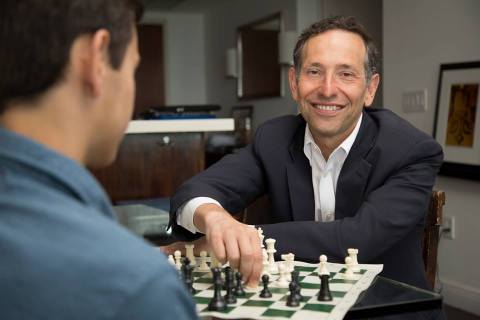
TK: Lastly, I have to ask you about being a national chess master. Please tell our readers about that experience. What does chess means to you? Also, if you were ever matched up against Levon Aronian, who do you think would win?
MS: I learned how to play chess from my older brother, when I was 5 years old visiting family in Coral Gables. I took to the game immediately, and it has been an important part of my life ever since. I was the state high school chess champion back in Massachusetts. Being able to excel at something outside of school is thrilling, and for me chess was that thing. I later found out that I was one of five people in Massachusetts’ history to become a national chess master while in high school. When I was at Georgia Tech, we were in the top 10 every year. Later, I got into speed chess, and wrote about it’s effect on me in a column for Atlantic Magazine. Today, I’m ranked in the top 1% in the world in speed chess in my category.
Chess has brought me many things including analytical thinking, discipline, personal responsibility, and patience.
It would be a privilege to play against Levon Aronian, no matter the outcome.
TK: Thank you, Mr. Samuelian, for taking the time to speak with us and best of luck on Election Day.
MS: Thank you for the opportunity to speak about my campaign. I encourage everyone to stay engaged and get involved, whether it’s in this election cycle or future ones because an active community is what makes us stronger as a city.
Every Armenian American has a similar, yet unique story. Whether we’re talking about his life accomplishments, family history, passion for public service, or the things that bring joy to his life, getting to know Mark Samuelian was truly inspiring. We encourage everyone living in Miami-Dade County to vote on November 7th. By this time next week, we may very well have the first Armenian American elected official in Miami-Dade County.
To learn more about the Mark Samuelian for Miami Beach Commission campaign, you can visit his website here.
For election night results, follow us on Twitter @FLArmenians, or check our Facebook Page, on Tuesday, November 7. Polls close at 7:00pm.
How Armenian Immigrants are Making Their Mark in Ybor City

Alex Mesropian moved to Tampa, Florida from Armenia in his early 20s. He married a local woman of Armenian origin, and together they started successful real estate and property maintenance companies in Ybor City.
The first cigar was rolled in Tampa’s Ybor City in 1885, turning the district into one of Florida’s most renowned immigrant enclaves.
In almost a century and a half since it was founded by a Spaniard who emigrated to Cuba, Vicente Martinez Ybor, Ybor City is morphing into one of Tampa’s entrepreneurial hubs, with a fresh wave of aspiring immigrants channeling the area’s heritage, the Miami Herald says.
The second episode of ‘Making it in America,’ a Florida-wide documentary series that features immigrant entrepreneurs, takes a look at how Ybor City’s immigrant roots continue to deepen. Featured in the video are Panamanian-born Roberto Torres and Mesropian, an Armenian immigrant.
Mesropian and his wife currently employ more than 30 people, he said.
“We ended up owning our own office in Ybor City and we ended up managing at least 30 percent of properties in Ybor City,” Mesropian said.
“My goal is to really wake up younger generations and tell them ‘you can do this.’”