Blog Archives
An Unforgettable Summer
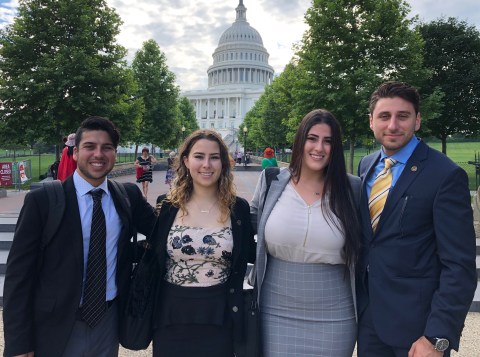
Mireille Samra (center right) with Armenian American interns on Capitol Hill
By Mireille Samra
Special Guest Contributor
After packing my five very heavy suit cases, I felt prepared to enter my direct flight to Washington D.C. Why might a South Florida native fly to Washington D.C. other then touring all the national monuments and museums? The simplest answer is to learn. My name is Mireille Samra and I am currently enrolled in the Armenian Assembly of America’s Terjenian-Thomas Summer Internship Program in Washington, D.C. Through the internship with the Assembly, I was placed on Capitol Hill, in the Office of Congressman Gus Bilirakis (R-FL), Vice Chairman of the Armenian Caucus in Congress.

President of Armenia, Armen Sargsyan with Mireille Samra at the Embassy of Armenia in Washington, D.C.
As an intern with the Armenian Assembly this summer, I have gained several new professional and personal connections. I was able to meet the President of Armenia twice in one day, along with the honorable First Lady of Armenia, on their first official visit to the U.S. So far, the 2018 class of Assembly interns have met with several community, political, and industry leaders. Early on, we met with the Director of the Armenian National Institute (ANI), Dr. Ruben Adalian. ANI provides historical information concerning the Armenian Genocide. In addition, the Assembly program provides us with direct meetings with elected officials, such as Congresswoman Jackie Speier (D-CA), Congressman Bilirakis, and Senator Ed Markey (D-MA), to name a few.

Armenian Assembly interns talking with Rep. Gus Bilirakis (R-FL) in his Capitol Hill office.
Currently, I have only been in D.C. for about one month. In that short amount of time, I have been learning things I could have never expected to learn, from how the metro (subway) system works, and the fact that finding parking in Washington, D.C. is like winning the lottery! Growing up, I’ve been known for always taking opportunities and not thinking much about them. Truthfully, this internship has taught me a lot. A typical workweek is Monday through Friday, 9:00am to 6:00pm, most days. Working on Capitol Hill, the people you meet are endless. Just last week I was giving a tour of the Capitol when the Queen of Jordan Rania Al-Abdullah walked by a few feet away from me! Something that keeps the internship on the Hill very interesting is that no two days are ever the same. For any Armenian American that is passionate about working hard in a big city and learning, the summer internship with the Armenian Assembly of America is a must before graduating.
Mireille Samra is a resident of Boca Raton, Florida and an active member of the South Florida Armenian American community. She graduated from Spanish River High School and currently studies Criminal Justice at Lynn University in Boca Raton.
Armenian National Institute Releases New Exhibit on YMCA & American Relief in Armenia
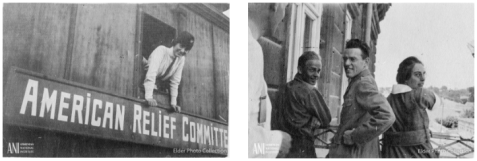
Left Image: Gertrude Pearson; Right Image: John Elder (left) with Tredwell Smith in Yerevan
ANI Releases Another Major Exhibit on the YMCA & American Relief in Armenia A Century Ago
WASHINGTON, D.C. – The Armenian National Institute (ANI) launched a new 24-panel digital exhibit displaying the role of the YMCA and American relief work during the first republic of Armenia (1918-1920). The exhibit focuses on John Elder and James O. Arroll who arrived in Yerevan, Armenia in January 1918 to open a YMCA center. As with digital exhibits previously released by ANI, American Relief in the First Republic of Armenia 1918-1920, subtitled “John Elder and James Arroll in Yerevan, Gyumri, Sevan & Etchmiadzin,” is freely downloadable from the ANI website.
Neither Elder nor Arroll had anticipated being stranded as the only Americans left in the country’s capital city with all communication to the outside world cut off when the frontline faltered. World War I was still raging at the time and Allied forces were in retreat on the Caucasian front. The November 11, 1918 Armistice that ended the global conflict was many months away, crucial months during which the very existence of the Armenian people hung in the balance.
By the time they left Yerevan in August 1919, John Elder and James O. Arroll had become responsible for the entire operation set up by U.S.-based charities that had earlier sent emergency aid and volunteer workers to Armenia. As John Elder wrote on January 16, 1919: “One year in Yerevan and what a year it has been. Had anyone told me a year ago that in addition to running a YMCA, I would be in charge of factories employing 7,500 people, orphanages with 350 children and a 120 bed hospital, I would have thought them crazy.”
ANI Chairman Van Z. Krikorian said: “The stellar example of American humanitarianism by Elder and Arroll continues to be emulated to this day. They were pathfinding pioneers who traveled all the way to Armenia during a very difficult time. All the relief workers who went to Armenia after the 1988 earthquake, and the Peace Corps volunteers who continue every year to extend their helping hand are following John Elder’s and James O. Arroll’s superb example. Armenians and Americans alike are proud to share this chapter of remarkable service to those in need.”
The exhibit reconstructs the story of the near superhuman efforts undertaken by John Elder and James O. Arroll to rescue Armenians from the many perils they faced during the 1918-1920 independent Republic of Armenia. The exhibit relies upon John Elder’s own words from his published journal, along with original records that he personally saved from the time of his service, and the photographs that he made and captioned.
Elder and Arroll arrived as two enthusiastic young men dedicated to the purpose of sustaining morale among soldiers enduring long campaigns and treacherous conditions as the Great War kept grinding on, year after year, without end. They departed as two celebrated heroes who stood by the Armenian people at the fateful hour. John Elder wrote on May 26, 1918, as Ottoman Turkish forces advanced to the outskirts of Yerevan: “You never can tell what may happen. Just as the end seems at hand the pendulum swings the other way…After a two-day battle at Sardarabad, the Turks have been completely routed.” With the decisive battle won, two days later, on May 28, 1918, Armenia declared independence.
The only Americans in Yerevan at the time, Elder and Arroll witnessed momentous events and the unfolding of a heart-wrenching humanitarian disaster as the ravages of war were revealed once the fighting stopped. A year elapsed before a new crew of relief workers reached Armenia to lighten the burden they shouldered. In the meantime, their efforts and accomplishments had become legend among admiring Armenians and fellow Americans at home.
The YMCA digital exhibit is the fifth such exhibit developed by ANI based on American documentation of the Armenian Genocide. It follows upon other educational material developed for the centennial of the Armenian Genocide, including the four large exhibits displaying hundreds of historic photographs.
These exhibits include:
- Witness to the Armenian Genocide: Photographs by the Perpetrators’ German and Austro-Hungarian Allies;
- The First Refuge and the Last Defense: The Armenian Church, Etchmiadzin, and the Armenian Genocide;
- The First Deportation: The German Railroad, The American Hospital, and the Armenian Genocide;
- Iconic Images of the Armenian Genocide (also available as a slideshow);
- Survivors of the Armenian Genocide.
The exhibit displays 95 images, 64 from John Elder’s photo collection, 8 contemporaneous records and documents, and 4 maps. With 32 quotations from Elder’s journal authenticating the photographs, along with introductory and explanatory text, the exhibit opens a window into life during the first year of the newly independent Armenian republic in 1918. The exhibit includes the entire set of photographs Elder attributed to his time in Armenia.

Children in the government orphanage
Several American relief workers are also mentioned in the exhibit, including Reverend Ernest Yarrow, Gertrude Pearson, F. Tredwell Smith, and Mabel Farrington. Mary Kifer, whose life was cut short after leaving the Caucasus, improbably found romance while conducting relief work in Armenia. Her story parallels “A Farewell to Arms” before Ernest Hemingway wrote his WWI era tragedy.
Other American personalities in the region appearing in the exhibit include F. Willoughby Smith, U.S. Consul in Tiflis, who supported the efforts of the relief workers; Robert McDowell, who was at the front when the Turkish forces broke through and invaded Alexandropol/Gyumri; Dr. John H.T. Main, president of Grinnell College in Iowa, who witnessed the horrific conditions in Armenia firsthand on behalf of the American Committee for Relief in the Near East; missionary Grace Knapp; and John Mott, longtime president of the American YMCA, who, with the encouragement of his friend President Woodrow Wilson, dispatched young Americans wherever they could lend civilian support behind the front to men in combat.
John Elder was particularly happy to welcome two Pennsylvania natives like himself, Pittsburgh businessman Howard Heinz, and president of the American Bar Association Walter George Smith, who traveled to Armenia on behalf of the American Relief Administration. Both were members of prominent families. Smith was married to Elizabeth Drexel, whose uncle, banker and philanthropist Anthony Drexel, founded Drexel University in Philadelphia. Smith became the most vocal American Catholic advocate of the Armenian people at the time.
“The Armenian National Institute thanks the Elder family for supporting the research undertaken to develop the exhibit, and for permitting our organization to continue to honor the memory of such a committed humanitarian,” stated ANI Director Dr. Rouben Adalian. “At the height of the conflict in the Caucasus when other relief workers chose to evacuate, John Elder refused to leave fearing that tens of thousands more Armenians would die of starvation if the relief programs were discontinued. He is credited in providing relief for 15,000 Armenian orphans. Such selfless heroism must be recognized.”
Adalian added: “I also want to thank Dr. Christina Maranci, Professor of Armenian Art and Architecture at Tufts University for lending her expertise. Dr. Andrew Anderson of the University of Calgary graciously extended permission to reproduce the very high quality map depicting the situation in the Caucasus in 1918. I thank as well the staff at the YMCA Archives for retrieving critical information about the protagonists of this exhibit.”
Dr. Adalian continued: “The YMCA exhibit should be viewed as a continuation of the historical reconstruction provided in a previously issued ANI exhibit and titled, The First Refuge and the Last Defense: The Armenian Church, Etchmiadzin, and the Armenian Genocide. That exhibit documented the extent of the spillover consequences in Eastern Armenia, then part of the Russian Empire, and of the atrocities committed in Western Armenia in the Ottoman Empire in 1915. The YMCA exhibit is a compelling reminder that the aftermath of the Armenian Genocide continued to unfold over the course of many years and spread across Eastern Armenia as well with every advancing step of the Turkish armies. The evidence gathered by John Elder demonstrates that Russian Armenia was not spared the genocide perpetrated by the Young Turk regime. He wrote on January 16, 1919: ‘Among the refugees it has been a holocaust.'”
The exhibit concludes with U.S. President Herbert Hoover’s tribute to the remarkable role of the YMCA pair who risked going to Armenia in the thick of World War I. The exhibit marking the centennial of the founding of the Armenian republic also extends appreciation to the Peace Corps volunteers today who are following in Elder’s and Arroll’s footsteps under the leadership of U.S. Ambassador to Armenia Richard M. Mills, Jr. who happened to be the State Department’s first Armenia desk officer when Armenia regained independence in 1991.
New Records Added to ANI Website, English and Turkish Language Sites Expanded
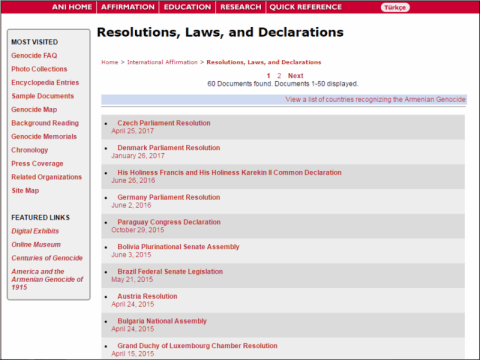
WASHINGTON, D.C. – With 7.5 million hits registered in 2017, the Armenian National Institute (ANI) websites in English and Turkish have obtained global reach as students, teachers, researchers, journalists, and public servants tap their substantial catalogue of critical records on the Armenian Genocide. In response to this encouraging trend and user feedback, ANI announced another expansion of its popular sites, adding new materials.
Sixty official documents on the Armenian Genocide, ranging from Denmark to Brazil, many of which were posted in their original language, are now all translated. The documents in this critically important section under the heading Resolutions, Laws, and Declarations are now available in their original languages, as well as in English and Turkish.
The Turkish language version of the ANI website has been growing continuously since it was launched in February 2017. More translations of key documents posted on the ANI website have been added with the goal of educating Turkish-speaking audiences about the Armenian Genocide in the face of the Turkish government’s standing policy of denying this history. The Turkish language site currently holds 72 documents, 8 encyclopedia entries, the Wegner photo collection, and FAQs, among other contents.
Well over 500 documents can now be accessed on the ANI website, including records from International Organizations, Religious Institutions, States and Provinces, Municipal Governments, Curriculum Mandates, and others. Over 200 U.S. state level resolutions and gubernatorial declarations are accessible.
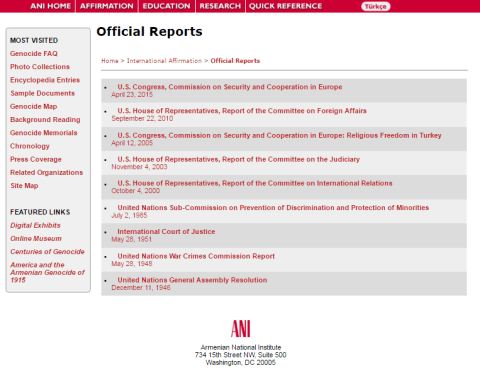
A newly expanded section titled Official Reports now features reports on proposed Congressional resolutions approved by several committees, including the Committee on Foreign Affairs (previously called the Committee on International Relations), the Committee on the Judiciary, and the Commission on Security and Cooperation in Europe. These official reports of the United States Congress, such as Affirmation of the United States Record on the Armenian Genocide Resolution Report of 2000, and A Century of Denial: The Armenian Genocide and the Ongoing Quest for Justice of 2015, trace the progress of several resolutions introduced over the years to affirm the American historical record on the Armenian Genocide.
The release of the movie The Promise brought the Armenian Genocide to the attention of broader audiences. Writing in the Los Angeles Review of Books about the importance of films depicting this painful subject, Professor of History at the University of Nevada, Las Vegas, Dr. Michelle Tusan, compares The Promise to the 1919 film titled Ravished Armenia. Her article along with some other 250 interesting selections from the international press also can be accessed on the ANI website under the Press Coverage section where they are categorized for easy selection under several headings, such as Editorial, Feature Story, Film Review, Opinion, Reporting, and so forth.
In 2016 the ANI website and its associated online museum, Armenian Genocide Museum of America (AGMA), became fully accessible on mobile devices such as tablets and smartphones. The AGMA online museum is an interactive site depicting the entire story of the Armenian Genocide through expandable galleries, along with dynamic narratives featuring survivors and historical imagery. The online museum was launched on April 24, 2015.

Lastly, due to the popularity of the ANI digital exhibits and their particular usefulness as teaching tools, the digital exhibit “Iconic Images of the Armenian Genocide” can now be viewed as an online slide show. Using historic photographs, the exhibit traces the deportation, annihilation, expropriation, and expulsion policies of the Young Turk regime and concludes with images of successful rescue efforts conducted by organizations such as the Armenian General Benevolent Union (AGBU), and the American humanitarian organization expressly created to address the plight of the survivors, Near East Relief (NER).
Founded in 1997, the Armenian National Institute (ANI) is a 501(c)(3) educational charity based in Washington, D.C., and is dedicated to the study, research, and affirmation of the Armenian Genocide.




 Florida Armenians