Blog Archives
From Tallahassee to Yerevan: My First Trip to Armenia
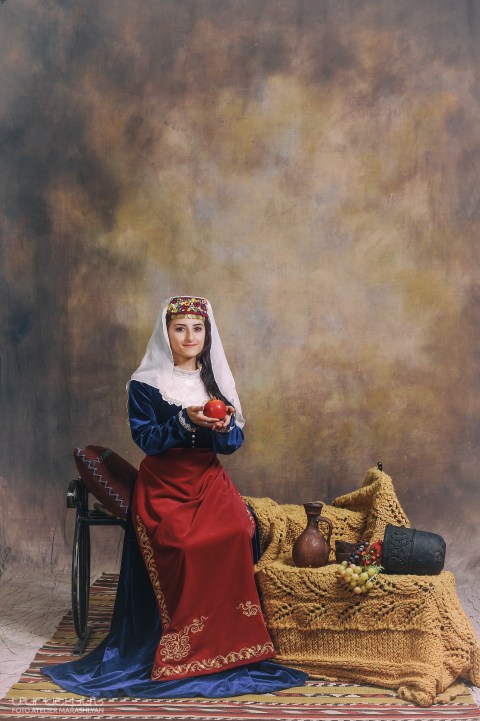
Margaret Atayants in traditional Armenian clothing. Photo credit: Photo Atelier Marashlyan.
By Margaret Atayants
FLArmenians Tallahassee Contributor
It took me a while to sit down and write out all of the feelings and thoughts that I had gathered after my first trip to Armenia. I am blessed to be an Armenian that was born and raised in America, a country that allows me to have everything right at arms reach. Growing up, my parents never really talked about Armenia because they were born and raised in Baku, Azerbaijan and the only thing that really connected them to Armenia was the blood that flowed within their veins. As I grew older, the more I began to feel what it meant to be Armenian. I started reading and learning more about my culture. I befriended Armenians who grew up in the homeland and other families who came from Western Armenia, descendants of survivors of the Armenian Genocide. I read more; I watched more; I listened more; but never in my life did I imagine to see what I saw when I arrived in Mother Armenia.
I had been planning my trip for three years, not really knowing how it would all play out. I imagined arriving at the airport, falling to my knees, crying and kissing the ground that my ancestors built. Instead, I arrived at the airport and a spirit that was greater than me took over and held me up stronger than I have ever felt in my life. It was an uplifting emotional experience. I retrieved my bags and as I approached the exit the sliding doors opened, and I smelled the heavy air. It filled my lungs and fed my soul.
The ride from the airport was long and confusing. I thought that I would be riding into a city straight from the airport but I was riding through a ghetto of homes that were left unbuilt from after the fall of the Soviet Union. It’s amazing how after 24 years of independence some parts still look like it happened yesterday. When you arrive to Armenia, you’re stepping into the past. It’s a land that hasn’t been touched by the hands of modern men. Granted there are modernized buildings standing in Yerevan, but I never felt the air change.
I was blessed to travel from the northern edges of Armenia in Alaverdi, down to the south where we rode over the mountains to Tatev Monastery. I had the privilege to smell and feel Lake Sevan. It was cold but delightful because I could hear the sounds of the Armenian duduk in the wind as it blew through my hair.

An Armenian villager in Garni.
I always knew that our people were hospitable and generous, kind with hearts and souls as wide as the ocean. But never did I imagine it to be so pure.
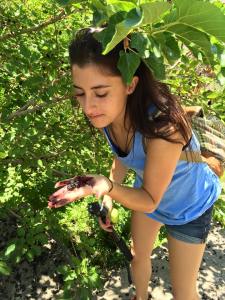
Margaret Atayants eating mulberries.
I will never forget the moment I was in Garni and we walked by a woman sitting down at her stand, selling homemade jam and molasses made from pomegranates; apricots that drip with juices that tasted as sweet as honey. As I bit into the apricot I looked up into the sky to thank God for these people who were filling the emptiness that has been in my soul for so long. As I looked away from the sky, my eyes slowly came down and stopped at the mulberry tree. As I child, I remember laying down a blanket and shaking the tree to collect the berries that I didn’t even understand at such a young age, why they tasted to good. Without thinking, I yelled out, “Tout!” (the Armenian word for mulberry), and the woman turned around and said to me, “Climb up my life, and pick the mulberries and eat them. This is my mulberry tree and I want to share with you.” So I did. I climbed up and as I was picking the berries off of the tree, they were melting into my hands, staining them black. Never in my life had I tasted something so delicious, something so sweet, something so full of life. I had my camera in one hand and the mulberries in the other as I was climbing back down the stairs from the tree. I didn’t know what to do with my dirty hand and this is the moment that I would never forget. The woman who’s tree I was eating from, saw that I was struggling, and told me to wait. She ran into her home to get a cup of water to wash my hands. Then a stranger grabbed my hand and washed it so gently that no matter how deep the stain it would be clean because this is what this woman had wished.
A stranger? They were no strangers. They are my family.
If Mother Armenia is calling you, go. Do not question her calls. She will pave the ground that you walk on. She will show you beauty that you cannot paint or write. She will pull your soul out of your body and with her majestic beauty and land show you what your own soul looks like. The whole country is filled with music and art, love and kindness, purity and faith, joy and sorrow. Go and understand why you love the way you love, why you cry the way you cry, why you care the way you care and why you breath the way you breath. Armenia changed my life like nothing else in this world ever had. Many people are poor; some people have nothing; some people are hungry; some people are waiting and praying, but they are the happiest to see you and love you and offer you all that they have.

Margaret Atayants looking towards Mount Ararat.
Today, when I listen to the duduk, images flash of the family I never knew I had in Armenia. Wait for me, my brothers and sisters. I will be back very soon to give you all that I have and more. Armenia, you have changed me and I will forever fall to my knees and love you.
ANI Genocide Website Announces Expansion
50 Official Records Affirming the Armenian Genocide Added; 30 Monuments Added to Memorials Database

WASHINGTON, D.C. – The Armenian National Institute (ANI) announced the completion of a major expansion of its heavily-used website. ANI updated one of the central features of the site which is widely consulted and provides an extensive catalogue of affirmation records from around the world.
As the spate of recognition and affirmation of the Armenian Genocide picked up pace with the centennial commemorations, ANI focused on obtaining the official documents attesting to this new international reality.
The documents from countries that entered the list formally recognizing the Armenian Genocide in 2015 were also augmented with official copies of declarations from prior years allowing the public to view the actual documents as well as have easy access to their text.
The current list of countries that have historically recognized the Armenian Genocide include Argentina, Austria, Belgium, Bolivia, Brazil, Bulgaria, Canada, Chile, Cyprus, France, Germany, Greece, Italy, Lebanon, Lithuania, Luxembourg, Netherlands, Paraguay, Poland, Russia, Slovakia, Sweden, Switzerland, United States, Uruguay, Vatican City, and Venezuela. The list of 27 countries is supported by 55 official documents available under the section Resolutions, Laws and Declarations.
Under the category of States and Provinces, the ANI website provides dozens of state-level resolutions and declarations from nine countries, including Argentina, Australia, Brazil, Canada, Italy, Spain, Switzerland, United Kingdom, and the United States. For the U.S., records from 44 states referencing the Armenian Genocide are reproduced, while countries like Spain and the UK are represented even as their central governments remain off record.
With important statements issued in April by heads of states and major religious and public institutions, these have been organized into new categories for easy access, such as International Organizations, Religious Institutions, and Heads of States, Parliaments, and Presidential Statements. A separate page reproduces all the April 24 and related statements issued by presidents of the United States from Woodrow Wilson to Barack Obama.
Many other sections of the ANI website were expanded including Education, Press Coverage, and the Memorials database. Some 200 Armenian Genocide memorials in 32 countries are identified, along with basic information about their location, designers, sponsors, and other features .
As previously announced, ANI notes the rapid expansion of scholarship on the Armenian Genocide and the numerous publications issued on the occasion of the centenary. These are featured under the section Armenian Genocide Resource Guide, and are grouped according to topic under Armenian Genocide and America, Armenian Genocide Studies, The Problem of Genocide, and other categories for easy identification. Over 100 publications are listed in the Resource Guide, with many others offered under the broader Educational Resources section.
The ANI website also features four large exhibits including the 10-panel Witness to the Armenian Genocide: Photographs by the Perpetrators’ German and Austro-Hungarian Allies issued in 2013; the 20-panel exhibit The First Refuge and the Last Defense: The Armenian Church, Etchmiadzin, and the Armenian Genocide released in 2014; the 24-panel exhibit The First Deportation: The German Railroad, The American Hospital, and the Armenian Genocide released in January 2015, and the 22-panel Iconic Images of the Armenian Genocide in March 2015; and a one-page poster depicting survivors in April 2015.
Because of popular interest in the exhibits which display hundreds of historic photographs, they have been made available through the Armenian Genocide Museum of America (AGMA) and Armenian Assembly of America (Assembly) websites as well. The digital exhibits are being continuously utilized and some quarter million copies have been downloaded to date.
The success of these new products has continued to sustain ANI as the leading institution providing information about the Armenian Genocide. Moreover, the combined addition of new resources on the ANI website has exponentially expanded the number of visitors. In 2013, the statistics jumped from 2 million hits to 3 million. In 2014, over 3 million hits were registered, and in 2015, over 4 million hits have been reached.
Through the ANI website visitors can also see the online museum launched by AGMA on April 24, 2015. The new interactive site includes an introductory video and a dynamic narrative that features survivors, background music, and significant imagery. The AGMA site is slated for expansion in 2016 and the second phase of the project will include mobile-friendly access for visitors. The site is envisioned to contain the entire story of the Armenian Genocide through expandable galleries.
The ANI website also served as a major resource for media from around the world to help provide coverage of the centennial commemorations. Nearly all global media paid close attention to the meaning of the centenary of the Armenian Genocide, with The Daily Mail in England, as an example, which has a circulation of 1.4 million and is believed to have a readership of 3 million, making extensive use of the historic images available from ANI.
“We want to thank all those who have sent ANI information about developments in their countries, whether new recognitions, the construction of memorials, or the release of noteworthy publications,” stated ANI chairman Van Z. Krikorian. “They all help maintain the ANI website as a central location for making this valuable data available to students, teachers, and the general public. The work that Rouben Adalian has done from the inception of this website is truly remarkable, and the fact that it is cited so prominently and often is a real achievement.”
“I especially need to thank the Armenian Genocide Museum-Institute in Yerevan and the Armenian Foreign Ministry for being helpful in retrieving many of the valuable documents posted on the ANI site where the collective effort of the Armenian people on the occasion of the of the centennial of the Armenian Genocide can be viewed and appreciated,” added ANI Director Dr. Rouben Adalian. “I also want to note the contributions of interns and volunteers who pitched in at ANI, most notably Karina Demircyan and Mariam Khaloyan for their dedication and participation in this effort by helping to expand the ANI website, and our longtime webmaster Mark Malkasian for his standing commitment to our goals,” Adalian said.
Founded in 1997, the Armenian National Institute (ANI) is a 501(c)(3) educational charity based in Washington, DC, and is dedicated to the study, research, and affirmation of the Armenian Genocide.
How Florida Representatives Voted on the Bill to Pause the Syrian Refugee Program
By Taniel Koushakjian
FLArmenians Managing Editor
Yesterday, the U.S. House of Representatives voted 289-137 to adopt H.R. 4038, the American Security Against Foreign Enemies (SAFE) Act of 2015, a bill that would pause the federal government’s current resettlement program for refugees from Syria and Iraq.
The bill requires the Director of the Federal Bureau of Investigations (FBI), Director of National Intelligence (DNI), and Secretary of the Department of Homeland Security (DHS) to perform background checks and sign off that each refugee “is not a threat to the security of the United States.”
The current policy only requires the DHS to perform background checks and takes 18-24 months to complete. The additional security checks would prolong the current process. All refugees seeking resettlement in the U.S. are first registered with the United Nations High Commissioner for Refugees (UNHCR) and those eligible are reported to DHS to begin the process.
The legislation comes on the heels of the November 13th terrorist attack in Paris, France that left 129 dead. At least one of the Paris attackers is known to have travelled from Syria to Europe through Greece, the route used by millions of migrants fleeing the Islamic State (also known as ISIS, ISIL, Daesh) in Syria and Iraq.
The House vote is a rebuke to President Obama, who threatened on Wednesday to veto the legislation. The additional security measures are “unnecessary and impractical,” the White House said. “Given the lives at stake and the critical importance to our partners in the Middle East and Europe of American leadership in addressing the Syrian refugee crisis, if the president were presented with H.R. 4038, he would veto the bill.”
47 Democrats joined 242 Republicans, giving House lawmakers a veto-proof majority they hope will force the President’s hand on the issue.
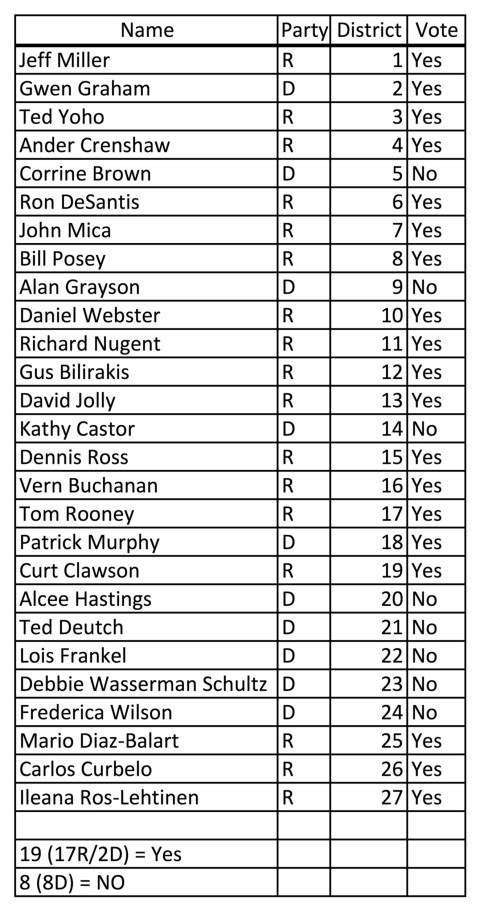
In Florida, 19 of the state’s 27 Representatives voted in favor of the tougher measures, with two Democrats joining Florida’s entire Republican delegation in support of the bill.
Rep. Patrick Murphy (D-FL), a candidate for U.S. Senate in 2016, voted in favor of the SAFE Act. He released the following statement after the vote: “I am deeply disappointed how divisive this debate has become. Homeland security should never be partisan and our number one priority is to always keep the American people safe. With new security considerations following the tragic and cowardly attacks in Paris last week, we must ensure that we have the strongest safeguards to certify refugees are not a threat to homeland security. This bill ensures that our entire intelligence community is on the same page without turning our backs on those fleeing violence and terror. We must put aside partisan differences to develop a comprehensive strategy that combats the threat ISIS poses to people who love freedom everywhere.”
Meanwhile, Murphy’s opponent for U.S. Senate, Rep. Alan Grayson (D-FL) voted against the bill. Murphy “chose fear over humanity when he voted against Syrian refugees,” Grayson posted on Twitter.
Rep. Gwen Graham (D-FL) is the other Florida Democrat to break ranks, stating “As the granddaughter of a Christian who came to America after fleeing religious violence, I do believe we have a role in helping peace-seeking refugees — but in light of new threats, we must strengthen our vetting process. We must be able to identify those who wish to do us harm, while continuing to offer a safe haven to those in need of refuge from war and persecution.”
Graham represents a swing district in northern Florida and narrowly won election in 2014. Her seat is expected to become safe-Republican after the Florida Supreme Court completes the redistricting process before the end of the year.
“As elected officials, we have the responsibility to do everything we can to protect our nation,” stated Armenian Caucus Vice Chair Rep. Gus Bilirakis (R-FL). “The SAFE Act puts in place a robust, extensive vetting and monitoring process to identify individuals who pose a security threat. It fulfills our promise to the American people that we are working diligently to prevent terrorists from reaching our shores.”
ARMENIAN AMERICANS REACT
For Armenian Americans, the issue tugs at the heartstrings as images and stories of those fleeing the violence emerge. Following the World War I Armenian Genocide, Christian Armenian orphans and other survivors were accepted into Syrian society and over the last century developed into a critical part of Syria’s multi-cultural mosaic. Some 180,000 Armenian Christians used to call Aleppo home up until a few years ago when they were driven out by ISIS and Jabhat al-Nusra.
“I fully support the resettlement of Syrian refugees, irrespective of their ethno-religious affiliation, in the U.S.,” stated Sarkis Balkhian, Advocacy Director for the Aleppo Compatriotic Charitable Organization, who is himself an Armenian American citizen from Aleppo. “During the 4.5 years of the Syrian conflict, the United States has resettled approximately 2,000 Syrian refugees out of a total of 4.3 million. That’s a comical number,” Balkhian said. “But yesterday’s vote confirmed that 289 Representatives are oblivious about the U.S. resettlement program and the vigorous vetting process already in place. What’s worse is that it appears they have succumbed to fear and are punishing the victims of ISIS rather than ISIS itself.”
Yet, Armenian Americans seem to be equally concerned about the potential influx of radical extremists who seek to harm us and destroy our way of life.
“I am wholeheartedly opposed to our government’s current plan to bring refugees from Syria and Iraq to the United States,” stated Ani Tramblian, an Armenian American from Annandale, Virginia. “I use the term bringing, because we are literally bringing them here, using American taxpayer dollars. Our President is putting U.S. citizens in harms way and exposing us to unnecessary risk. The House was right to pause the current process and add tougher security measures especially in light of terrorist attacks in Paris, and I hope our President takes our Congress seriously,” she said.

On Wednesday night, Florida Armenians launched an online poll, admittedly unscientific. At the time of this writing, the poll finds 51% of Armenian Americans in support of accepting 10,000 Syrian and Iraqi refugees as currently planned. 35% of Armenian Americans oppose accepting refugees from Syria and Iraq, while 13% agree with the House measure and support a pause in the current resettlement program, according to the Florida Armenians poll.
The Florida Armenians poll on Syria refugees will close on Friday at midnight.