Blog Archives
Armenian National Institute Website Now Includes 795 Official Records Affirming the Armenian Genocide
WASHINGTON, DC – The Armenian National Institute (ANI) has completed a massive expansion of its widely-consulted website containing extensive information on the Armenian Genocide. The 2019 resolutions adopted by the U.S. House and Senate expressly “encourage education and public understanding of the facts of the Armenian Genocide, including the United States role in the humanitarian relief effort, and the relevance of the Armenian Genocide to modern-day crimes against humanity.’ President Joe Biden’s April 24, 2021, remembrance day statement called for a “world unstained by the daily evils of bigotry and intolerance, where human rights are respected, and where all people are able to pursue their lives in dignity and security.”
The Affirmation section of the ANI website, that contains a collection of official documents pertaining to the international recognition of the Armenian Genocide, was thoroughly updated. The Affirmation records are now organized in 14 distinct categories covering resolutions, laws, and declarations by federal level governments, U.S. presidential statements, statements by heads of states, international organizations, religious organizations, official reports, public petitions, and other relevant documents.

Eighty-six new records were added to the Affirmation page, especially updating the sections on ‘Resolutions, Laws, and Declarations,’ ‘State and Provincial Governments,’ and ‘Municipal Governments.’
With strong community support promoting instruction in human rights and genocide prevention, state educational curricula are now mandated in some 10 states across the United States, including Massachusetts, Nevada, Ohio, Connecticut, Michigan, Rhode Island, Illinois, California, New York, and New Jersey. The relevant pieces of legislation are all accessible under ‘Curriculum Mandates.’
As for the 31 countries that formally acknowledge the Armenian Genocide, they include: Argentina, Austria, Belgium, Bolivia, Brazil, Canada, Chile, Cyprus, Czechia, Denmark, France, Germany, Greece, Italy, Latvia, Lebanon, Lithuania, Luxembourg, Netherlands, Paraguay, Poland, Russia, Slovakia, Sweden, Switzerland, Syria, Vatican City, Venezuela, United States, and Uruguay.
In all, the ANI website presently holds 795 affirmation records from around the world.
The ANI collection of affirmation records was developed with the collaborative support of the Armenian Genocide Museum-Institute (AGMI) in Yerevan. A new cooperation agreement reached between AGMI and ANI allowed for extensive research in the AGMI holdings in order to reverify and update the records posted on the ANI website. The agreement was signed in Yerevan by AGMI Director Dr. Harutyun Marutyan and ANI Chairman Van Z. Krikorian on August 5, 2021. AGMI in Armenia and ANI in the United States have become two important depositories of official affirmation records, AGMI holding an international collection, and ANI holding a considerable American collection of original documents.
Robert Arzoumanian, who joined ANI as assistant to the director, conducted the research at AGMI where additional records were identified that have been mounted on the ANI website for easy access by the public. Arzoumanian, a Brown University graduate, interned at ANI and in Congressman Frank Pallone’s office in 2016 and returned the following year as the Armenian Assembly’s summer intern program coordinator. He also has experience working with Armenia-based media. Arzoumanian undertook the challenge of standardizing the presentation of the full scope of international records identified by ANI in order to facilitate their usage by an international audience.
Since its founding in 1997, the Armenian National Institute has been working closely with AGMI, and over the years has supported several conferences and joint projects. Continuing this long-standing cooperation with AGMI, ANI sent a video message on April 16, 2021, welcoming the release by the museum of the volumes prepared by Ara Ketibian and Father Vahan Ohanian titled, “Armenian Genocide: Prelude and Aftermath as Reported in the U.S. Press, The Washington Post (1890-1922),” to which ANI Director Dr. Rouben Adalian contributed an introduction.
Earlier in 2021, AGMI also released the fourth edition of Dr. Adalian’s essay, “Remembering and Understanding the Armenian Genocide,” which AGMI originally issued in 1995.
In 2021, ANI also continued to expand its online presence by launching the Arabic version of the popular ANI website. The announcement was issued in Arabic as well. Soon after its launch on April 17, the site was being consulted in countries ranging from Lebanon to United Arab Emirates, Egypt, Saudi Arabia, Jordan, Iraq, Kuwait, Syria, Qatar, Oman and Morocco.
The Arabic-language site represents the third translated edition of the ANI website. The Spanish-language edition appeared in 2020 and the Turkish version in 2017. In light of U.S. President Biden’s affirmation and general media coverage, interest remains high on the subject of the Armenian Genocide. Following the disruptions associated with the shutdown precipitated by the pandemic, with the reopening of educational institutions, a large number of visitors are returning to the ANI website, which registered 4 million hits in 2021.
The process of international recognition remains an ongoing concern for Armenian communities around the world. Efforts are presently under way in England, Israel, and Australia. In 2021, Latvia formally adopted recognition on May 6. Dr. Adalian, along with Dr. Ronald Suny and Armenia’s Ambassador to the Baltic states Tigran Mktchyan, was invited on April 20, to testify in front of the Foreign Affairs Committee of the Latvian Parliament that was considering the resolution recognizing the Armenian Genocide.
Founded in 1997, the Armenian National Institute (ANI) is a 501(c)(3) educational charity based in Washington, D.C., and is dedicated to the study, research, and affirmation of the Armenian Genocide. The ANI website can be consulted in English, Turkish, Spanish, and Arabic. ANI also maintains the online Armenian Genocide Museum of America (AGMA).
Armenian National Institute Website Available in Spanish
The Luisa Hairabedian Foundation of Argentina Joins ANI in Launching Website
WASHINGTON, DC – The Armenian National Institute (ANI) announced the launch of the Spanish version of its widely-consulted website on the Armenian Genocide. The creation of the Spanish ANI site follows upon the earlier successful launch of the Turkish language version of the site.
The ANI website contains extensive records on the history and affirmation of the Armenian Genocide when 1.5 million Armenian Christians fell victim to the Young Turk government policy of mass deportation and annihilation. The Spanish version reproduces ANI’s catalog of official documents from around the world. These records are posted in their original languages, many in PDF format, and can now be accessed in English, Turkish, and Spanish. The leading institutional website on the Armenian Genocide since its inception 23 years ago, the ANI website annually registers more than 7 million hits. Widely consulted by educators and students, the site is also a major source of information in preparation of April 24 commemorative activities utilized by journalists, government officials, and the public.

The ANI Spanish site reproduces many of the most popular sections of the main site: maps, photographs, FAQs, chronology, list of countries, and international affirmation records, including the milestone resolutions adopted by the United States House of Representatives and the United States Senate in October and December 2019 respectively.
Countries in the Spanish-speaking world were among some of the first to reaffirm the Armenian Genocide, with Uruguay leading the process as far back as 1965. Most South American countries, including Argentina, Bolivia, Chile, Paraguay, Venezuela, and Brazil recognize the Armenian Genocide. Portuguese-speaking Brazil was joined by Portugal itself whose parliament recognized the Armenian Genocide in April 2019.
“We feel privileged to bring the widely used ANI resource to the attention of the Spanish-speaking world, which has produced some of the greatest champions of human rights around the world” said ANI Board Chairman Van Z. Krikorian. “Raphael Lemkin, who coined the term ‘genocide’ in 1944, cited the Armenian experience as a definitional example. In supporting the 1948 United Nations Genocide Convention, the United States in 1951 did the same. In addition, the Armenian Genocide was cited as a precedent in the post-WWII Nuremberg trials. Campaigns to deny and rewrite the history of genocide and human rights violations have led to worse crimes and continue, even today.”
“The lessons those who remember the Armenian and other genocides try to teach relate directly to universal issues of basic human dignity. Genocides start with thoughts and words, build step by step, and culminate with mass scale violence, forced conversions, and similar atrocities. We stand with every person of good conscience to work against such man-made disasters and hope that instructional resources available through ANI can become additional tools for educating about this fundamental area of knowledge,” added Krikorian.
“The ANI Spanish site was created with the support and encouragement of several individuals,” added ANI Director Dr. Rouben Adalian. “I want to thank them for pulling together another chapter in the Institute’s ongoing efforts to educate the public about the Armenian Genocide. Our summer intern Serena Hajjar skillfully embarked on the project. Sonia Arakelian extended editorial support from Mexico City. Federico Gaitan Hairabedian, who heads the Buenos Aires, Argentina-based The Luisa Hairabedian Foundation, an organization dedicated to the cause of historical justice, and the team that he assembled, especially Garine Morcecian and Vilén Ter Gazarian, steered this phase of the project to completion,” added Dr. Adalian.
“Our longtime webmaster Mark Malkasian continues to guide ANI’s digital presence,” continued Dr. Adalian. “Above and beyond managing our Internet presence and seeing to it that the sites’ design makes the difficult subject of the Armenian Genocide easily accessible to the general public, especially to students and teachers, Malkasian continues to oversee making the site presentable in all platforms. As of late, he has overseen the upgrading of the ANI site and has made it even more mobile-friendly. Whichever their preferred platform, ANI visitors will be viewing a more streamlined website with easier access to content,” stated Dr. Adalian.
ANI maintains a broad range of online resources about the Armenian Genocide. The online museum is an interactive site allowing visitors to proceed at their own pace, and includes a very popular introductory video. Several digital exhibits released by ANI since the centennial of the Armenian Genocide cover many aspects of the experience of the Armenian people starting in 1915. The ANI digital exhibits are based on photographic collections from U.S. archival repositories and document the extensive humanitarian intervention of American volunteers, who arrived in Armenia and across the Middle East in the immediate aftermath of the genocide.
“I also want to thank The Luisa Hairabedian Foundation for collaborating with ANI, as well as recognize their many contributions for raising awareness about human rights and the recognition of the Armenian Genocide in Argentina. We appreciate their partnership, welcome their participation in bringing ANI resources to the attention of the Latin American public, and look forward to continuing our collaboration,” concluded Krikorian.
Sitio Web Del Instituto Nacional Armenio Disponible En Espanol
La Fundacion Luisa Hairabedian de Argentina se une a ANI en Lanzamiento del Sitio
WASHINGTON, DC – El Instituto Nacional de Armenia (ANI) anunció el lanzamiento de la versión en español de su sitio web ampliamente consultado sobre el Genocidio Armenio. La creación del sitio ANI en español sigue al lanzamiento exitoso anterior de la versión turca del sitio.
El sitio web de ANI contiene extensos registros sobre la historia y la afirmación del Genocidio Armenio cuando 1.5 millones de cristianos armenios fueron víctimas de la política de deportación y aniquilación masiva del gobierno de los Jóvenes Turcos. La versión en español reproduce este catálogo de documentos oficiales de todo el mundo. Estos registros se publican en sus idiomas originales, muchos en formato PDF, y ahora se puede acceder en inglés, turco y español. El sitio web institucional líder sobre el Genocidio Armenio desde su creación hace 23 años, registra anualmente más de 7 millones de visitas. Ampliamente consultado por educadores y estudiantes, el sitio también es una fuente importante de información en preparación de las actividades conmemorativas del 24 de abril utilizadas por periodistas, funcionarios gubernamentales y el público.
El sitio ANI en español reproduce muchas de las secciones más populares del sitio principal: mapas, fotografías, preguntas frecuentes, cronología, lista de países y los registros de afirmación internacional, incluidas las resoluciones históricas adoptadas por la Cámara de Representantes de los Estados Unidos y el Senado de los Estados Unidos. en octubre y diciembre de 2019, respectivamente.
Los países del mundo de habla hispana fueron algunos de los primeros en reafirmar el Genocidio Armenio, con Uruguay liberando el proceso desde 1965.
La mayoría de los países sudamericanos, incluidos Argentina, Bolivia, Chile, Paraguay, Venezuela y Brasil, hoy reconocen el Genocidio Armenio. El Brasil de habla portuguesa se unió al propio Portugal, cuyo parlamento reconoció el Genocidio Armenio en abril de 2019.
“Nos sentimos privilegiados de llevar el recurso ANI ampliamente utilizado a la atención del mundo de habla hispana, que ha producido algunos de los mayores defensores de los derechos humanos en todo el mundo”, dijo el presidente de la junta de ANI, Van Z. Krikorian. “Raphael Lemkin, quien acuñó el término” genocidio “en 1944, citó la experiencia armenia como un ejemplo definitorio. Al apoyar la Convención de Genocidio de las Naciones Unidas de 1948, los Estados Unidos en 1951 hicieron lo mismo. El genocidio armenio también fue citado como precedente en los juicios de Nuremberg posteriores a la Segunda Guerra Mundial. Las campañas para negar y reescribir el historial de violaciones de los derechos humanos y el genocidio han llevado a crímenes peores y continúan, incluso hoy en día “.
“Las lecciones que los que recuerdan los armenios y otros genocidios que intentan enseñar se relacionan directamente con cuestiones universales de dignidad humana básica. Los genocidios comienzan con pensamientos y palabras, se desarrollan paso a paso y culminan con violencia a gran escala, conversiones forzadas y atrocidades similares. Apoyamos a todas las personas de buena conciencia para trabajar contra tales desastres provocados por el hombre y esperamos que los recursos de instrucción disponibles a través de ANI puedan convertirse en herramientas adicionales para educar sobre esta área fundamental de conocimiento “, agregó Krikorian.
“El sitio ANI en español fue creado con el apoyo y el aliento de varias personas”, agregó el director de ANI, Dr. Rouben Adalian. “Quiero agradecerles por reunir otro capítulo en los esfuerzos continuos del Instituto para educar al público sobre el Genocidio Armenio. Nuestra pasante de verano, Serena Hajjar, se embarcó hábilmente en el proyecto. Sonia Arakelian extendió el apoyo editorial de la Ciudad de México. Federico Gaitan Hairabedian, quien dirige la Fundación Luisa Hairabedian en Buenos Aires, Argentina, una organización dedicada a la causa de la justicia histórica, y el equipo que reunió dirigió esta fase del proyecto a terminación junto con los voluntarios Garine Morcecian y Vilén Ter Gazarian.
“Nuestro antiguo webmaster Mark Malkasian continúa guiando la presencia digital ANI”, continuó Adalian. “Más allá de administrar nuestra presencia en Internet y velar por que el diseño de los sitios haga que el tema difícil del Genocidio Armenio sea más fácilmente accesible para el público en general, especialmente estudiantes y maestros, continúa supervisando hacer que el sitio sea presentable en todas las plataformas”. Últimamente, ha supervisado la actualización del sitio ANI y lo ha hecho aún más amigable para dispositivos móviles. Cualquiera que sea su plataforma preferida, los visitantes de ANI verán un sitio web más ágil con sus contenidos aún más fácilmente accesibles “.
ANI mantiene una amplia gama de recursos en línea sobre el Genocidio Armenio. El museo en línea es un sitio interactivo que permite a los visitantes continuar a su propio ritmo e incluye un video introductorio muy popular. Las diversas exhibiciones digitales lanzadas por ANI desde el centenario del Genocidio Armenio cubren muchos aspectos de la experiencia del pueblo armenio a partir de 1915. Las exhibiciones digitales de ANI son basado en colecciones fotográficas de repositorios de archivos de EE. UU. y documentar la amplia intervención humanitaria de los voluntarios estadounidenses que llegaron a Armenia y a través del Medio Oriente inmediatamente después.
“También quiero agradecer a la Fundación Luisa Hairabedian por colaborar con ANI, así como reconocer sus muchas contribuciones para crear conciencia sobre los derechos humanos y el reconocimiento del Genocidio Armenio en Argentina. Agradecemos su asociación, agradecemos su participación en llevar los recursos de ANI a la atención del público latinoamericano y esperamos continuar nuestra colaboración “, concluyó Krikorian.
Fundado en 1997, el Instituto Nacional de Armenia (ANI) es una organización benéfica educativa 501 (c) (3) con sede en Washington, D.C., y se dedica al estudio, investigación y afirmación del Genocidio Armenio.
Armenian National Institute Exhibit Opens at Republic of Armenia’s Ministry of Defense

Major General Lee Tafanelli of the Kansas Army National Guard with U.S. military delegation, U.S. Ambassador Lynne Tracy, Dr. Ashot Melkonian of the Armenian Academy of Sciences, and Defense Minister Davit Tonoyan at the Republic of Armenia’s Defense Ministry for the opening of the ANI exhibit.
YEREVAN, ARMENIA – United States Ambassador to Armenia Lynne Tracy and Kansas Army National Guard Adjutant-General, Major General Lee Tafanelli, joined Armenia’s Minister of Defense Davit Tonoyan for the opening of the exhibit “The United States Military in the First Republic of Armenia 1919-1920” on January 27 at the Republic of Armenia’s Ministry of Defense in Yerevan.
Created by the Washington, D.C.-based Armenian National Institute, the new exhibit focuses on the enormous extent of humanitarian assistance rendered by the United States to Armenia in the aftermath of World War I through the services of American military missions sent to Armenia.
In his opening remarks, Minister Tonoyan thanked Ambassador Tracy for the support extended by the United States in recent years to Armenia. Reflecting on the historical exhibit, Tonoyan noted that: “For many, U.S. assistance during those years was critical, especially the new opportunities created to provide education thanks to which many Armenians received schooling during that difficult time and went on to make impressive achievements.”
Ambassador Tracy delivered welcoming remarks congratulating those present on the occasion of the 28th anniversary of the Armenian Army and spoke about the important work done over the past 100 years.
U.S. General Tafanelli along with his delegation of officers viewed the exhibit and are in Yerevan as part of the U.S.-Armenia military partnership program.

U.S. Ambassador Lynne Tracy, Major General Lee Tafanelli, and Babken Vartanian at the Republic of Armenia’s Defense Ministry for the opening of the ANI exhibit.
Regional Director Arpi Vartanian, speaking on behalf of the Armenian Assembly of America and the Armenian National Institute, pointed out the importance of the high level military mission that U.S. President Woodrow Wilson dispatched to Armenia and stressed their effective intervention in stabilizing the humanitarian crisis in the country despite the small size of the American contingents. She thanked as well Armenia’s servicemen on the occasion of the 28th anniversary of the founding of Armenia’s modern-day army.
The 27-panel exhibit documents the tremendous importance of the U.S. humanitarian intervention during the most difficult years in the life of the newly-formed Armenian state. Based upon the photographic collection of an American medical officer, Dr. Walter P. Davenport, the exhibit reveals the depth and breadth of measures taken by U.S. military personnel to stabilize the humanitarian crisis in Armenia, and especially the caretaking of the most vulnerable part of the population through hospitals, orphanages, food distribution points, and other facilities.
Subtitled “The American Relief Administration and Walter Davenport of the U.S. Army Medical Corps,” the exhibit reveals how in 1919, U.S. military personnel and civilian aid workers cared for tens of thousands of children. As Dr. Davenport reported: “At the present time we are furnishing food and medical relief to 75,000 children daily, this work being done through the medium of orphanages, orphanage hospitals, soup kitchens, cocoa kitchens, milk stations, bread distributing points, orphanage infirmaries, and public dispensaries.”
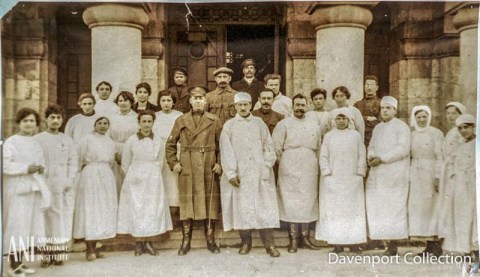
Dr. Walter P. Davenport with local Armenian medical staff.
The Davenport collection of photographs not only documents the humanitarian crisis unfolding in Armenia, but also the measurable difference American relief efforts made in the span of only a few months. The exhibit displays official and personal records related to Dr. Davenport’s activities in Armenia, which he subsequently reported in The Military Surgeon journal. With 103 photographs, 3 maps, 14 documents, and several newspaper articles, the exhibit pictorially reconstructs the conditions that U.S. military personnel witnessed in Armenia.
The digital version of the ANI exhibit is available on online and free to download from the ANI website where five other exhibits may be viewed. Designed for instructional purposes, the exhibits explain several aspects of the Armenian Genocide that were well documented photographically.




 Florida Armenians