Category Archives: Food
The Armenian Kitchen Hits One Million Views
By Tom Vartabedian
BOYNTON BEACH, FL — What’s cooking in the Armenian Kitchen these days?
Chief cooks Doug and Robyn Kalajian happen to be celebrating an auspicious occasion with another delectable meal and perhaps a bottle of champagne.
They’re toasting a happy marriage as well as a happy website that has caught the attention of its one-millionth page viewer.
“Raise the glasses and bring out the special tableware for this occasion,” bubbles Robyn. “What a milestone! You could knock us over with a feather.”
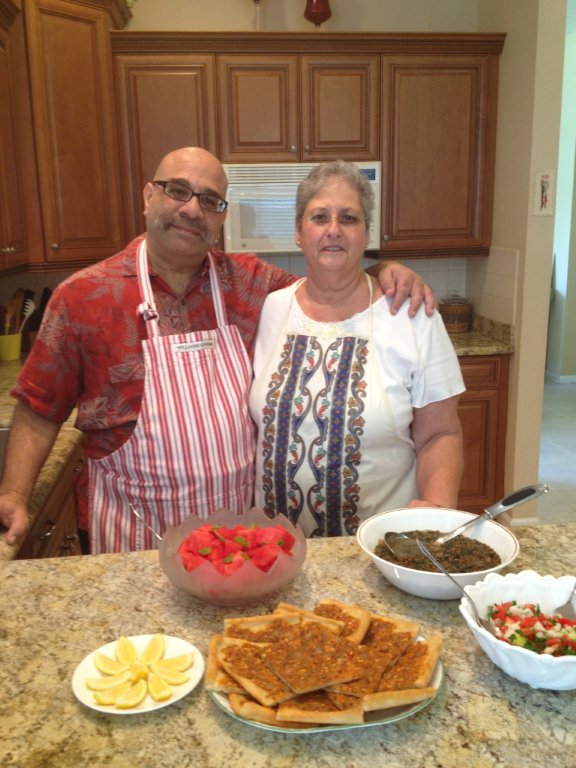
You’re all invited to dinner with Robyn and Doug Kalajian inside their Armenian Kitchen online.
The big day arrived May 27 when the website registered 547 hits, a tad less than the previous day, which received 931. Over May, the site registered 27,580 views, and passed the million mark by 331.
It has anything and everything you wanted to know about Armenian food a million times over and still counting.
Among the latest queries was from Mark Gavoor with his oud in hand. He represents the voice of Chicago with an appetite to match, especially when it comes to such delectables as perper salata, Kharpert kufteh and topig. Just like medzmama’s cooking!
He has this to say about the Kalajians:
“Their Armenian Kitchen blog is an Armenian-American treasure. Their passion for the preservation and dialogue of our culinary roots is nonpareil. I wish I were more of a cook than simply an avid fan of results of Armenian cooking pros like Doug and Robyn. If I were, I’d certainly take advantage of their wonderful and voluminous collection of recipes. Maybe one day.”
Whether it’s their concoctions, a friend’s, or from another’s cookbook, it’s all up there for people to enjoy, says Gavoor.
“The Kalajians provide great stories and give ample credit to wherever the recipes may originate from,” he adds.
Their website—www.TheArmenianKitchen.com—shares everything you want to know about Armenian food one recipe and story at a time, whether it’s Aunt Arpie’s deviled eggs or Gavoor’s amazing cheese puff/bourag called “penerli.”
Put on an apron, wash your hands, and join the Kalajians on their epicurean journey.
“Armenian recipes are as varied as their regions and dialects,” agrees Robyn. “No two choreg recipes are alike. Food connects us across all boundaries. We like to think we’re preserving our heritage one recipe at a time.”
We caught up with the Kalajians in the comfort of their kitchen. No doubt, it’s their favorite room. And with the electronic era, they share it with the world.
Doug, too, is absolutely dumbstruck by the overall popularity of his nutmeg. As he understands it, the stats mean his website has been clicked on over a million times by almost 300,000 different readers.
“It tells us that people keep coming back,” he says. “We know this because Google tracks visits automatically and tells us what stories they read and where they may live, right down to the village in China, Africa, or the Middle East. It’s been an amazing journey over these past five years.”
Other remote areas include Mongolia, Laos, Iceland, Uzbekistan, and United Arab Emirates. A man from Australia was so desperate for the taste of basterma, he sought the recipe. A woman from Canada sent along an easy method of making madzoon in a microwave. Others are hoping to find lost family recipes.
Doug worked as an editor, reporter, and feature writer for over 16 years with the Palm Beach Post before retiring in 2008 from what he calls “a sadly shrinking newspaper industry.”
Along the way, he wrote a non-fiction book called Snow Blind about a crusading public defender caught up in Florida’s cocaine insanity of the 1980’s.
Robyn, a retired culinary arts teacher, remains the chief cook with this production duet; her husband calls himself a sous chef. Dining with them in an elaborate Florida restaurant is quite the appetizer.
“I’m absolutely dumbstruck by the overall popularity of YouTube, which has displaced traditional TV for so many people,” Doug points out.
Most popular so far is how to make shish kebab with more than 65,000 views. More so than the website, the videos seem to draw a diverse audience that includes many non-Armenians. The reaction has been powerful and sometimes overwhelming.
“Our cooking videos have been watched more than 230,000 times by viewers from around the world.” Doug notes that some videos have also become a lightning rod.
“There’s a furious international food fight being carried out among various groups claiming the identity and origin of dishes from throughout the Near and Middle East,” he confirms. “Armenian cuisine is under heavy fire, particularly from Azerbaijan and Turkey. The comments get downright nasty sometimes, but I rarely feel the need to reply because Armenian viewers jump in quickly with their own response.”
The Kalajians remain content to leave questions about the food industry to the experts while they try to satisfy a clear desire among Armenians to share their recipes and the traditions they represent.
One lesson that’s been driven home is that the Armenian menu is incredibly varied because it reflects the far-reaching experiences and travels of the Armenian people over centuries.
“Our cuisine is still evolving as Armenians adapt to the changing world,” he agrees. “Ask Armenians from Yerevan and Lebanon to describe a typical meal and you may get very different answers. But you might find the same divergence between two Armenians from New Jersey if one family came from Dikranagerd and the other from Van.”
After starting the website in March 2009 with nothing more than the thought of sharing recipes with an unknown global audience, it’s become an evolving turnstile.
“We always wanted to work on something together,” they said. “Robyn’s knowledge of food and cooking with my writing skills was an obvious conclusion.”
The Kalajians are based in Boynton Beach, where they cook and write. Both are involved with St. David’s Armenian Church and piped into the Armenian community. They’ve connected people with recipes, specific ingredients, and other curiosity-seekers. Through their website, they found a cousin named Maro Nalabandian, a noted pastry chef.
“I’d heard about her family over the years but we’d never met until this past April,” said Robyn. “The passion for food must be in our genes.”
Baking the distinctive cheese bread recipe that Robyn learned from her grandmother not only brings back memories, it gives the Kalajians a small taste of the little village in the shadow of Musa Dagh, which her ancestors left nearly a century ago.
A plea for assistance came from Tigran Shahverdyan, a scientist from Moscow participating in the International Space University’s studies program at Florida Institute of Technology.
He didn’t have a car and needed to know where the nearest Middle Eastern store was located. He wished to buy lavash for a cultural project to which he was committed. Being the only Armenian in the group, he wanted to do an Armenian-style barbeque.
Using her computer, Robyn located a store near his school that sold lavash and passed on the information diligently, much to the delight of the faculty and students.
“We’ve posted recipes related to certain Armenian traditions, celebrations, and holidays,” she brought out. “Our main purpose continues to find and preserve Armenian family-style recipes. Sometimes, it’s a challenge with regional dialect and recipe name/spelling differences, but we’re always up for that. At times, we turn to readers for help and someone usually comes to the rescue.”
The Kalajians would love to publish their own cookbook but the idea always seems to find “the back burner.” Yet, it’s not out of the question. A calendar has been suggested and that’s another possibility. It’s just a matter of time and timing.
As for television, that’s highly unlikely. They’ll stick to their YouTube videos for now. In the meantime, they’ll focus on being an interactive site that reaches far beyond their wildest dreams.
This article has appeared in various Armenian-American publications and is reprinted with the permission of the author.
Meat Boregs – Detroit Style
By Robyn and Doug Kalajian
FLArmenians Cuisine Contributors
After two years of preparation and anticipation, the 111th Diocesan Assembly and Clergy Conference in beautiful Boca Raton concluded on Sunday, May 5, 2013.

Boreg-Lahmajoun Table
It was a whirlwind week of events with hundreds of attendees from Mid-Western, East Coast, and Southern states. In addition to the planned sessions and meetings, guests participated in luncheons, kef time (featuring the music of Johnny Berberian), area sightseeing, and a gala banquet honoring Armenians of the Year – Janet and Edward Mardigian, and Friend of the Armenians – former Florida Governor Jeb Bush. The week-long gathering culminated with a lavish farewell Sunday brunch for departing Very Rev. Fr. Nareg Berberian of St. David Armenian Church.
I had a mini part in the grand scheme of things, but it was exciting just the same. Many of our seasonal visitors rolled up their sleeves alongside local parishioners to help create the massive menu for the farewell brunch.
Serving stations were set with assorted salads, yalanchi, lahmajoun, cheese boregs, meat boregs, and hummus. A carving station offered sliced-to-order roast beef, ham and turkey. Desserts included kourabia cookies, paklava, semolina cakes, fruit kabobs, and more. The beverage station served-up Mimosas (orange juice and champagne), plain orange juice, and coffee to help wash everything down.
Weeks before the brunch, I was at church working on another aspect of the preparation while a group of seasonal parishioners from Detroit were in the kitchen making the meat boregs. They made Dolly Matoian’s recipe which came from St. John Armenian Church (Detroit) cookbook. This is not a ‘home version’ recipe as it yields 375 to 400 boregs, and requires 20 workers over a 2-day period to complete.
Desert Table
Instead of using phyllo dough or puff pastry, the dough was more chorag-like. The meat filling had a nice ‘kick’ from the blend of black pepper and cayenne pepper in the filling. I got to sample a test boreg as it came out of the oven – it was soft, warm, and so delicious!
I have made an attempt to break down the large-group recipe for the home kitchen, but be warned – I have not tested this version. The new ingredient amounts represent 1/8th the original recipe measurements.
The smaller recipe should yield about 45 to 50 boregs, and I would suggest having one or two extra pairs of hands to assist. Oh yes, it’s important to prepare the meat mixture one day in advance.
Please don’t be discouraged by the lengthy recipe. One thing is for sure, I can certainly appreciate the time and effort the Detroit ladies put into this recipe, and I truly did savor every bite!
Here’s the (untested) home version recipe…
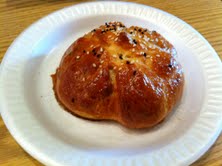
Detroit-Style Meat Boreg
Meat Boreg (Beoreg)
Yield: 45 to 50 pieces
Filling Ingredients:
1 lb. chopped onions
3 Tbsp. vegetable oil
1 ¾ lbs. ground lamb
1 ¾ lb. ground sirloin (or chuck)
¾ tsp. salt
¼ tsp. black pepper
¼ tsp. cayenne pepper
½ tsp. paprika
¾ lb. (3 sticks) butter
¾ c. dried parsley (or 1 cup fresh, chopped parsley)
Dough Ingredients:
¼ lb. (1 stick) butter
¼ cup vegetable shortening
1¼ c. milk
5 eggs
1 Tbsp. sugar
1 Tbsp. plus 2 tsp. dry granular yeast
½ cup warm water
2 ¼ tsp. sugar
1 ½ tsp. salt
3 ¼ lb. all-purpose flour (approx. 12 cups)
Egg wash:
2 eggs, beaten
Topping:
Regular or black sesame seeds
Directions:
Day 1:
1. Heat vegetable oil in a skillet. Saute onions until soft, but not mushy. Strain onions in a colander, pressing firmly to remove any liquid. Set aside until ready to use.
2. In a large frying pan, cook lamb and beef over medium heat until brown. Break meat down with a fork to remove any large lumps. Strain out any excess fat.
3. Place cooked onions and meat in a large mixing bowl. Stir in all of the seasonings. Taste for flavor and spiciness. Make any adjustments, if necessary.
4. Melt the butter in a skillet and add to the meat-onion mixture. Finally, add the chopped parsley.
5. Place mixture in shallow containers; cover and refrigerate until day 2.
Day 2:
Directions for Dough Preparation:
1. Melt butter and shortening in a saucepan. Allow to cool. Add milk to butter mixture; set aside.
2. Using a hand or stand mixer and a large bowl, beat eggs and sugar until well-blended.
3. Begin adding flour, a little at a time, to the egg mixture for a uniform mixture.
4. In a medium bowl, combine the ½ c. warm water, yeast and sugar, whisking to dissolve. Cover with plastic wrap and allow to proof.
5, Add proofed yeast to the flour mixture and knead dough well.
6. Using a food scale, portion the dough into 1 ½ to 2 oz. portions; place on trays, cover with plastic wrap or parchment paper and allow to rest.
7. Portion the meat into 1/12 to 2 oz. portions.
8. On a work surface (no flour should be needed), roll each dough portion into 4-inch circles, and place on platters.
Forming and baking the boregs:
9. Hold each round of dough in one hand; top with meat mixture. Pinch or fold the dough over the meat to completely seal the filling.
10. Place – seam side down – on parchment-lined baking sheets. Lightly press down to make a bun shape instead of a ball shape. Continue the process until the trays are filled. Allow boregs to rest about 15 minutes before baking.
11. Bake in preheated 375°F oven (350°F for convection oven) until golden.
12. Place baked boregs on cooling racks; cool completely. If not serving immediately, place borges in freezer bags in single layers, and freeze until ready to use.
13. Prior to serving, defrost boregs in the refrigerator, and bake in preheated 325°F oven until warmed through.
Robyn Kalajian is a retired culinary teacher and Chief Cook at www.TheArmenianKitchen.com. Douglas Kalajian is a retired editor/journalist and Sous Chef at www.TheArmenianKitchen.com.




 Florida Armenians