Blog Archives
Youth Profile: George Arut, Florida Supreme Court Intern

Florida Supreme Court Justices (seated) with 2013 Interns (standing). Chief Justice Ricky Polston (center) and George Arut (center standing)
By John Brooks
FLArmenians Guest Contributor
George Arut, a young Armenian student of distinction, recently completed an internship for Chief Justice Ricky Polston of the Florida Supreme Court in Tallahassee this past summer. His journey from childhood to his brilliant future is worthy of detailing so that young Armenians can aspire just as he did to make and achieve goals.
George is a wonderful example of a young Armenian who in his short life has thus far accomplished so much in which all should be proud.
His family moved to the U.S. in January 1991 and George was born later that year. After spending most of his childhood in Cleveland, Ohio, George moved with his family to Florida in 2001, where they now live.
After going to public school from kindergarten through the fifth grade, George was home-schooled from middle school onwards, basically teaching himself via computer, since his parents were working hard to achieve their own version of the American Dream. Being a straight “A” student, he was able to skip grades due to his stellar academic achievements, finishing high school at the age of 16. George was then accepted to the University of North Florida (UNF) with a Bright Futures Scholarship. In just three years he graduated Summa Cum Laude at the age of 19, obtaining a Bachelor of Arts in Philosophy.
Since childhood, George told his parents that he would someday be an attorney. Thus, he applied to several law schools in his final year of college. George chose to go to Florida Coastal School of Law, as they were the first to send him an invitation and offer a school scholarship for his high educational achievements. He is currently entering his final year of law school and will be graduating next year. At this rate, George will have a Juris Doctorate at only 22 years of age!
Because of his high achievements in law school, ranking #1 out of 500+ students for at least four semesters, George was chosen to do a summer internship at the Florida Supreme Court in Tallahassee under Chief Justice Ricky Polston. When I spoke with him, George remarked on his experience at the Court. “Being at the Court has been a truly awesome, and certainly humbling, experience. Getting to see how the highest appellate court in the state operates is something that many people do not get to see, and I feel honored that I had the chance to do just that. Not to mention the fact that I got to meet some of the Justices, staff attorneys, and other employees of the Court in person, and see a few oral argument sessions live, too. I even had the chance to help out high school students from Girls State in their mock oral arguments at the Court when they were in town, and to educate them on what law school is like. Then, to top it off, I got to meet and interact with several law students from across the state who were also interning at the Court. Overall, it was an experience that I will definitely take with me going forward,” Arut said.
Although he was not born in the “old country” and never visited there, George loves his Armenian culture, especially the music. George’s advice is to find your passion, follow your dreams and not to lose site of your faith and cultural heritage. When not obtaining his educational goals, George enjoys spending time with his family, who are the owners of INI Realty Investments in Jacksonville, Florida.
This is a perfect occasion for the Armenian community to celebrate the accomplishments of the future generation of outstanding Armenian-American leaders. Also, it is an opportunity to encourage our youth to keep their eyes on positive role models rather than the entertainment industry’s fantasy version of success in America. We in the Florida Armenian community will be watching this rising star and wish him great success.
John Brooks is the Vice Chair of the Armenian Church of Jacksonville.
Armenians and the Purple Heart
By Taniel Koushakjian
August 8, 2013
Yesterday marked the 231st anniversary of the establishment of the “Badge of Military Merit,” known today as the Purple Heart, by General George Washington on August 7, 1782. When I first heard this news, I was drawn to the memory of my grandfather, U.S. Army Sergeant Ara Odabachian. Although a well-decorated soldier in his own right, he did not receive a Purple Heart, but there had to have been some Armenians who did. After all, thousands of Armenians have fought valiantly in the U.S. Armed Forces, with verified records dating as far back as the Civil War.
 According to Professor Ray Raymond, upon his victory at Yorktown, General Washington’s “officers were on the verge of mutiny because of lack of pay, rations and supplies withheld by a corrupt and negligent Congress. Worse, Congress had taken away the authority of his general officers to recognize their soldiers’ courage and leadership by awarding commissions in the field. Congress simply could not afford to pay their existing officers let alone any new ones. As a result, faithful service and outstanding acts of bravery went unrecognized and unrewarded. George Washington was determined to end that. So from his headquarters perched 80 feet above the Hudson, he issued a general order establishing the ‘Badge of Distinction’ and ‘Badge of Merit.’”
Although not a national holiday, the great State of Florida is one of a few states that recognize August 7 as Purple Heart Day.
Our country’s oldest military award, the Badge of Military Merit was intended to be permanent; however, the end of the Revolutionary War marked the end of the award. That is until 1932, one hundred and fifty years after its inception. On the bicentennial of George Washington’s birth:
…By order of the President of the United States, the Purple Heart, established by General George Washington at Newburgh, August 7, 1782, during the War of the Revolution is hereby revived out of respect to his memory and military achievements.
By order of the Secretary of War:
Douglas MacArthur
General, Chief of Staff
So that morning I thought to myself, “How many Armenians have received the Purple Heart? Somebody has to know!” To my astonishment, no such list existed, until today.
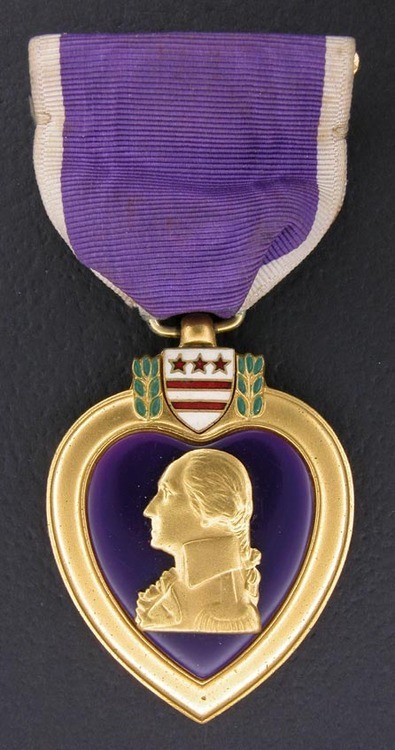
With the assistance of the Assembly’s ARAMAC-Pennsylvania Vice Chair Paul Sookiasian, who is active with his local Pennsylvania Armenian-American Veterans Association (PAAVA), he directed me to the National Purple Heart Hall of Honor registry. There I was able to search and compile a list of nearly 80 confirmed Armenian recipients of the Purple Heart. In addition to this list, I consulted one of the most important publications on Armenian-American military figures, the 1996 “Triumph and Glory: Armenian World War II Heroes,” by Richard N. Demirjian. I found one name that was not in the registry and there has got to be potentially more Armenians who have served that do not carry the “ian.”
Florida Armenians would be proud to know that two of our very own are on this list. First is Barkef Assarian (1922-2004) from Clearwater who received three Purple Hearts for his service in World War II. 92-year-old Middleton Mustian from Tallahassee, the father of former Tallahassee City Commissioner Mark Mustian, is the second. “My father, Middleton Mustian, served in the medical corps of the Third Army under General Patton, and was wounded near the town of Koblenz in 1945,” Mark Mustian told FLArmenians. “He still bears shrapnel in his leg to this day from it. He told me that, after he recovered from his injury, he was recalled to the front but didn’t want to go back. When he returned to the front he asked his commanding officer why he had called him back, and the officer told him his replacements had been ‘too scared.’ When my father told him that he was scared, too, the officer said, ‘Yes, but you can get the job done.’ It’s still difficult to get him to talk a whole lot about it,” Mustian said.
From the Assembly’s 2006 National Advocacy Conference, to the designation of the Colonel George Juskalian United States Post Office in Centreville, Virginia in 2010, and other activities honoring our service men and women, the Armenian Assembly of America has a strong record of raising awareness of and honoring Armenian veterans of the United States.
I know this list is incomplete. Therefore, I am asking anyone with more information about Armenian-Americans who have received the Purple Heart to contact the Assembly at info@aaainc.org or 202-393-3434. With the help of the Armenian-American community we can complete this list and together raise awareness of the proud Armenian presence in the U.S. Armed Forces.
Please click here to view the Assembly’s list of Armenian Purple Heart recipients.
This article originally appeared on the Armenian Assembly’s Blog and has been edited for FLArmenians readers.




 Florida Armenians