Category Archives: Food
Kalajians Cook Up a Storm Inside Their Armenian Kitchen
Kalajians Cook Up a Storm Inside Their Armenian Kitchen
By Tom Vartabedian
BOYNTON BEACH, Fla.—Want to know the perfect recipe for vosbov kufteh? How about the ideal bourma? Looking for a new and different pilaf recipe?
Doug and Robyn Kalajian offer their home to you as collaborators and connoisseurs of ‘The Armenian Kitchen’.
Take it from Doug and Robyn Kalajian. It all starts with the best ingredients, plenty of time, a sprinkle of patience, and a measure of love.
“A well-stocked pantry doesn‘t hurt, either,” they agree. “It’s all in the way you delve off the beaten path. Explore. Experiment. Enjoy. Paree akhorjag. Have a good appetite!”
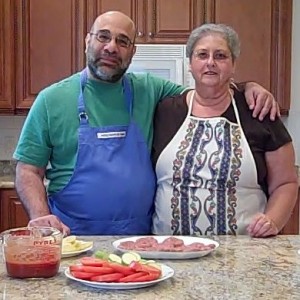
Doug and Robyn Kalajian offer their home to you as collaborators and connoisseurs of ‘The Armenian Kitchen’
The Kalajians don’t consider themselves epicureans by any stretch, just a fun-loving couple who enjoy sampling good Armenian food and sharing recipes with others—whether their own or from others.
Log on to their website www.theArmenianKitchen.com and you’ll find a heritage of Armenian recipes with a personal touch, whether it’s French toast, chicken soup, or Christmas pudding.
It’s where you will be inspired by an ancient cuisine, experiment with exotic ingredients, master cooking techniques you were afraid to attempt, and much more.
It doesn’t matter where you live, what your ethnic background happens to be, what degree your food preparation skills are, or your finances. Everybody has to eat.
“Armenian recipes are as varied as their regions and dialects,” says Robyn. “No two choreg recipes are alike. Food connects us across all boundaries—generational, national, physical, social, nutritional, and cultural.”
They each have their roles. Robyn, a retired culinary arts teacher, is the chief cook. Doug remains the sous chef. He’s an author and retired journalist who spent 16 years at the Palm Beach Post. He worked as an editor, reporter, and feature writer during that stint before retiring in 2008 from what he called “our sadly shrinking industry.”
Over the years, Doug hunkered down to cover a few hurricanes, chronicled the annual outbreak of spring break madness, sneaked into a mob funeral, and came nose-to-nose with an alligator or two while crisscrossing the state.
Along the way, he wrote a non-fiction book called Snow Blind about a crusading public defender caught up in Florida’s cocaine insanity of the 1980’s. His favorite assignment?
“Going to France and walking Normandy’s Utah Beach with a veteran who landed there on D-Day in 1944,” he recalls. “When I’m not cooking, or more likely eating, I do freelance editing and writing.”
He and Robyn discovered a common interest in Armenian cooking the night they met back in 1976. He was working at the New York Daily News while she was teaching at a high school by the New Jersey shore.
“We were immediately struck by our similarities and backgrounds,” said Doug. “Not only were we both Armenian, but our fathers’ families both came from Dikranagerd. We had many friends in common and had experienced similarly Armenian-intensive childhoods. Talk about destiny!”
They wed the following year and moved to Florida when Doug took an editing job at the Miami Herald. Although they suspected Florida to be a short-term engagement, they’re still in the Sunshine State after 31 years. A daughter Mandy lives in New York where she’s a marketing executive.
Robyn studied home economics at New Jersey’s Montclair State College. She taught in New Jersey and Florida public schools for more than 30 years. During that time, she honed her cooking skills in a variety of classes at such noted institutions as Johnson & Wales University in Rhode Island.
Before retiring nearly three years ago, she taught in the culinary academy at Olympic Heights High School in Boca Raton.
The idea for “The Armenian Kitchen” evolved while discussing retirement plans.
“We’ve always wanted to work on something together,” added Doug. “Robyn’s knowledge of food and cooking with my writing skill was an obvious conclusion.”
They discussed a number of potential projects, including a cookbook and a theme calendar.
Every idea they hatched involved Armenian food. Using the internet was something that would have intimidated both of them not long ago. But friends who were avid bloggers suggested they give it a try.
“It was daunting at times,” Doug admitted. “But we were both delighted and amazed at how quickly we reached a large and enthusiastic audience. So many people are interested in Armenian cuisine and willing to help by contributing recipes, photos, even videos.”
They started their project with a gut feeling that many folks shared an urge to preserve the recipes and cooking techniques of their parents and ancestors. The reaction they get each day proves them right.
Many requests come from around the world and start with the phrase “I remember…” and go on to describe some wonderful dish they haven’t consumed since grandma died.
“A non-Armenian gentleman from Queensland, Australia, who was so desperate for the taste of basterma, asked for a recipe to make it at home since there were no stores near him to purchase it,” said Robyn. “A woman from Canada sent us an easy method of making madzoon in a microwave. Others write us hoping to find lost family recipes.”
The most unusual request had nothing to do with food. A reader asked the Kalajians if they could translate an English saying into Armenian (including the lettering) for a family member who wanted to have it tattooed on her arm before her upcoming wedding. The request was fulfilled.
Since the first item appeared in March 2009, the Kalajians have reached more than 70,000 readers in 160 countries.
“You can attribute much of it to digital magic,” Doug maintains. “The internet makes it possible to keep track of every computer that clicks its way to our site. The analytics even tell us where they are. What a thrill it is to discover that someone in Armenia, or even China and Africa, has taken the time to read one of our posts.”
Posting videos on YouTube has carried them to an even broader audience, including many non-Armenians.
“I’m amazed that more than 20,000 people around the world have watched me make Armenian coffee,” Doug reveals. “Judging by the comments, it’s clear people take their coffee seriously. Even more rewarding is the fact we hear from readers every day.”
It’s not for the money because there isn’t any. The website is a labor of love. Advertising on the site is provided by Google through an arrangement available to all bloggers.
“Our income from this is what I would call modest, but only if I were bragging,” says Doug. “It doesn’t actually cover the cost of ingredients. Our goal from the beginning was to preserve and share the recipes Armenians have carried around the world and the stories behind them. The reaction we’ve received is incredibly positive and far-reaching.”
Growing up, Armenian food was on the default menu. Doug’s parents worked long hours in the dry cleaning store, but that never stopped Mom from making fresh madzoon to spoon over her kufteh.
“I can’t match her energy, much less her cooking style,” he admits, “but making her kind of food is a way of remembering and honoring her. Sharing our food with family and friends is a gesture of love and respect that’s missing from today’s microwave society.”
Baking the distinctive cheese bread recipe that Robyn learned from her grandmother not only brings back memories, it gives the Kalajians a small taste of the little village in the shadow of Musa Dagh, which her ancestors left nearly a century ago.
Their ultimate Armenian dinner would start with cheese beoregs and a hefty plate of mezza, including basterma and yalanchi. The main course would include bulgur pilaf, any type of kebab, kufteh, vegetable geragoor, and chopped salad. Finally, dessert would be baklava with Armenian coffee.
“None of that is particularly fancy or exotic,” Doug notes. “But it’s the food we know and love, and that makes us happy.”
One thing that may surprise people about Doug is that he can’t taste much of what Robyn or anyone else cooks.
Last fall while on a freelance writing assignment, he took a tumble and cracked his skull. As a result, he completely lost his sense of smell. Doctors say it’s unlikely to return.
“I’ve since discovered just how closely smell and taste are related,” Doug says. “I can still sense sweet, sour, hot, and a few other basic tastes. But most herbs and subtle flavorings are just a memory. Just as bad, I can’t smell what’s cooking.”
The good news is, he hasn’t lost his appetite. But any epicurean pretense is kaput at the moment.
“All this would be annoying under any circumstances, but it makes food blogging even more of a challenge,” he points out. “Luckily, Robyn has always had the more refined palate. She’s more than capable of maintaining the lead role in the kitchen as well as on the web.”
SOURCE: http://www.armenianweekly.com/2011/11/08/kalajians-cook-up-a-storm-inside-their-armenian-kitchen/
Chef John Minas adds Armenian Flair to Florida Fare as New Executive Chef at the Governor’s Mansion
Chef John Minas adds Armenian Flair to Florida Fare as New Executive Chef at the Governor’s Mansion
By Doug Kalajian
FLArmenians Cuisine Contributor
Ask anyone with a glimmer of culinary consciousness about Florida cuisine and you’ll most likely hear a tale of Caribbean-Latin fusion that sizzles like the sands of South Beach.
Then ask Chef John Minas.
For one of his first dinners as Executive Chef at the Florida governor’s mansion, Minas served notice that there’s a new culinary accent in the Sunshine State: Armenian.
“I made grape leaves,” he said proudly.
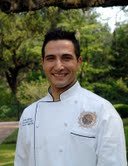
Executive Chef John Minas
Minas, who grew up in the deep-rooted Armenian community of Watertown, Mass., inherited a love of food from his Armenian and Assyrian family. He credits his paternal grandfather, Bashir Minas, with inspiring him.
“Every Sunday, we’d go to my grandfather’s house,” he said. “He cooked the best Armenian and Middle Eastern food I ever tasted. Dolmas, sarmas. And his fasoulia — oh my gosh! He made it all and he made it amazing. He wasn’t a trained chef, but he was a great cook.”
On weekdays, young Minas rushed home from high school to watch the back-to-back shows of Food Network pioneers Emeril Lagasse and Mario Batali. “Those guys were all about the food and the technique,” he said.
The idea took hold that he could meld the elegance and discipline of Western fine dining with the flavors and ingredients he grew up with.
After training at the prestigious Culinary Institute of America in Hyde Park, New York, Minas worked at several restaurants in the Northeast and was planning to open his own when he heard about the unique opportunity in far-off Tallahassee, Florida. He sent a resume and got a quick invitation for an interview on April 11, his 26th birthday.
The interview turned out to be an audition.
“All of a sudden I was cooking breakfast at the mansion,” he said. “That was followed by lunch and then dinner.” While he was at it, Minas volunteered an afternoon snack, “a real mezze platter” including feta cheese and pita bread.
Nearly every dish in his day-long cooking marathon reflected Minas’ cultural connection.
“My dinner entree was a watercress tabbouleh with Chilean sea bass and grilled asparagus,” he said. “It was a French take on Middle Eastern. I’m very big on that.”
The fourth of six candidates to try out, Minas was barely back in Boston when he received news that he’d been hired. He started his new job in May and launched straight into an exciting yet demanding routine. Minas supervises all planning and preparation for a whirlwind of state dinners and charity events as well as daily meals for Gov. Rick Scott and First Lady Ann Scott.
Minas said he’s excited about Florida’s rich variety of fresh seafood and produce, but the job has kept him so busy that he’s had limited opportunity to travel around the state. “I’m really looking forward not only to getting to know the state, but to meet the Armenians here,” he said. “I want to get to Boca Raton and all the other Armenian communities.”
So far, Minas has brought not only Armenian touches to the mansion menu but other Middle Eastern favorites.
“I take our cuisine and try to make it relevant for a new generation,” he said. “I make a very refined hummus, with several variations on a plate. For example, a kalamata hummus served with traditional pita chips and a basil-pesto hummus with tomato pita chips. It’s no better than my mother’s hummus, but it’s my version.”
Gov. Scott has become such a fan that he appointed Minas and his sous chef, Carin Butler, to represent the state in the 2011 Great American Seafood Cook-Off in New Orleans. “John is a talented chef and cooks up some of the best food I’ve ever tasted,” the governor announced. “He’s going to give those other chefs a run for their money.”
Minas presented a Florida black grouper with avocado crème fraiche and spicy shrimp toast that he said “tastes like the state of Florida on a plate.” He didn’t win, but he wasn’t discouraged.
“I’m just getting started,” he said. “The job and the people here are wonderful. I plan to be in Tallahassee for a long time. Then, who knows?”
Doug Kalajian is a retired journalist in Palm Beach County and Sous Chef at http://www.TheArmenianKitchen.com.
The Florida Pomegranate
The Florida Pomegranate?
By Robyn and Doug Kalajian
FLArmenians Cuisine Contributors
Published: August 18, 2011
Everyone associates Florida with citrus groves – the state’s oranges and grapefruit are famous nationwide, maybe even world-wide.
Our license plates read “Sunshine State” and depict the ever-famous orange. But pomegranates?
According to the July 2011 issue of “Florida Agriculture” magazine, William Castle, professor emeritus at University of Florida and whose specialty is horticulture science, is studying the possibility of pomegranate production in the Sunshine State as an alternative to citrus.
Pomegranate trees are a common sight in California. The small trees produce an apple-sized, red fruit with juicy, ruby-like arils with a tart-sweet taste. TheArmenianKitchen.com has praised the health aspects of the pomegranate – full of antioxidants, vitamins and minerals, and shared some recipes using this fruit’s arils and tasty juice. (See our recipes for homemade pomegranate jelly, and shish kebab marinade, too!)
Castle began his study two years ago with Jim Baldwin, a senior biologist at the Citrus Research and Education Center. Together they are examining every aspect associated with pomegranate-growing with the help of over 30 growers around the state.

The Florida Pomegranate
If the study proves positive, there could be numerous small-scale pomegranate groves popping up in Central Florida. Castle is convinced that pomegranate groves are a real possibility, and interest among growers is on the rise.
Pomegranates are used as a fruit, for their juice, and can be used as an ‘edible ornament for home and business landscapes’.
Castle said that if pomegranate production takes off, consumers will see Florida-grown pomegranates next to California pomegranates in our stores – plus locally produced pomegranate juice and juice blends.
Watch out POM Wonderful!
Robyn Kalajian is a retired culinary teacher in Florida and Chief Cook at http://www.TheArmenianKitchen.com. Douglas Kalajian is a retired editor/journalist and Sous Chef at http://www.TheArmenianKitchen.com.
SOURCE: http://www.thearmeniankitchen.com/2011/08/florida-pomegranate.html