
Category Archives: Arts & Culture
U.S., Turkey, Armenia Conference on Tourism and Hospitality: The Highway to Sustainable Regional Development
By Caucasus Research Resource Centers – Armenia Blog
July 3, 2013
On June 28-30, 2013, ATA Fellows (American, Turkish, and Armenian Fellows), which is a partnership of academics from the University of Florida, U.S.A., Dokuz Eylul University, Turkey, and Armenian State University of Economics, Armenia, as well as industry practitioners from each country, organized a conference on tourism and hospitality: “The Highway to Sustainable Regional Development.”
The conference was attended by CRRC-Armenia Junior Research Fellows Tigran Sukiasyan and Ani Karapetyan and brought together academics, researchers, NGO representatives, industry practitioners and scholars of different disciplines to focus on the knowledge development and implementation in the field of tourism and hospitality.
U.S. Ambassador to Armenia John A. Heffern gave the opening statement, emphasizing the importance of the ATA Fellows Project. In turn, Dr. Artak Manukyan, Armenian Director of the project, made a presentation on the prospects of the opening Armenia-Turkey borders, where detailed analysis from different angles were presented.

The three-day conference integrated separate sessions focusing on the theoretical, empirical and sustainable development opportunities. The discussions of the first session were dedicated to Peace and Tourism, Tourism and Sustainable Development, as well as Tourism Management and Corporate Responsibility. Dr. Mahmood Khan, a professor from Virginia Tech, talked about tourism and peace, stressing that governments should not intervene in the process of tourism development; indeed, people should do the job. In that way, only tourism will lead to peace facilitation process, he stated. Another interesting presentation was made by Dr. Kaye Chon, a professor from the School of Hotel and Tourism Management at Hong Kong Polytechnic University. He talked about innovative approaches to tourism and hospitality, and how they would lead to better quality and outcomes.
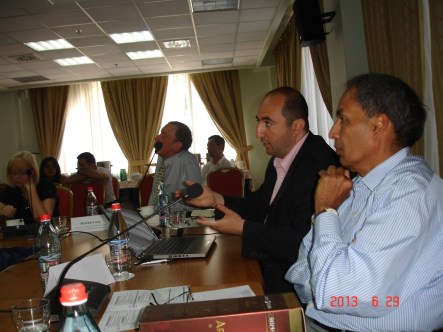
The second session of the conference was devoted to the Sustainable Tourism Issues and Capacity Building as a Prerequisite for Sustainable Development. During this session, several interesting comments were made by Armin Zerunyan, Country General Manager, Hilton Worldwide, Turkey, referring to the tourism development in Armenia. According to Mr. Zerunyan, high prices of flights to Armenia create a serious obstacle to the tourism development. Also, he pointed the importance of Armenian Diaspora for attracting more tourists to Armenia, bringing an example of Eastern Europe countries, which used their diaspora connections to create a well-developed tourism infrastructure. Lastly, Mr. Zerunyan marked out the importance of winter tourism for Armenia. As a supporting example, he noted that in winter, significant number of Turkish people travel to Bulgaria, where winter tourism is highly developed; indeed, by developing its own infrastructure, Armenia could be a strong competitor in that field. In addition, Dr. Muzaffer Uysal, Professor of Tourism at Virginia Tech, mentioned Italy with its free skiing and snowboarding schools having a huge positive impact on the tourism development, and suggested to implement similar projects in Armenia.
The last day of the conference summed up with a brainstorming session related to the further development of the ATA fellows project. The participants were divided into three groups: Research, Product Development, and Policy Making. In the Product Development part leading role of marketing and training for the actors providing tourism services, and investment opportunities for tourism development were emphasized, also stressing the fact that Armenia is the first Christian country (similar examples in other countries, where the religion played an important role for tourism development, were brought by Dr. Kaye Chon). More specific research in the region and cross border collaborations were proposed in the Research part, where CRRC Fellow Tigran Sukiasyan made a speech related to the project idea, which may contribute to the knowledge development and its implementation within the framework of the ATA fellows program. Database creation and analysis of the tourism trends in the Caucasus Region, cooperation with universities, NGOs, public and private institutions concluded the last Policy Making part of the brainstorming session.
The presentations will soon be posted on the ATA Fellows website.
This article originally appeared on the Caucus Research Resource Centers – Armenia Blog and is reprinted with the permission of the author.
The Armenian Kitchen Hits One Million Views
By Tom Vartabedian
BOYNTON BEACH, FL — What’s cooking in the Armenian Kitchen these days?
Chief cooks Doug and Robyn Kalajian happen to be celebrating an auspicious occasion with another delectable meal and perhaps a bottle of champagne.
They’re toasting a happy marriage as well as a happy website that has caught the attention of its one-millionth page viewer.
“Raise the glasses and bring out the special tableware for this occasion,” bubbles Robyn. “What a milestone! You could knock us over with a feather.”
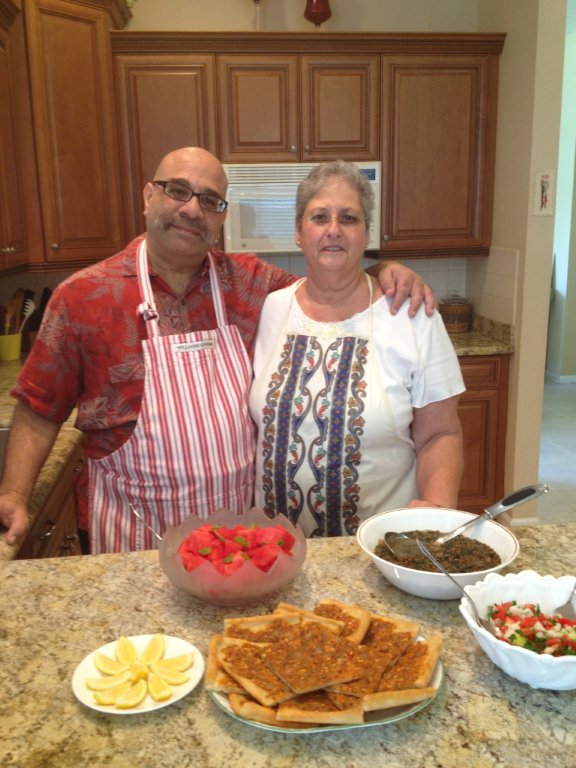
You’re all invited to dinner with Robyn and Doug Kalajian inside their Armenian Kitchen online.
The big day arrived May 27 when the website registered 547 hits, a tad less than the previous day, which received 931. Over May, the site registered 27,580 views, and passed the million mark by 331.
It has anything and everything you wanted to know about Armenian food a million times over and still counting.
Among the latest queries was from Mark Gavoor with his oud in hand. He represents the voice of Chicago with an appetite to match, especially when it comes to such delectables as perper salata, Kharpert kufteh and topig. Just like medzmama’s cooking!
He has this to say about the Kalajians:
“Their Armenian Kitchen blog is an Armenian-American treasure. Their passion for the preservation and dialogue of our culinary roots is nonpareil. I wish I were more of a cook than simply an avid fan of results of Armenian cooking pros like Doug and Robyn. If I were, I’d certainly take advantage of their wonderful and voluminous collection of recipes. Maybe one day.”
Whether it’s their concoctions, a friend’s, or from another’s cookbook, it’s all up there for people to enjoy, says Gavoor.
“The Kalajians provide great stories and give ample credit to wherever the recipes may originate from,” he adds.
Their website—www.TheArmenianKitchen.com—shares everything you want to know about Armenian food one recipe and story at a time, whether it’s Aunt Arpie’s deviled eggs or Gavoor’s amazing cheese puff/bourag called “penerli.”
Put on an apron, wash your hands, and join the Kalajians on their epicurean journey.
“Armenian recipes are as varied as their regions and dialects,” agrees Robyn. “No two choreg recipes are alike. Food connects us across all boundaries. We like to think we’re preserving our heritage one recipe at a time.”
We caught up with the Kalajians in the comfort of their kitchen. No doubt, it’s their favorite room. And with the electronic era, they share it with the world.
Doug, too, is absolutely dumbstruck by the overall popularity of his nutmeg. As he understands it, the stats mean his website has been clicked on over a million times by almost 300,000 different readers.
“It tells us that people keep coming back,” he says. “We know this because Google tracks visits automatically and tells us what stories they read and where they may live, right down to the village in China, Africa, or the Middle East. It’s been an amazing journey over these past five years.”
Other remote areas include Mongolia, Laos, Iceland, Uzbekistan, and United Arab Emirates. A man from Australia was so desperate for the taste of basterma, he sought the recipe. A woman from Canada sent along an easy method of making madzoon in a microwave. Others are hoping to find lost family recipes.
Doug worked as an editor, reporter, and feature writer for over 16 years with the Palm Beach Post before retiring in 2008 from what he calls “a sadly shrinking newspaper industry.”
Along the way, he wrote a non-fiction book called Snow Blind about a crusading public defender caught up in Florida’s cocaine insanity of the 1980’s.
Robyn, a retired culinary arts teacher, remains the chief cook with this production duet; her husband calls himself a sous chef. Dining with them in an elaborate Florida restaurant is quite the appetizer.
“I’m absolutely dumbstruck by the overall popularity of YouTube, which has displaced traditional TV for so many people,” Doug points out.
Most popular so far is how to make shish kebab with more than 65,000 views. More so than the website, the videos seem to draw a diverse audience that includes many non-Armenians. The reaction has been powerful and sometimes overwhelming.
“Our cooking videos have been watched more than 230,000 times by viewers from around the world.” Doug notes that some videos have also become a lightning rod.
“There’s a furious international food fight being carried out among various groups claiming the identity and origin of dishes from throughout the Near and Middle East,” he confirms. “Armenian cuisine is under heavy fire, particularly from Azerbaijan and Turkey. The comments get downright nasty sometimes, but I rarely feel the need to reply because Armenian viewers jump in quickly with their own response.”
The Kalajians remain content to leave questions about the food industry to the experts while they try to satisfy a clear desire among Armenians to share their recipes and the traditions they represent.
One lesson that’s been driven home is that the Armenian menu is incredibly varied because it reflects the far-reaching experiences and travels of the Armenian people over centuries.
“Our cuisine is still evolving as Armenians adapt to the changing world,” he agrees. “Ask Armenians from Yerevan and Lebanon to describe a typical meal and you may get very different answers. But you might find the same divergence between two Armenians from New Jersey if one family came from Dikranagerd and the other from Van.”
After starting the website in March 2009 with nothing more than the thought of sharing recipes with an unknown global audience, it’s become an evolving turnstile.
“We always wanted to work on something together,” they said. “Robyn’s knowledge of food and cooking with my writing skills was an obvious conclusion.”
The Kalajians are based in Boynton Beach, where they cook and write. Both are involved with St. David’s Armenian Church and piped into the Armenian community. They’ve connected people with recipes, specific ingredients, and other curiosity-seekers. Through their website, they found a cousin named Maro Nalabandian, a noted pastry chef.
“I’d heard about her family over the years but we’d never met until this past April,” said Robyn. “The passion for food must be in our genes.”
Baking the distinctive cheese bread recipe that Robyn learned from her grandmother not only brings back memories, it gives the Kalajians a small taste of the little village in the shadow of Musa Dagh, which her ancestors left nearly a century ago.
A plea for assistance came from Tigran Shahverdyan, a scientist from Moscow participating in the International Space University’s studies program at Florida Institute of Technology.
He didn’t have a car and needed to know where the nearest Middle Eastern store was located. He wished to buy lavash for a cultural project to which he was committed. Being the only Armenian in the group, he wanted to do an Armenian-style barbeque.
Using her computer, Robyn located a store near his school that sold lavash and passed on the information diligently, much to the delight of the faculty and students.
“We’ve posted recipes related to certain Armenian traditions, celebrations, and holidays,” she brought out. “Our main purpose continues to find and preserve Armenian family-style recipes. Sometimes, it’s a challenge with regional dialect and recipe name/spelling differences, but we’re always up for that. At times, we turn to readers for help and someone usually comes to the rescue.”
The Kalajians would love to publish their own cookbook but the idea always seems to find “the back burner.” Yet, it’s not out of the question. A calendar has been suggested and that’s another possibility. It’s just a matter of time and timing.
As for television, that’s highly unlikely. They’ll stick to their YouTube videos for now. In the meantime, they’ll focus on being an interactive site that reaches far beyond their wildest dreams.
This article has appeared in various Armenian-American publications and is reprinted with the permission of the author.




 Florida Armenians